Environmental sustainability has become one of the defining global challenges of the 21st century. Climate change, urban expansion, biodiversity loss, pollution, resource depletion, and ecological imbalance are transforming the relationship between humans and the environment at an unprecedented pace. As societies seek sustainable solutions, interdisciplinary research connecting geography, environmental studies, and human ecology is becoming increasingly important.
Today, the geography environmental human ecology field plays a critical role in understanding how human activity shapes ecosystems, urban spaces, climate systems, and sustainable development outcomes.
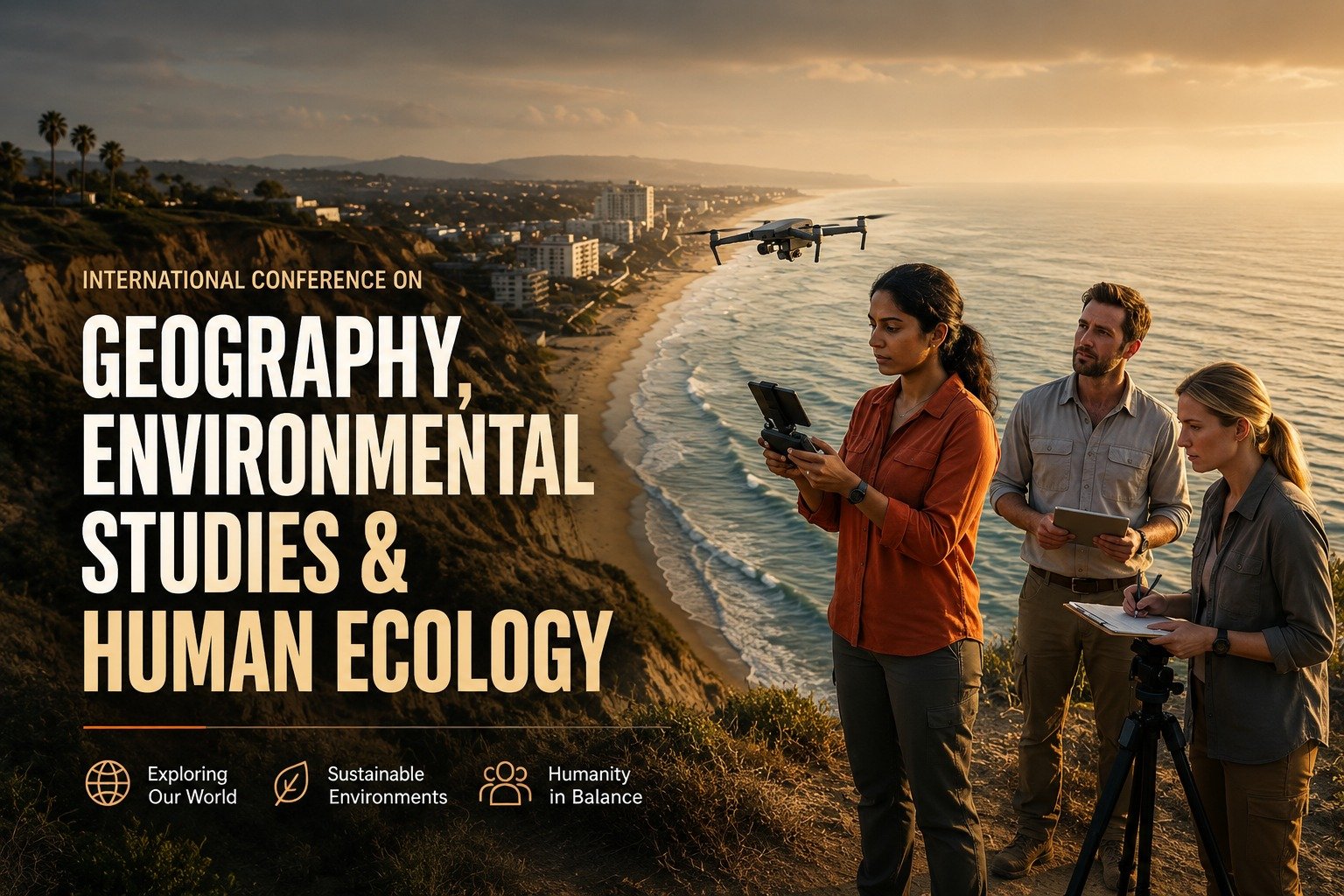
The International Conference on Geography, Environmental Studies & Human Ecology provides a global academic platform where geographers, environmental scientists, ecologists, policymakers, urban planners, educators, and sustainability researchers can discuss innovative environmental solutions, ecological resilience, spatial development, and sustainable human-environment interactions.
Explore more global conferences and academic events here: OneGrasp Events
The conference promotes interdisciplinary collaboration while encouraging innovative approaches to environmental sustainability, geographic analysis, and resilient ecological systems. (Onegrasp)
Why Geography, Environmental Studies, and Human Ecology Matter Today
Modern environmental challenges are interconnected and global in scale. Geography and environmental studies help researchers understand how climate systems, ecosystems, urbanization, resource use, and social development interact across regions and communities.
Human ecology focuses specifically on the relationship between humans and their environments, examining how social behavior, infrastructure, economics, and policy influence ecological sustainability.
These disciplines are increasingly important for addressing issues such as:
Climate adaptation
Sustainable urban planning
Resource conservation
Disaster resilience
Biodiversity protection
Environmental governance
Community sustainability
According to the United Nations Environment Programme (UNEP), integrated environmental planning and sustainable policy development are essential for protecting ecosystems and improving long-term societal resilience.
As a result, geography and environmental science research are becoming central to global sustainability strategies and environmental policymaking.
What the Conference Focuses On
The International Conference on Geography, Environmental Studies & Human Ecology focuses on environmental sustainability, spatial analysis, ecological systems, climate adaptation, and interdisciplinary sustainability research.
Key conference themes often include:
Climate change adaptation and mitigation
Land use and urbanization
Biodiversity conservation
Environmental governance and policy
Human ecology and sustainable lifestyles
GIS and remote sensing technologies
Water resource management
Disaster risk reduction
Renewable energy systems
Environmental education and community participation
These discussions help researchers and policymakers better understand how environmental systems and human societies influence one another. (Onegrasp)
Geography Environmental Human Ecology and Sustainable Development
The geography environmental human ecology field has evolved significantly due to rapid climate change, urban growth, technological innovation, and sustainability challenges.
Traditional environmental research often focused on isolated ecological systems. However, modern sustainability research increasingly integrates:
Geographic Information Systems (GIS)
Remote sensing technologies
Climate modeling
Environmental data analytics
AI-assisted environmental monitoring
Smart city planning
Sustainable infrastructure systems
For example, GIS and satellite technologies are now widely used for disaster management, environmental mapping, biodiversity monitoring, and urban planning.
According to research from the National Geographic Society, geospatial technologies are transforming environmental research and improving decision-making for conservation and sustainability planning.
This interdisciplinary approach is helping governments, organizations, and researchers create more sustainable environmental management systems.
The Growing Impact of Climate Change and Urbanization
Climate change and rapid urbanization are reshaping ecosystems, cities, and human communities worldwide.
Modern environmental studies increasingly focus on:
Rising temperatures and heatwaves
Coastal erosion and sea-level rise
Water scarcity
Sustainable urban expansion
Air pollution management
Environmental migration
Ecosystem restoration
Meanwhile, urban planners and environmental scientists are working together to develop resilient cities capable of adapting to climate-related challenges.
According to global environmental conference research, sustainable urban planning and ecological resilience are becoming essential for future environmental stability. (Onegrasp)
As a result, interdisciplinary environmental collaboration is becoming increasingly important across geography, ecology, engineering, public policy, and sustainability sectors.
Why GIS and Environmental Technologies Are Transforming Research
Geographic Information Systems (GIS), remote sensing, and environmental data science are revolutionizing how researchers study ecosystems and environmental change.
Modern environmental technologies help scientists:
Monitor deforestation
Track climate patterns
Analyze biodiversity changes
Study urban growth
Predict natural disasters
Manage water systems
Improve conservation planning
For example, AI-powered environmental monitoring systems can analyze satellite imagery and ecological data to improve sustainability planning and disaster preparedness.
According to the United States Geological Survey (USGS), geospatial technologies are becoming essential for environmental management, climate research, and resource conservation.
This technological transformation is making environmental science more data-driven, predictive, and globally collaborative.
Why Human Ecology Is Increasingly Important
Human ecology examines how social systems, economics, culture, and human behavior interact with environmental systems.
This field is becoming increasingly relevant because sustainability challenges cannot be solved through environmental science alone.
Modern human ecology research often addresses:
Community sustainability
Environmental justice
Sustainable lifestyles
Population and resource dynamics
Public health and ecosystems
Food security systems
Environmental education
For example, researchers studying urban human ecology may examine how transportation systems, housing policies, and social inequality affect environmental sustainability.
This interdisciplinary perspective helps policymakers develop more balanced and socially inclusive environmental strategies.
Why Virtual Conferences Are Important for Environmental Research
Virtual conferences have transformed global collaboration in geography, ecology, and sustainability research.
Previously, many international academic conferences required expensive travel and limited participation opportunities. Today, online conferences allow environmental researchers, policymakers, students, educators, and sustainability professionals worldwide to collaborate more efficiently.
This accessibility is especially valuable for:
Graduate students
Early-career researchers
Environmental NGOs
Urban planners
Sustainability professionals
Researchers from developing countries
Virtual conferences also reduce travel-related environmental impacts while improving international research collaboration.
According to discussions within global sustainability and environmental research communities, virtual academic platforms are improving interdisciplinary networking and global accessibility. (Onegrasp)
As a result, virtual environmental conferences are becoming increasingly important for international sustainability collaboration.
Call for Papers and Research Opportunities
The conference provides opportunities for participants to present original research, sustainability strategies, environmental analyses, and ecological innovations.
Researchers can typically submit papers in areas such as:
Climate adaptation and resilience
Sustainable urban development
Environmental governance
GIS and remote sensing applications
Ecosystem management
Water resource studies
Human ecology and sustainability
Biodiversity conservation
Renewable energy systems
Environmental education and policy
Abstract Submission Guidelines
Participants are generally encouraged to submit:
A 300–350 word abstract
Author details and affiliations
Keywords
Research objectives and findings
Submissions commonly undergo double-blind peer-review evaluation before acceptance. Participants may also attend as listeners without presenting research papers. (Onegrasp)
Who Should Attend This Conference
This conference is valuable for professionals and researchers working across geography, environmental science, sustainability, ecology, and public policy sectors.
It is especially suitable for:
Geographers
Environmental scientists
Urban planners
Ecologists
Sustainability researchers
GIS specialists
Climate policy experts
NGO representatives
Graduate students and PhD scholars
Even beginners can benefit because many sessions introduce foundational concepts related to environmental sustainability and human ecology.
Expert Insight / Analysis
Environmental sustainability increasingly depends on interdisciplinary collaboration between geography, ecology, technology, public policy, and social sciences.
Experts now recognize that climate resilience and sustainable development require integrated solutions combining environmental science, urban planning, ecological restoration, and community engagement.
Meanwhile, AI-assisted climate modeling, GIS technologies, and smart environmental monitoring systems are accelerating environmental research capabilities worldwide.
However, long-term sustainability also depends heavily on public awareness, governance quality, education systems, and global policy cooperation.
Institutions investing in interdisciplinary environmental research today may play major roles in future sustainability innovation and ecological resilience planning.
Latest Trends / Updates
AI-powered environmental monitoring systems are improving climate analysis and ecological forecasting capabilities.

GIS and remote sensing technologies are becoming essential tools for urban planning and disaster management.

Climate adaptation strategies are increasingly integrated into infrastructure and public policy planning.

Smart city initiatives are combining sustainability goals with advanced environmental technologies.

Renewable energy systems and green infrastructure projects are expanding globally.

Community-based sustainability programs and citizen science initiatives are increasing environmental participation worldwide.
Common Mistakes to Avoid
Many researchers and policymakers make avoidable mistakes when approaching environmental sustainability and human ecology research.
Common issues include:
Ignoring local community perspectives
Weak environmental data analysis
Limited interdisciplinary collaboration
Poor long-term sustainability planning
Overlooking climate resilience frameworks
Focusing only on short-term policy outcomes
Researchers and institutions can improve outcomes by integrating scientific analysis with social, economic, and environmental perspectives.
Real-Life Example / Mini Case Study
A rapidly growing coastal city launched a sustainability initiative designed to reduce flood risks and improve ecological resilience.
Initially, fragmented urban planning and weak environmental coordination created implementation challenges.
The city collaborated with geographers, environmental scientists, GIS specialists, and community organizations to develop climate-adaptive infrastructure and environmental monitoring systems.
Within several years, flood risk management improved significantly while urban green spaces and ecological restoration projects enhanced environmental resilience.
This example demonstrates how interdisciplinary environmental collaboration can improve sustainable urban development outcomes.
Traditional Environmental Planning vs Modern Sustainability Systems
Traditional Environmental Planning
Modern Sustainability Systems
Isolated environmental policies
Integrated sustainability frameworks
Manual geographic analysis
GIS and AI-powered analytics
Reactive disaster response
Predictive resilience planning
Limited community participation
Collaborative sustainability models
Conventional urban planning
Climate-adaptive smart cities
Pros and Cons of Virtual Environmental Conferences
Pros
Cons
Global accessibility
Reduced fieldwork interaction
Lower participation costs
Limited face-to-face networking
Reduced environmental impact
Time zone challenges
Easier interdisciplinary collaboration
Technical connectivity issues
Wider student participation
Limited informal discussions
Beginner vs Expert Approach in Environmental Research
Beginner Approach
Expert Approach
Focuses mainly on theory
Integrates policy and technology
General sustainability discussions
Specialized ecological systems analysis
Limited GIS knowledge
Advanced spatial analytics expertise
Basic climate awareness
Comprehensive resilience planning
Passive conference participation
Strategic interdisciplinary collaboration
What to Do Next
If you are interested in geography, environmental studies, sustainability, or human ecology research, begin preparing early for conference participation.
The International Conference on Geography, Environmental Studies & Human Ecology highlights the growing importance of interdisciplinary environmental research in shaping sustainable and resilient societies.
As climate change, urbanization, and ecological challenges continue affecting communities worldwide, geography and environmental science will remain essential for long-term sustainability planning and environmental innovation. Conferences like this provide valuable opportunities for academic collaboration, scientific exchange, and global sustainability research.
Whether you are a geographer, environmental scientist, policymaker, sustainability expert, student, urban planner, or ecological researcher, participating in this conference can deepen your understanding of human-environment interactions while connecting you with a global network of environmental and sustainability professionals.
FAQs
Yes, beginners can participate and learn foundational concepts related to geography, sustainability, environmental studies, and human ecology.
Yes, participants may join as listeners without presenting papers.
Topics include climate change, GIS technologies, sustainability planning, biodiversity conservation, human ecology, and environmental governance.
These fields help societies understand environmental challenges, improve sustainability planning, and develop resilient ecological systems.

 May 22, 2026
 10 Min
 No Comment