Discover 500+ International Scientific Conferences
Browse events

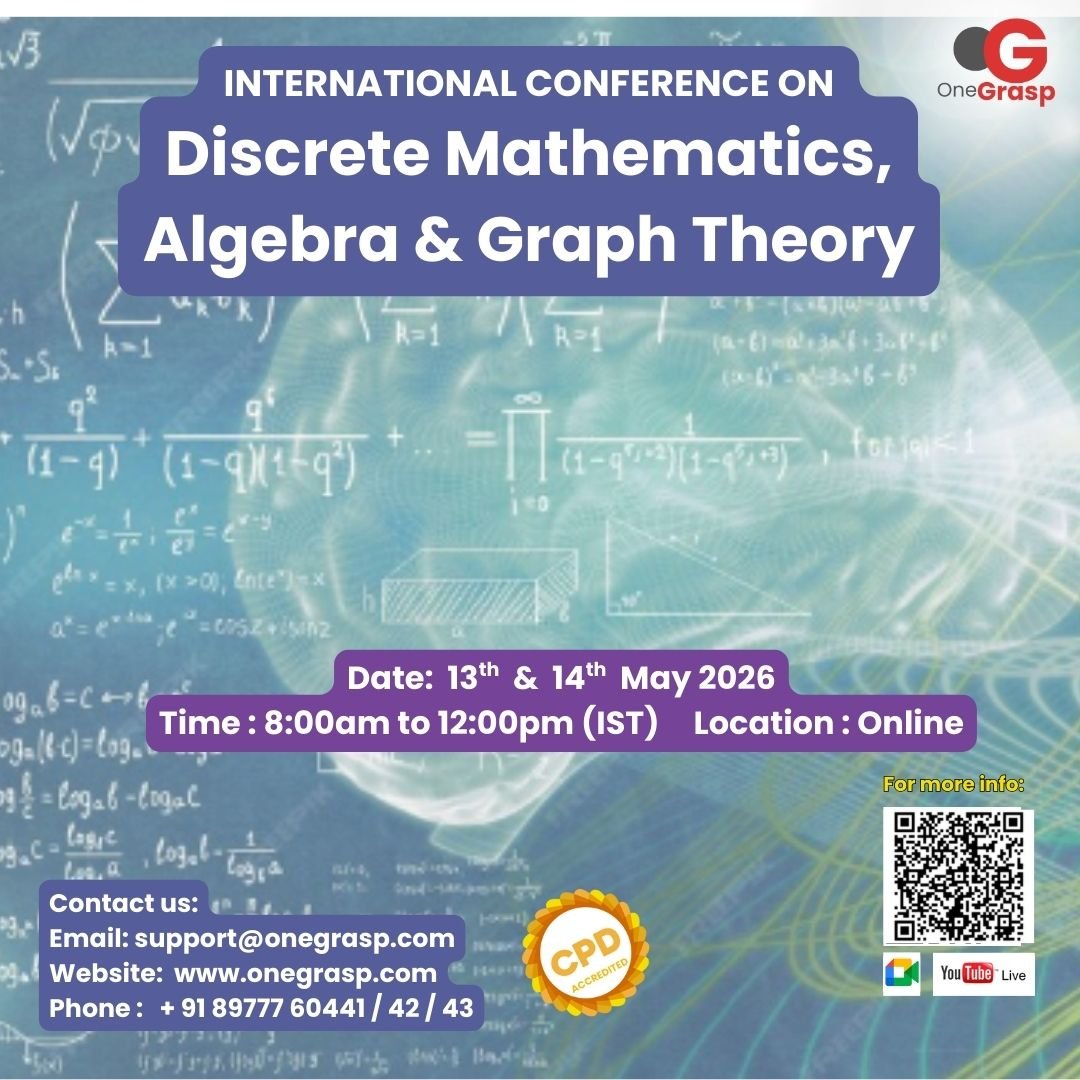
Date: 13th & 14th May 2026 | Time: 8.00 am – 12:00 pm (IST) | Location: Online
Overview
The International Conference on Discrete Mathematics, Algebra & Graph Theory provides a global platform for researchers, mathematicians, and educators to share contemporary research in discrete structures, algebraic systems, and combinatorial analysis. The conference emphasizes theoretical insights and computational applications that impact computer science, data networks, cryptography, optimization, and algorithmic design. It promotes collaboration across mathematical and applied disciplines, showcasing the role of discrete mathematics and algebra in solving real-world computational and structural problems.
Structure and Sessions (Who Does What)
Participate and Contribute (Who Benefits)
Benefits for Attendees
Abstract Topics / Call for Papers (CFP) Tracks
Detailed Program Grid
| Time (IST) | Day 1 | Day 2 |
| 08:00 – 08:15 | Opening Ceremony & Welcome | Recap and Opening Remarks |
| 08:15 – 09:00 | Keynote: Trends in Algebra and Discrete Mathematics | Keynote: Graph Theory and Network Applications |
| 09:00 – 10:15 | Technical Session I – Algebraic Structures & Combinatorics | Technical Session IV – Computational & Applied Graph Theory |
| 10:15 – 10:30 | Break | Break |
| 10:30 – 11:15 | Technical Session II – Discrete Mathematics and Algorithms | Technical Session V – Number Theory & Cryptography |
| 11:15 – 11:45 | Panel Discussion: Interdisciplinary Role of Discrete Mathematics | Student & Research Forum: Theoretical & Applied Studies |
| 11:45 – 12:00 | Day Summary & Announcements | Awards & Closing Ceremony |
Submit Abstract & Registration
| Conference Dates | Conference Title | Timing (IST) | Abstract Submission Deadline | Registration Deadline |
| 13th, 14th May 2026 | International Conference on Discrete Mathematics, Algebra & Graph Theory | 8:00 AM – 12:00 PM | 4th May 2026 | 6th May 2026 |
Abstract Guidelines
Conclusion
This international conference fosters academic exchange in discrete mathematics, algebra, and graph theory, bridging foundational research and computational innovation. Participants will collaborate on theoretical advancements and explore mathematical applications that shape digital networks, cryptography, and algorithmic sciences.