June 11, 2026
 9 Min
 No Comment
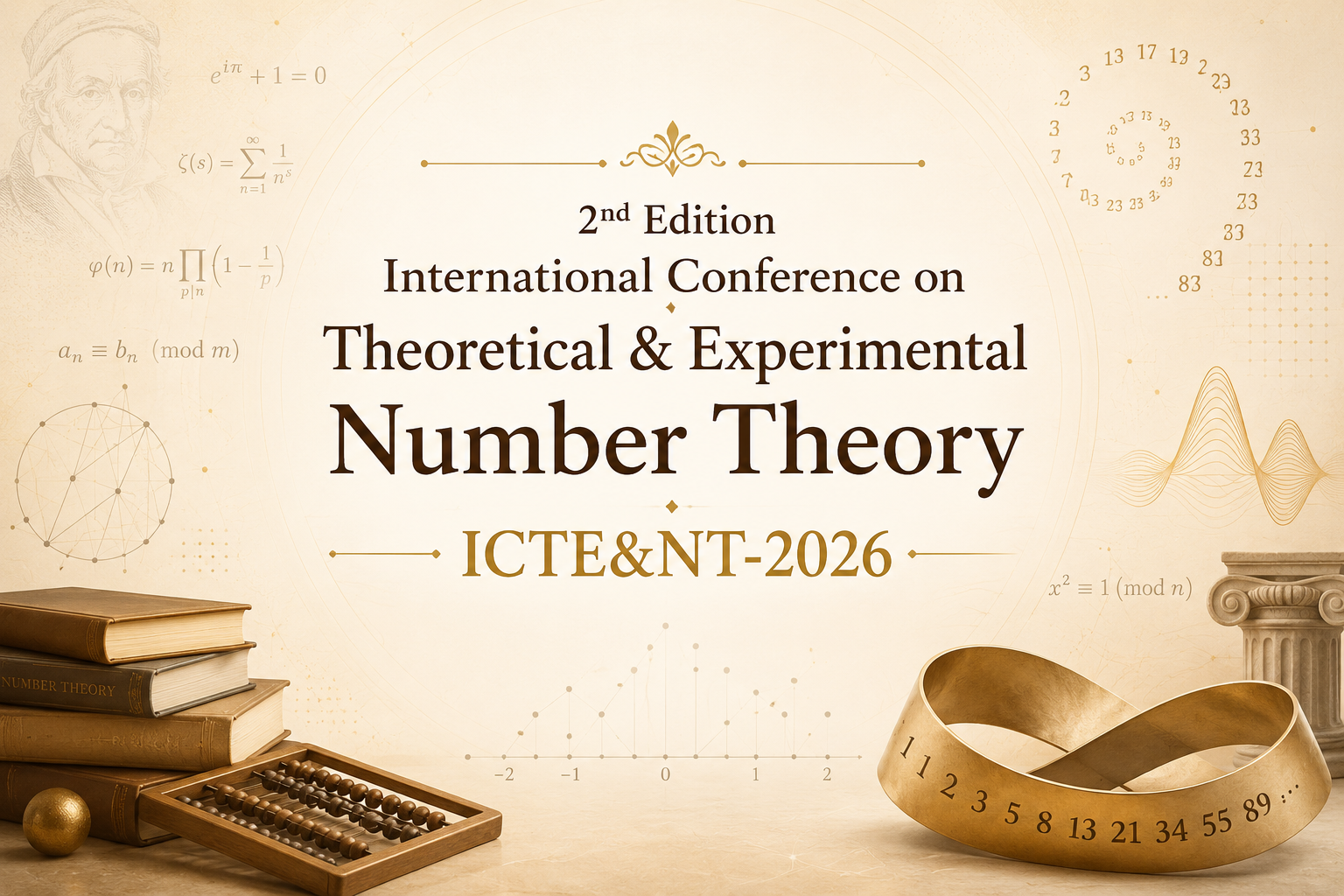
Mathematics has always been the invisible engine behind scientific progress, technological innovation, and modern computation. The Theoretical Experimental Number Theory community stands at the center of many breakthroughs that influence cryptography, cybersecurity, artificial intelligence, and advanced computing systems. As global interest in mathematical sciences continues to expand, the 2nd Edition International Conference on Theoretical & Experimental Number Theory (ICTE&NT-2026) provides an important platform for researchers, academics, students, and industry professionals to exchange ideas and explore emerging discoveries.
The conference arrives at a time when number theory is no longer viewed as a purely abstract discipline. Concepts once considered theoretical are now essential components of secure communications, blockchain technologies, quantum-resistant cryptography, and large-scale computational systems. Consequently, ICTE&NT-2026 offers participants an opportunity to engage with both foundational mathematics and its rapidly expanding real-world applications.
What the Conference Is About
Direct Answer: ICTE&NT-2026 is an international academic conference focused on theoretical and experimental advances in number theory, bringing together experts to discuss research developments, applications, and future directions.
Number theory has evolved from a classical branch of mathematics into a multidisciplinary field with significant practical relevance. Conferences dedicated to number theory serve as vital hubs where researchers present findings, discuss unresolved problems, and establish collaborations that often lead to major breakthroughs.
The conference emphasizes both theoretical exploration and experimental methodologies, reflecting the growing importance of computational techniques in modern mathematical research. Similar international mathematics conferences increasingly highlight computational experimentation as a tool for discovering new patterns and validating theoretical conjectures.
Why Theoretical Experimental Number Theory Matters Today
Direct Answer: Number theory plays a foundational role in modern cryptography, cybersecurity, data protection, and advanced computational systems.
Many people encounter number theory without realizing it. Every encrypted banking transaction, secure online purchase, and protected digital communication relies on mathematical principles rooted in number theory.
According to research and industry analyses published by organizations such as the World Economic Forum and OECD, cybersecurity remains one of the most critical global challenges as digital economies continue expanding. Secure encryption systems depend heavily on mathematical structures including prime numbers, modular arithmetic, and elliptic curves.
Furthermore, the rise of quantum computing has intensified interest in number-theoretic research. Mathematicians are actively investigating new approaches to cryptographic security that can withstand future computational capabilities.
For broader context on digital transformation and innovation, readers can explore https://www.weforum.org/ and https://www.oecd.org/.
Theoretical Experimental Number Theory Research Areas and Conference Themes
Direct Answer: The conference covers a wide range of topics spanning pure mathematics, computational techniques, and practical applications.
Key research themes commonly associated with contemporary number theory conferences include:
- Algebraic Number Theory
- Analytic Number Theory
- Diophantine Equations
- Prime Number Research
- Modular Forms
- Arithmetic Geometry
- Elliptic Curves
- Computational Number Theory
- Cryptographic Applications
- Mathematical Modeling
Modern conferences increasingly encourage interdisciplinary discussions that connect mathematical theory with computer science, engineering, and data science. This trend reflects the growing recognition that major innovations often emerge at the intersection of multiple disciplines.
Theoretical Experimental Number Theory and Sustainable Development
Direct Answer: Although number theory appears abstract, its applications contribute to secure digital infrastructure and sustainable technological development.
Sustainable development depends heavily on reliable digital systems. Secure communication networks support financial inclusion, government services, healthcare platforms, and educational technologies.
The United Nations Sustainable Development Goals emphasize the importance of digital access and resilient infrastructure. Modern cryptographic systems, many rooted in number theory, help ensure trust and security across these critical services.
Researchers increasingly examine how mathematical innovation can support broader societal objectives. More information about global sustainability goals can be found at https://www.un.org/sustainabledevelopment/.
Emerging Trends in Digital Transformation and Mathematical Research
Direct Answer: Computational experimentation, AI-assisted discovery, and quantum-era cryptography are reshaping modern mathematical research.
Experimental mathematics has gained significant momentum during the last decade. Researchers now use high-performance computing systems to test hypotheses, identify patterns, and generate evidence before developing rigorous proofs.
According to analyses from McKinsey and Harvard Business Review, advanced analytics and computational technologies continue transforming research methodologies across disciplines.
Mathematicians increasingly leverage:
- High-performance computing
- Machine learning-assisted theorem exploration
- Symbolic computation systems
- Large-scale numerical experimentation
- Automated proof verification
These developments are accelerating the pace of discovery while expanding the scope of mathematical inquiry.
Additional insights are available at:
Ethical Innovation and Governance in Mathematical Sciences
Direct Answer: Mathematical research influences technologies that require responsible governance, transparency, and ethical oversight.
As mathematical methods become embedded in AI systems, financial technologies, and cybersecurity infrastructure, ethical considerations are increasingly important.
Researchers today must evaluate:
- Data privacy implications
- Algorithmic fairness
- Security vulnerabilities
- Transparency requirements
- Responsible AI development
The relationship between mathematics and public policy continues to grow stronger. Consequently, conferences such as ICTE&NT-2026 provide valuable opportunities for discussions that extend beyond technical research and address societal impact.
Opportunities for Researchers, Students, and Early-Career Scholars
Direct Answer: The conference provides networking, publication, collaboration, and professional development opportunities.
For students and early-career researchers, participation can be transformative.
Benefits include:
- Presenting original research
- Receiving expert feedback
- Building international collaborations
- Exploring interdisciplinary applications
- Learning emerging methodologies
Academic conferences often serve as launching points for future research partnerships, joint publications, and doctoral opportunities.
Many successful mathematical collaborations originate from conference discussions that evolve into long-term research projects.
Career Benefits of Participating
Participation offers value far beyond publication opportunities.
Researchers can:
- Enhance academic visibility
- Build professional credibility
- Discover funding opportunities
- Connect with leading mathematicians
- Stay informed about emerging trends
For industry professionals, number theory expertise remains highly relevant in cybersecurity, fintech, blockchain systems, and advanced computing sectors.
The increasing demand for cryptographic expertise has elevated the practical value of mathematical research careers worldwide.
Expert Insight / Analysis
From an expert perspective, one of the most significant developments in mathematics is the growing convergence between pure theory and practical application.
Historically, many mathematical discoveries found practical use decades after their creation. Today, that timeline is shrinking dramatically. Number theory provides an excellent example. Research once considered purely theoretical now powers internet security, digital payments, blockchain systems, and post-quantum cryptography.
The long-term significance of conferences like ICTE&NT-2026 lies in their ability to accelerate this knowledge transfer. They create environments where theoretical mathematicians, computational scientists, and industry practitioners can identify common challenges and develop collaborative solutions.
As global digital infrastructure expands, the importance of foundational mathematical research is expected to increase rather than decline.
Latest Trends & Updates
Artificial intelligence is increasingly being used to assist mathematical discovery, helping researchers identify patterns that might otherwise remain hidden for years.

Governments worldwide are investing in post-quantum cryptography research as quantum computing capabilities continue advancing. This shift has renewed interest in several number-theoretic problems and cryptographic frameworks.

Digital public infrastructure initiatives are expanding globally, creating additional demand for secure mathematical foundations that support authentication, identity verification, and encrypted communications.

Responsible innovation frameworks are becoming standard across research institutions. Mathematical researchers are now encouraged to consider societal impact, security implications, and ethical dimensions alongside technical contributions.

Interdisciplinary collaboration continues growing rapidly. Modern mathematical research increasingly intersects with computer science, economics, cybersecurity, artificial intelligence, and sustainability studies.

Open-access research platforms and collaborative computing environments are making advanced mathematical tools more accessible to students and researchers around the world.

Global policy discussions surrounding AI governance, cybersecurity resilience, and digital trust are creating new opportunities for number theorists to contribute expertise beyond traditional academic settings.
Real-Life Example / Mini Case Study
Consider a doctoral student researching elliptic curve cryptography at a university mathematics department.
Initially, the student focused solely on theoretical aspects of algebraic structures. After participating in an international number theory conference, they attended sessions on cybersecurity applications and quantum-resistant encryption.
Through networking discussions, they connected with researchers working on practical cryptographic systems. This collaboration led to a joint publication and eventually contributed to a funded research project focused on next-generation encryption technologies.
The conference experience transformed a narrowly focused research project into an interdisciplinary initiative with real-world impact.
Traditional Innovation vs Sustainable Innovation
| Traditional Innovation | Sustainable Innovation |
|---|---|
| Technology-first approach | Human-centered approach |
| Short-term objectives | Long-term societal value |
| Isolated research efforts | Collaborative ecosystems |
| Limited stakeholder engagement | Inclusive participation |
| Narrow performance metrics | Broader impact evaluation |
Beginner vs Expert Comparison
| Beginners | Experts |
|---|---|
| Learn mathematical tools | Understand systems thinking |
| Focus on formulas | Focus on impact and applications |
| Study isolated topics | Connect multiple disciplines |
| Solve predefined problems | Identify emerging challenges |
| Limited research scope | Broader analytical perspective |
Pros and Cons
| Pros | Cons |
|---|---|
| Global networking opportunities | Requires time commitment |
| Exposure to cutting-edge research | Competitive academic environment |
| Collaboration potential | Travel or registration costs |
| Professional recognition | Preparation required |
| Publication opportunities | High-quality submissions expected |
Common Mistakes to Avoid
Many participants reduce the value of conference attendance by making avoidable mistakes.
One common error is submitting weak abstracts that fail to clearly communicate research significance. Strong abstracts should highlight originality, methodology, and expected contribution.
Another mistake is focusing exclusively on technical details while ignoring interdisciplinary perspectives. Modern research increasingly benefits from cross-disciplinary collaboration.
Some attendees also underestimate networking preparation. Reviewing speaker profiles and identifying potential collaborators beforehand often leads to more meaningful interactions.
Finally, researchers sometimes overlook sustainability and societal impact dimensions. Increasingly, funding agencies and institutions value research that demonstrates broader relevance.
What to Do Next (Actionable Steps)
If you are considering participation:
- Review conference themes carefully.
- Identify a suitable research topic.
- Prepare a strong abstract.
- Conduct a focused literature review.
- Register early when possible.
- Develop a concise presentation.
- Plan networking objectives.
- Follow emerging trends in number theory and cryptography.
- Engage with interdisciplinary sessions.
- Maintain contact with researchers after the event.
Quick Checklist
✔ Select a research topic
✔ Draft your abstract
✔ Review submission guidelines
✔ Prepare supporting research
✔ Complete registration
✔ Create presentation materials
✔ Update academic profile
✔ Schedule networking opportunities
✔ Explore collaboration possibilities
Conclusion
The 2nd Edition International Conference on Theoretical & Experimental Number Theory (ICTE&NT-2026) represents far more than a traditional academic gathering. It serves as a meeting point for mathematical innovation, computational advancement, and interdisciplinary collaboration.
As number theory continues influencing cybersecurity, digital infrastructure, artificial intelligence, and emerging technologies, the importance of forums that encourage knowledge exchange becomes increasingly clear. Researchers, students, and professionals who engage with these conversations position themselves at the forefront of both theoretical discovery and practical impact.
For anyone passionate about mathematics and its future role in society, ICTE&NT-2026 offers an opportunity to learn, contribute, collaborate, and help shape the next generation of mathematical innovation.
Frequently Asked Questions
Researchers, academicians, students, mathematicians, data scientists, and industry professionals interested in number theory and its applications.
Yes. Many conferences actively encourage participation from undergraduate, postgraduate, and doctoral students.
Not always. Many participants attend as listeners, collaborators, or networking delegates.
Yes. Modern mathematics conferences increasingly support interdisciplinary research connecting mathematics with computing, AI, cybersecurity, and data science.
Participation can expand professional networks, improve research visibility, create collaboration opportunities, and enhance academic credentials.