June 9, 2026
 9 Min
 No Comment
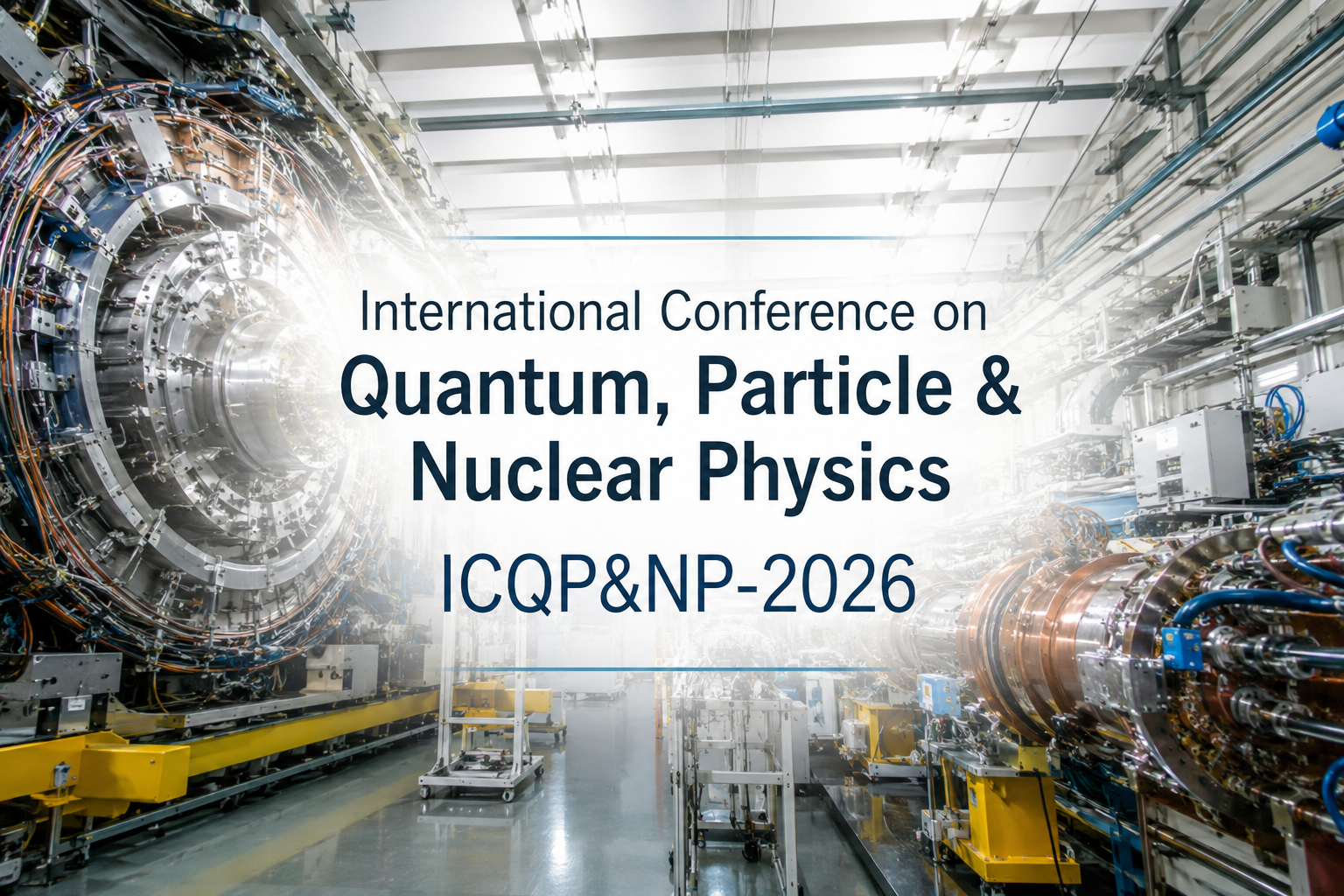
Few scientific disciplines attempt to answer questions as profound as those explored in quantum, particle, and nuclear physics. What is matter made of? How did the universe begin? What forces govern reality at the smallest scales? These questions drive some of the most groundbreaking research in modern science.
The Quantum Particle Nuclear Physics conference, officially known as the International Conference on Quantum, Particle & Nuclear Physics (ICQP&NP-2026), brings together physicists, researchers, academicians, engineers, and students working at the forefront of fundamental science. The conference provides a platform for presenting theoretical advances, experimental discoveries, computational innovations, and emerging technologies that are shaping the future of physics. (Onegrasp)
As global investment in quantum technologies, nuclear science, and high-energy physics continues to accelerate, ICQP&NP-2026 offers a valuable opportunity to explore the next generation of scientific breakthroughs.
Official Conference Information
Conference Dates: 24–25 June 2026
Format: Virtual Conference
Official Conference Page: International Conference on Quantum, Particle & Nuclear Physics (ICQP&NP-2026)
What the Conference Is About
Featured Snippet Answer
The International Conference on Quantum, Particle & Nuclear Physics (ICQP&NP-2026) focuses on quantum mechanics, particle physics, nuclear science, quantum computing, high-energy physics, cosmology, detector technologies, and computational physics. (Onegrasp)
The conference aims to foster collaboration among researchers investigating the fundamental laws governing matter, energy, space, and time.
Participants will discuss theoretical models, experimental findings, simulation techniques, and technological innovations across multiple areas of modern physics. Conference sessions include keynote presentations, technical paper discussions, student research forums, and interdisciplinary panel sessions focused on emerging scientific challenges. (Onegrasp)
Why Quantum Particle Nuclear Physics Matters Today
Featured Snippet Answer
Quantum, particle, and nuclear physics drive innovations in computing, medicine, energy production, materials science, national security, and our understanding of the universe.
Many technologies used today originated from fundamental physics research.
Examples include:
- Medical imaging systems
- Radiation therapies
- Semiconductor technologies
- GPS navigation
- Nuclear energy
- Quantum cryptography
- Advanced computing systems
According to the World Economic Forum, quantum technologies are expected to become increasingly important for solving complex computational and scientific challenges.
Meanwhile, particle physics experiments continue expanding our understanding of dark matter, neutrinos, antimatter, and the origins of the cosmos.
As a result, fundamental physics remains a cornerstone of scientific and technological progress.
Quantum Particle Nuclear Physics Research Themes
Featured Snippet Answer
ICQP&NP-2026 explores quantum mechanics, particle physics, nuclear reactions, quantum computing, dark matter, cosmology, detector systems, and computational modeling. (Onegrasp)
Major conference themes include:
- Quantum Mechanics and Quantum Field Theory
- Particle Physics and Collider Experiments
- Nuclear Physics and Atomic Structure
- High-Energy Theoretical Physics
- Quantum Computing and Information Science
- Neutrino Physics
- Dark Matter Research
- Nuclear Fission and Fusion
- Quantum Optics and Photonics
- Cosmology and Astroparticle Physics
- Quantum Materials
- Detector Technologies
- Computational Physics and Simulation Models
These research areas collectively contribute to our understanding of both microscopic particles and large-scale cosmic phenomena. (Onegrasp)
Quantum Computing and the Future of Science
Featured Snippet Answer
Quantum computing leverages quantum mechanical principles to solve problems that are difficult or impossible for classical computers.
Quantum computing has become one of the fastest-growing areas of scientific research.
Unlike traditional computers that use binary bits, quantum computers utilize quantum bits (qubits), enabling entirely new computational approaches.
Researchers are exploring applications including:
| Application Area | Potential Impact |
|---|---|
| Drug Discovery | Faster molecular simulations |
| Materials Science | Advanced material design |
| Nuclear Physics | Complex simulations |
| Cryptography | Enhanced security systems |
| Climate Modeling | Improved predictions |
| Artificial Intelligence | Advanced optimization |
Specialized research initiatives are already exploring how quantum computing can advance nuclear physics simulations and high-energy theoretical models. ((Indico))
Particle Physics and the Search for New Discoveries
Featured Snippet Answer
Particle physics investigates the fundamental particles and forces that make up the universe.
Major international research facilities continue exploring unanswered questions about reality.
Scientists investigate:
- Higgs boson properties
- Dark matter candidates
- Neutrino behavior
- Matter-antimatter asymmetry
- Beyond Standard Model physics
- Fundamental forces
Global conferences and collaborations regularly bring together theorists and experimental physicists to share discoveries and accelerate progress in high-energy physics research. (The University of Manchester)
These investigations may eventually reshape our understanding of the universe itself.
Nuclear Physics and Sustainable Energy Innovation
Featured Snippet Answer
Nuclear physics contributes to energy production, medical technologies, industrial applications, and scientific discovery.
Modern nuclear research extends far beyond power generation.
Current areas of focus include:
- Nuclear fusion technologies
- Advanced reactor designs
- Nuclear medicine
- Radiation detection
- Nuclear astrophysics
- Materials testing
According to global nuclear research initiatives, advances in fusion and next-generation reactor technologies could play important roles in future low-carbon energy systems. (Biennial International Conference)
Consequently, nuclear science remains a critical component of long-term sustainability and energy security strategies.
Career Benefits of Participating in ICQP&NP-2026
Featured Snippet Answer
Participation in ICQP&NP-2026 helps researchers expand professional networks, showcase research, and stay informed about emerging developments in physics.
Conference participants can benefit through:
- International networking
- Research publication opportunities
- Academic collaboration
- Exposure to emerging technologies
- Professional recognition
- Knowledge exchange
- Career advancement
The conference includes student research forums, technical paper presentations, keynote lectures, and expert panel discussions. Accepted abstracts may also be considered for publication opportunities according to conference guidelines. (Onegrasp)
For students and early-career researchers, such events provide valuable exposure to the global scientific community.
Expert Insight: The Future of Fundamental Physics
Physics is entering an exciting period characterized by unprecedented computational power, advanced experimental facilities, and global scientific collaboration.
Several trends are expected to shape the future:
- Quantum advantage computing
- AI-assisted scientific discovery
- Dark matter detection programs
- Fusion energy breakthroughs
- Quantum communication networks
- Advanced particle detectors
- Precision cosmology
Research institutions worldwide increasingly recognize that breakthroughs in fundamental physics often generate transformative technologies decades later.
From MRI scanners to semiconductors, many modern innovations originated from curiosity-driven research into the laws of nature.
Therefore, continued investment in quantum, particle, and nuclear physics remains essential for both scientific discovery and technological advancement.
Latest Trends & Updates
Quantum computing research continues to accelerate globally. Governments, universities, and technology companies are investing billions of dollars into quantum hardware, algorithms, and software platforms capable of solving previously intractable scientific problems.
Artificial intelligence is becoming an important tool for physics research. Machine learning models are increasingly used to analyze particle collision data, optimize detector performance, and identify subtle patterns that may indicate new physical phenomena.
Dark matter research remains one of the most active areas in modern physics. Although dark matter is believed to constitute a significant portion of the universe’s mass, its precise nature remains unknown, driving extensive experimental and theoretical investigations worldwide.
Nuclear fusion research has achieved notable progress in recent years. Scientists continue advancing technologies aimed at producing clean, sustainable energy through controlled fusion reactions, potentially transforming future energy systems.
International collaboration is becoming increasingly important. Large-scale physics projects now involve researchers from dozens of countries, reflecting the global nature of scientific discovery and the growing complexity of modern experimental facilities.
Real-Life Example: Student Research Success Through Physics Conferences
A postgraduate physics student specializing in computational nuclear physics initially focused on theoretical simulations with limited international exposure.
After presenting research at a major physics conference, the student connected with experts working on quantum simulation methods and advanced computational techniques.
These collaborations led to joint research projects, co-authored publications, and access to new computational resources.
Within two years, the student secured a doctoral research position at a leading international laboratory.
This example demonstrates how conference participation can accelerate both scientific progress and career development.
Traditional Computing vs Quantum Computing
| Traditional Computing | Quantum Computing |
|---|---|
| Binary bits | Quantum bits (qubits) |
| Sequential processing | Quantum parallelism |
| Limited optimization capability | Enhanced optimization potential |
| Classical algorithms | Quantum algorithms |
| Conventional simulations | Advanced quantum simulations |
Beginners vs Experts
| Beginners | Experts |
|---|---|
| Learn physical principles | Develop new theoretical models |
| Study established theories | Explore unknown phenomena |
| Focus on equations | Solve complex interdisciplinary challenges |
| Understand experiments | Design advanced research programs |
| Analyze results | Lead scientific innovation |
Pros and Cons of Conference Participation
| Pros | Cons |
|---|---|
| Global networking | Time commitment |
| Research exposure | Competitive submissions |
| Publication opportunities | Preparation requirements |
| Professional development | Technical complexity |
| Collaboration opportunities | Intensive schedules |
| Access to emerging research | Learning curve for newcomers |
Common Mistakes to Avoid
Submitting Weak Abstracts
Clearly explain research objectives, methodology, findings, and significance.
Ignoring Interdisciplinary Opportunities
Physics increasingly intersects with computing, materials science, engineering, and artificial intelligence.
Focusing Only on Theory
Practical applications and experimental relevance strengthen research impact.
Neglecting Emerging Technologies
Quantum computing, AI, and advanced simulations are rapidly reshaping physics research.
Poor Networking Preparation
Research key speakers, institutions, and potential collaborators before attending.
What To Do Next
To maximize conference participation:
- Review conference tracks carefully.
- Identify relevant research themes.
- Conduct a comprehensive literature review.
- Prepare a strong abstract submission.
- Register before deadlines.
- Attend keynote presentations.
- Engage in networking discussions.
- Follow emerging developments in quantum technologies.
Quick Checklist
✔ Select a research topic
✔ Draft your abstract
✔ Verify submission requirements
✔ Register before deadlines
✔ Prepare presentation materials
✔ Review conference sessions
✔ Research keynote speakers
✔ Build networking goals
Conclusion
The International Conference on Quantum, Particle & Nuclear Physics (ICQP&NP-2026) provides an exceptional platform for exploring some of the most fundamental questions in science. By bringing together experts from quantum mechanics, particle physics, nuclear science, cosmology, and computational research, the conference fosters collaboration and innovation across multiple scientific frontiers.
As humanity continues searching for deeper insights into matter, energy, and the structure of the universe, conferences like ICQP&NP-2026 play a crucial role in advancing discovery. Whether you are an established researcher, early-career scientist, or student entering the field, the conference offers valuable opportunities to learn, collaborate, and contribute to the future of physics. (Onegrasp)
FAQ
Researchers, physicists, engineers, academicians, students, and professionals working in quantum science, particle physics, nuclear physics, and related disciplines.
Yes. The conference includes dedicated student research forums that encourage participation from emerging scientists. (Onegrasp)
Quantum mechanics, particle physics, nuclear science, quantum computing, dark matter studies, cosmology, detector technologies, and computational physics. (Onegrasp)
Accepted abstracts may be considered for conference proceedings and publication opportunities according to conference guidelines. (Onegrasp)
Participation enhances research visibility, supports networking opportunities, encourages collaboration, and helps researchers stay informed about emerging scientific developments.