Discover 500+ International Scientific Conferences
Browse events

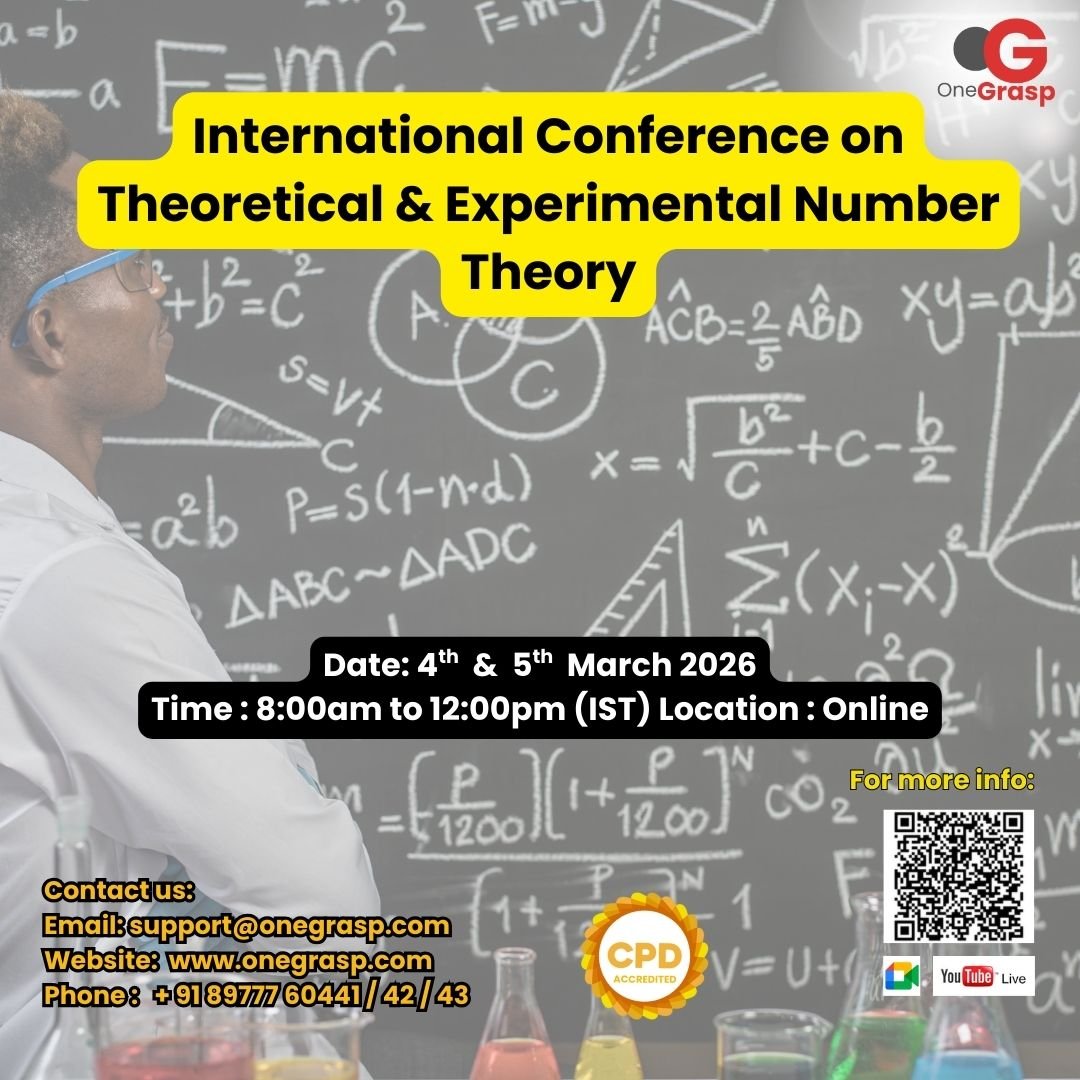
Date: 4th & 5th March 2026 | Time: 8.00 am – 12:00 pm (IST) | Location: Online
Overview
The International Conference on Theoretical & Experimental Number Theory brings together mathematicians, researchers, and students engaged in exploring the beauty, structure, and depth of number theory. The conference emphasizes the synergy between classical theories and modern computational or experimental approaches. It aims to bridge analytic, algebraic, and geometric aspects of number theory and encourages interdisciplinary collaborations that connect mathematical theory with cryptography, computer science, and applied mathematics.
Structure and Sessions (Who Does What)
Participate and Contribute (Who Benefits)
Benefits for Attendees
Abstract Topics / Call for Papers (CFP) Tracks
Detailed Program Grid
| Time (IST) | Day 1 | Day 2 |
| 08:00 – 08:15 | Opening Ceremony & Welcome | Recap and Opening Remarks |
| 08:15 – 09:00 | Keynote: The Harmony of Theory and Computation in Numbers | Keynote: Modern Tools for Exploring Mathematical Patterns |
| 09:00 – 10:15 | Technical Session I – Analytic & Algebraic Number Theory | Technical Session IV – Computational and Algorithmic Insights |
| 10:15 – 10:30 | Break | Break |
| 10:30 – 11:15 | Technical Session II – Prime Numbers & Modular Forms | Technical Session V – Cryptographic and Applied Number Theory |
| 11:15 – 11:45 | Panel Discussion: The Future of Number Theory Research | Student & Research Forum: New Ideas & Explorations |
| 11:45 – 12:00 | Day Summary & Announcements | Awards & Closing Ceremony |
Submit Abstract & Registration
| Conference Dates | Conference Title | Timing (IST) | Abstract Submission Deadline | Registration Deadline |
| 4th, 5th March 2026 | International Conference on Theoretical & Experimental Number Theory | 8:00 AM – 12:00 PM | 26th Jan 2026 | 28th Jan 2026 |
Abstract Guidelines
Conclusion
This international conference promotes study and innovation in number theory by uniting classical approaches with modern computational exploration. Participants will exchange ideas, discuss open problems, and discover new directions in one of mathematics’ most profound and dynamic fields.