June 8, 2026
 7 Min
 No Comment
Mathematics has always been the foundation of technological progress. From artificial intelligence and machine learning to smart cities and autonomous systems, mathematical innovation powers nearly every modern technological breakthrough. As industries increasingly rely on data-driven decision-making and intelligent automation, the role of mathematics in shaping smart technologies has never been more important.
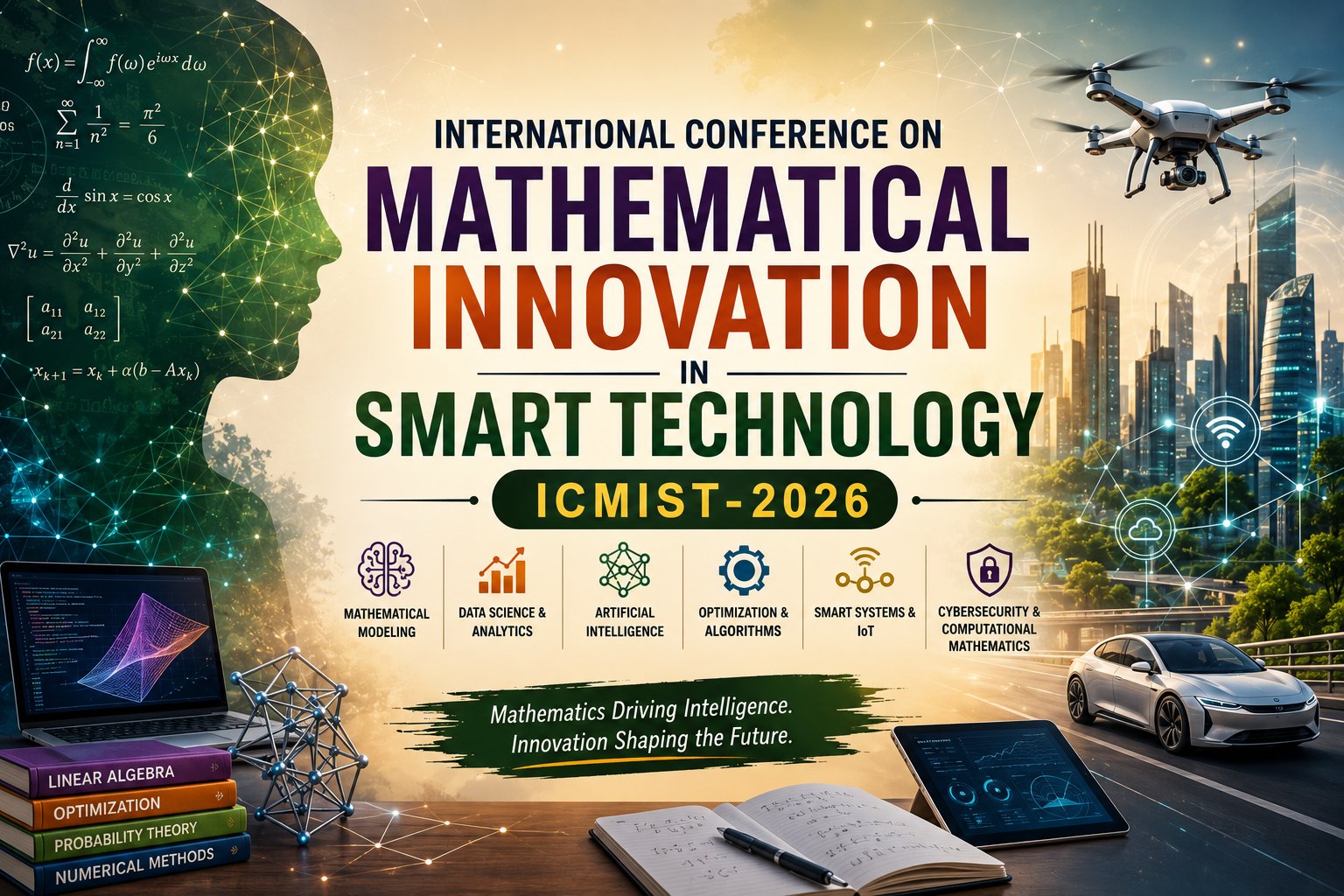
The Mathematical Innovation Smart Technology conference, officially known as the International Conference on Mathematical Innovation in Smart Technology (ICMIST-2026), provides a global platform where researchers, academicians, engineers, data scientists, and technology innovators can explore how mathematical methods are transforming the next generation of intelligent systems.
The conference serves as an interdisciplinary hub for discussing emerging research, practical applications, and future opportunities at the intersection of mathematics, artificial intelligence, computational science, and smart technologies.
Official Conference Page:
What the Conference Is About
Featured Snippet Answer
The International Conference on Mathematical Innovation in Smart Technology (ICMIST-2026) focuses on applying advanced mathematical concepts to develop intelligent technologies, computational systems, data-driven solutions, and next-generation digital innovations.
Modern technological systems depend heavily on mathematical foundations. Whether designing machine learning algorithms, optimizing smart transportation networks, securing digital communications, or predicting complex system behaviors, mathematics provides the tools necessary for innovation.
ICMIST-2026 aims to bring together experts from mathematics, engineering, computer science, artificial intelligence, operations research, and data science to discuss cutting-edge developments and emerging challenges in smart technology research.
Why Mathematical Innovation Smart Technology Matters Today
Featured Snippet Answer
Mathematical innovation drives technological advancement by enabling intelligent decision-making, predictive analytics, automation, optimization, and data-driven problem-solving across industries.
The modern digital economy increasingly depends on sophisticated mathematical models.
According to the World Economic Forum, artificial intelligence and advanced analytics are among the most transformative technologies shaping the future workforce and global industries.
Similarly, McKinsey estimates that AI-driven technologies could contribute trillions of dollars in economic value annually through enhanced productivity and innovation.
These advancements rely fundamentally on mathematical disciplines including:
- Statistics
- Optimization
- Linear algebra
- Differential equations
- Computational mathematics
- Probability theory
- Graph theory
- Numerical analysis
As a result, mathematics is no longer confined to academic research—it has become a strategic driver of innovation and competitiveness.
Mathematical Innovation Smart Technology Research Themes
Featured Snippet Answer
ICMIST-2026 explores mathematical modeling, machine learning, computational intelligence, optimization, smart systems, data analytics, and emerging technologies.
Key research areas include:
- Mathematical Modeling and Simulation
- Artificial Intelligence Algorithms
- Machine Learning Mathematics
- Data Science and Analytics
- Computational Intelligence
- Smart City Technologies
- Internet of Things Optimization
- Operations Research
- Cybersecurity Mathematics
- Predictive Analytics
- Scientific Computing
- Digital Transformation Technologies
These themes demonstrate how mathematical research increasingly influences practical technological applications across sectors.
Mathematics Behind Smart Technologies
Featured Snippet Answer
Smart technologies rely on mathematical models to process data, optimize performance, predict outcomes, and automate decision-making.
Every intelligent system contains mathematical components operating behind the scenes.
Examples include:
| Smart Technology | Mathematical Foundation |
|---|---|
| Machine Learning | Statistics & Linear Algebra |
| Smart Cities | Optimization Theory |
| Autonomous Vehicles | Calculus & Control Theory |
| Cybersecurity | Number Theory & Cryptography |
| Recommendation Systems | Probability & Graph Theory |
| Digital Twins | Mathematical Modeling |
These mathematical tools enable systems to learn, adapt, and make intelligent decisions.
Moreover, mathematical innovation helps organizations solve increasingly complex problems efficiently and accurately.
Digital Transformation and Intelligent Systems
Featured Snippet Answer
Digital transformation depends on mathematical frameworks that support automation, predictive intelligence, and real-time decision-making.
Organizations worldwide are investing heavily in smart technologies.
According to Harvard Business Review, successful digital transformation initiatives combine technological innovation with analytical capabilities and data-driven strategies.
Applications include:
- Smart healthcare systems
- Intelligent transportation networks
- Financial technology platforms
- Smart manufacturing
- Energy optimization systems
- Digital governance platforms
Mathematics serves as the common language connecting these innovations.
Consequently, researchers working at this intersection are helping define the future of intelligent infrastructure.
Career Benefits of Participating in ICMIST-2026
Featured Snippet Answer
Participation in ICMIST-2026 can improve research visibility, enhance technical expertise, expand professional networks, and create new career opportunities.
Attendees can benefit through:
- Academic recognition
- Research publication opportunities
- International networking
- Industry collaboration
- Exposure to emerging technologies
- Skill development
- Career advancement
For students, the conference provides exposure to cutting-edge research and emerging career paths in artificial intelligence, data science, and computational technologies.
For professionals, it offers opportunities to connect with researchers developing the next generation of intelligent systems.
Expert Insight: The Long-Term Impact of Mathematical Innovation
The significance of mathematical innovation extends far beyond academic theory.
Over the next decade, mathematical models will increasingly drive:
- Autonomous systems
- Sustainable infrastructure
- Smart healthcare
- Climate modeling
- Quantum computing
- Advanced robotics
- AI governance frameworks
The OECD emphasizes the growing importance of digital skills, data literacy, and analytical competencies for future economic growth.
As technologies become more sophisticated, mathematical expertise will become increasingly valuable across industries.
Conferences such as ICMIST-2026 play an essential role in accelerating knowledge exchange and interdisciplinary collaboration.
[Latest Trends & Updates]
Artificial intelligence continues to evolve toward more explainable and transparent systems. Researchers are increasingly focusing on mathematical frameworks that improve AI interpretability, fairness, and accountability.
Digital public infrastructure is becoming a major area of research. Mathematical optimization methods are helping governments improve digital identity systems, public services, and large-scale data management platforms.
Sustainable technology development is receiving increased attention worldwide. Mathematical models are being used to optimize renewable energy systems, smart grids, transportation networks, and resource allocation strategies.
Quantum computing represents one of the most promising research frontiers. Advances in mathematical algorithms are enabling researchers to explore computational possibilities beyond traditional computing architectures.
Responsible innovation is emerging as a central theme across technology policy discussions. Governments, researchers, and industry leaders are increasingly prioritizing ethical AI, trustworthy algorithms, and human-centered technology design.
Real-Life Example: A Student Research Project
Consider a graduate student studying traffic congestion in a rapidly growing urban area.
Initially, the project focused on collecting transportation data. However, after attending a mathematics and smart technology conference, the student learned advanced optimization techniques and machine learning approaches.
By integrating mathematical models with real-time traffic data, the student developed a predictive traffic management framework.
The project later attracted interest from local authorities and transportation researchers.
This experience highlights how conference participation can transform theoretical research into practical innovation with real-world impact.
Beginners vs Experts
| Beginners | Experts |
|---|---|
| Learn formulas | Design mathematical frameworks |
| Focus on tools | Focus on systems |
| Solve individual problems | Optimize complex ecosystems |
| Study algorithms | Develop new methodologies |
| Analyze data | Drive innovation strategies |
Pros and Cons of Conference Participation
| Pros | Cons |
|---|---|
| International networking | Time commitment |
| Research exposure | Competitive submissions |
| Publication opportunities | Preparation requirements |
| Academic recognition | Intensive technical discussions |
| Career advancement | Registration costs |
| Industry collaboration | Learning curve for newcomers |
Common Mistakes to Avoid
Submitting Weak Abstracts
Clearly explain objectives, methodology, findings, and practical significance.
Ignoring Interdisciplinary Perspectives
Smart technologies require expertise across mathematics, engineering, computing, and social sciences.
Focusing Only on Theory
Strong research should connect mathematical concepts to practical applications.
Neglecting Emerging Technologies
Researchers should stay informed about AI, quantum computing, digital twins, and smart infrastructure.
Poor Networking Preparation
Identify relevant speakers and research groups before attending the conference.
What To Do Next
To maximize conference benefits:
- Review conference themes carefully.
- Conduct a comprehensive literature review.
- Identify research gaps.
- Prepare a strong abstract submission.
- Register before deadlines.
- Attend technical sessions.
- Network with experts.
- Follow current AI and smart technology trends.
Quick Checklist
✔ Select a research topic
✔ Review conference tracks
✔ Prepare abstract submission
✔ Verify guidelines
✔ Register early
✔ Prepare presentation materials
✔ Follow emerging technology trends
✔ Build professional connections
Conclusion
The International Conference on Mathematical Innovation in Smart Technology (ICMIST-2026) highlights the critical role mathematics plays in driving modern technological innovation. As artificial intelligence, smart systems, and digital transformation continue reshaping industries, mathematical research remains essential for developing intelligent, sustainable, and scalable solutions.
By bringing together researchers, educators, industry professionals, and students, ICMIST-2026 creates opportunities for collaboration, innovation, and knowledge exchange. Whether your goal is advancing research, building professional networks, exploring emerging technologies, or contributing to the future of smart systems, this conference offers a valuable platform for growth and impact.
FAQ
Researchers, mathematicians, engineers, data scientists, AI professionals, students, and technology innovators.
Yes. The conference is suitable for undergraduate, postgraduate, and doctoral students interested in mathematics and smart technologies.
No. Participants may attend as presenters or general attendees depending on registration options.
Mathematical modeling, machine learning, optimization, smart systems, computational intelligence, data science, and related fields.
It enhances research visibility, expands professional networks, supports publication opportunities, and improves technical expertise.