The future of industry is no longer defined solely by automation and efficiency. A new industrial era is emerging where technology works alongside human creativity, sustainability becomes a core business objective, and intelligent systems support long-term economic resilience. This shift has given rise to Sustainable Automation Industry 5.0, a rapidly evolving field that combines advanced technologies with human-centered innovation and environmental responsibility.
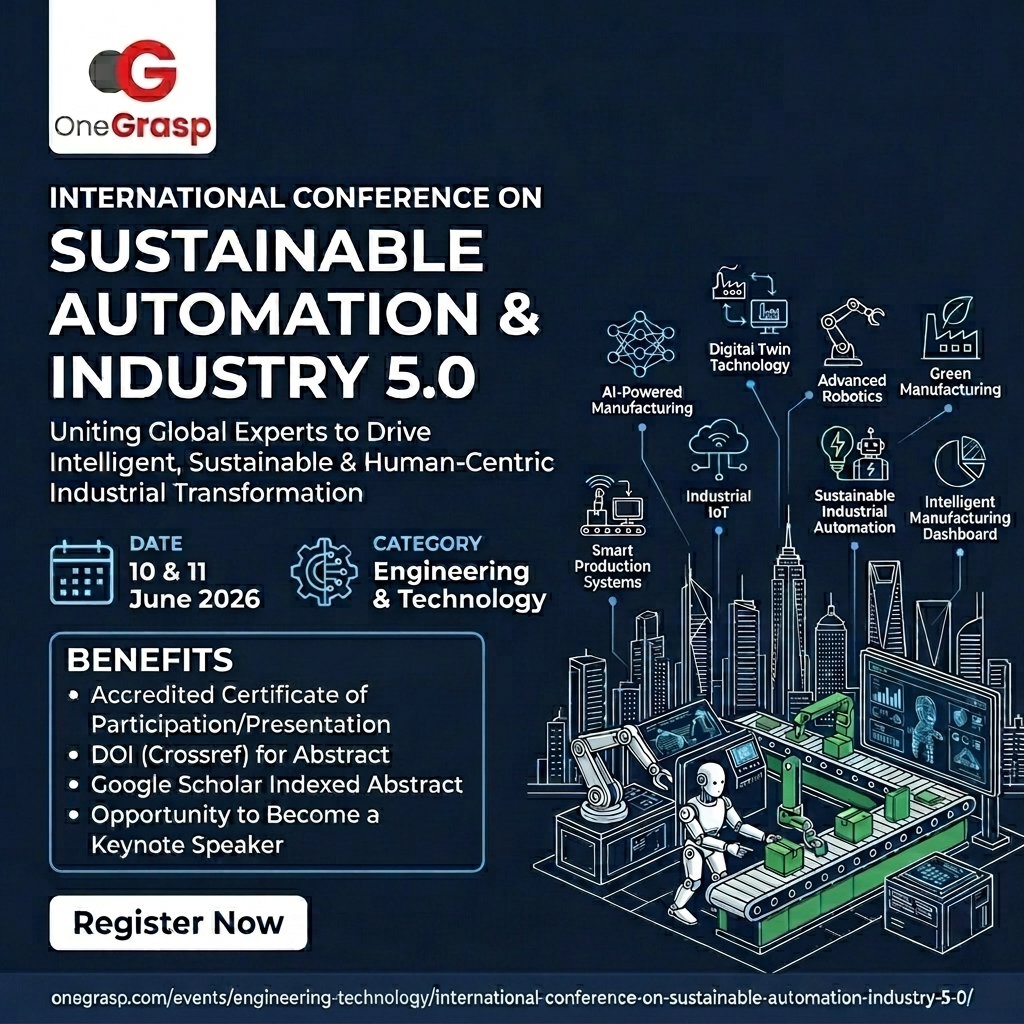
The International Conference on Sustainable Automation & Industry 5.0 (ICSAI-2026) provides a global platform for researchers, engineers, academicians, technology professionals, industrial leaders, and policymakers to explore the next generation of intelligent industrial systems. As industries worldwide face increasing pressure to improve productivity while reducing environmental impact, Industry 5.0 has become one of the most important topics in engineering and technology research.
Participants interested in attending or presenting research can explore the official conference page here:
The conference aims to foster collaboration between academia and industry while addressing emerging challenges related to automation, artificial intelligence, sustainable manufacturing, robotics, digital transformation, and human-machine collaboration.
ICSAI-2026 is an international conference focused on sustainable automation, smart manufacturing systems, Industry 5.0 technologies, and next-generation industrial transformation.
The conference serves as an interdisciplinary forum where experts discuss how emerging technologies can improve industrial productivity while promoting sustainability, resilience, and human well-being.
Unlike previous industrial revolutions that primarily emphasized mechanization and automation, Industry 5.0 introduces a more balanced approach where technological innovation works alongside human expertise. The concept focuses on creating intelligent ecosystems that prioritize sustainability, personalization, and collaboration.
Research presented at the conference typically explores advanced automation systems, AI-powered manufacturing, cyber-physical systems, digital twins, industrial IoT, robotics, smart factories, sustainable production models, and future workforce transformation.
Why Sustainable Automation Matters Today
Sustainable automation enables industries to improve efficiency while reducing environmental impact and resource consumption.
Manufacturing sectors worldwide are under growing pressure to reduce carbon emissions, optimize resource utilization, and improve operational efficiency. According to global sustainability reports published by organizations such as the World Economic Forum, industries are increasingly investing in intelligent technologies that support both productivity and environmental goals.
Traditional industrial systems often prioritize output and cost reduction. However, modern industries must also consider:
Energy efficiency
Waste reduction
Workforce well-being
Resource optimization
Environmental sustainability
Supply chain resilience
As a result, automation is evolving from simple process optimization toward intelligent, sustainable, and human-centric industrial ecosystems.
Understanding Industry 5.0 and Its Importance
Industry 5.0 represents the next phase of industrial evolution where humans and intelligent technologies collaborate to create sustainable and resilient systems.
Industry 4.0 introduced technologies such as IoT, big data analytics, automation, and cyber-physical systems. Industry 5.0 builds upon these foundations while placing greater emphasis on human creativity, sustainability, and societal impact.
Research on Industry 5.0 highlights three major pillars:
Human-Centric Innovation
Technology should enhance human capabilities rather than replace them.
Sustainability
Industrial systems must minimize environmental impact while supporting long-term growth.
Resilience
Organizations should develop adaptive systems capable of responding to disruptions and uncertainty.
Studies on Industry 5.0 suggest that future manufacturing environments will increasingly integrate collaborative robots, artificial intelligence, digital twins, and intelligent communication networks to achieve these objectives.
Conference Themes and Research Areas
ICSAI-2026 explores the technologies, strategies, and frameworks shaping the future of sustainable industrial systems.
Key topics include:
Sustainable Manufacturing Systems
Research on environmentally responsible production methods and resource-efficient operations.
Artificial Intelligence in Industry
Applications of machine learning, predictive analytics, and intelligent automation within industrial environments.
Smart Factories and Industrial IoT
Connected manufacturing ecosystems that enable real-time monitoring, optimization, and decision-making.
Human-Robot Collaboration
Studies focused on collaborative robotics, workplace safety, and human-machine interaction.
Digital Twins and Simulation Technologies
Virtual models used for system optimization, predictive maintenance, and operational efficiency.
Industrial Cybersecurity
Protection of connected manufacturing systems from digital threats and vulnerabilities.
Circular Economy and Green Manufacturing
Strategies for reducing waste, improving resource efficiency, and supporting sustainability goals.
Advanced Robotics and Automation
Emerging robotic technologies capable of enhancing industrial productivity and flexibility.
These themes reflect the growing importance of integrating technological innovation with sustainability objectives.
Sustainable Automation Industry 5.0 and Global Development
Industry 5.0 supports sustainable economic development by aligning industrial growth with environmental and social priorities.
The United Nations Sustainable Development Goals increasingly influence industrial policies worldwide. Governments and organizations are investing in technologies that enable cleaner production processes, responsible resource management, and sustainable economic growth.
For example, many manufacturing companies are adopting AI-driven energy optimization systems to reduce energy consumption and operational costs. According to sustainability research discussed by the World Economic Forum, intelligent automation can significantly improve resource efficiency while supporting climate goals.
Similarly, digital technologies are helping organizations monitor environmental performance in real time, enabling faster decision-making and continuous improvement.
These developments demonstrate how automation and sustainability can work together rather than compete against each other.
Emerging Technologies Driving Industry 5.0
Several advanced technologies are accelerating the transition toward Industry 5.0 ecosystems.
Artificial Intelligence and Machine Learning
AI systems help industries improve predictive maintenance, quality control, supply chain optimization, and operational efficiency.
Collaborative Robots (Cobots)
Unlike traditional industrial robots, cobots are designed to work safely alongside humans.
Digital Twins
Digital twin technologies create virtual representations of industrial assets, enabling advanced monitoring and simulation capabilities.
Edge Computing
Real-time processing improves industrial responsiveness and supports intelligent decision-making.
Advanced Sensor Networks
Connected sensors provide continuous operational data that enhances efficiency and predictive analytics.
Industrial Internet of Things (IIoT)
IIoT platforms enable seamless communication between machines, systems, and operators.
According to research examining Industry 5.0 implementation, intelligent communication infrastructures and cognitive technologies are expected to become foundational components of future industrial ecosystems.
Opportunities for Researchers, Engineers, and Students
ICSAI-2026 provides valuable opportunities for knowledge exchange, research collaboration, and professional development.
Researchers can:
Present original work
Receive peer feedback
Expand academic networks
Explore interdisciplinary collaborations
Engineers can:
Learn about emerging technologies
Understand implementation challenges
Discover industrial best practices
Students can:
Gain exposure to advanced research
Build professional connections
Explore future career opportunities
Industry professionals can:
Identify innovation trends
Engage with researchers
Explore technology partnerships
The conference creates an environment where participants can connect across disciplines and industries.
Expert Insight: The Future of Industry 5.0
Industry 5.0 is not simply a technological upgrade. It represents a broader shift toward responsible industrial development.
Future factories will likely combine:
Human expertise
Artificial intelligence
Sustainable production systems
Autonomous operations
Real-time analytics
Resilient supply chains
Organizations that successfully integrate these elements will be better positioned to navigate economic uncertainty, environmental challenges, and technological disruption.
Moreover, researchers increasingly argue that trustworthy AI and ethical automation will become essential components of industrial competitiveness. Sustainable innovation requires balancing efficiency with transparency, accountability, and societal impact.
Latest Trends & Updates
Artificial intelligence is becoming a core driver of industrial transformation. Manufacturing organizations are increasingly deploying machine learning systems for predictive maintenance, quality assurance, and intelligent process optimization.
Human-robot collaboration continues to expand across manufacturing sectors. New generations of collaborative robots are designed to improve productivity while enhancing workplace safety and flexibility.
Digital twin adoption is accelerating as organizations seek better visibility into operational performance. These virtual models allow companies to simulate scenarios, reduce downtime, and improve decision-making.
Sustainability reporting requirements are influencing industrial investment decisions. Companies are increasingly implementing automation technologies that support carbon reduction targets and environmental compliance objectives.
Industry 5.0 research is placing greater emphasis on human-centered design principles. Rather than replacing workers, modern automation systems aim to augment human capabilities and create more meaningful work environments.
Smart factories powered by AI, IIoT, edge computing, and advanced analytics are becoming central to industrial modernization strategies. These technologies are expected to drive the next wave of manufacturing innovation over the coming decade.
A mid-sized manufacturing company struggled with rising energy costs, inconsistent production quality, and increasing sustainability requirements.
The organization implemented AI-driven monitoring systems, predictive maintenance tools, and intelligent energy management solutions. Engineers also introduced collaborative robots to support repetitive production tasks while allowing workers to focus on higher-value activities.
Within two years, the company reduced downtime, improved energy efficiency, and enhanced product quality. Participation in international automation conferences helped management identify emerging technologies and connect with experts who guided implementation strategies.
This example highlights how Industry 5.0 principles can generate measurable operational and sustainability benefits.
Traditional Industry vs Industry 5.0 Systems
Traditional Industry
Industry 5.0 Systems
Automation-focused
Human-centric automation
Efficiency-first approach
Sustainability-driven approach
Limited adaptability
Resilient and adaptive systems
Isolated operations
Connected ecosystems
Reactive maintenance
Predictive maintenance
Resource-intensive processes
Optimized resource utilization
Beginner vs Expert Perspective in Industry 5.0
Beginners
Experts
Focus on technology tools
Focus on ecosystem transformation
Automation-centered thinking
Human-centered innovation
Short-term implementation view
Long-term sustainability strategy
Individual system optimization
Integrated industrial systems
Basic digital adoption
Advanced digital transformation planning
Pros and Cons of Participating in ICSAI-2026
Pros
Cons
Access to global expertise
Requires preparation time
Exposure to emerging technologies
Competitive research environment
Networking opportunities
Learning curve for beginners
Professional development
Need for continuous skill updates
Research collaboration potential
Active participation required
Common Mistakes to Avoid
Focusing Only on Automation
Industry 5.0 also emphasizes sustainability, resilience, and human collaboration.
Ignoring Sustainability Metrics
Technology implementation should align with environmental objectives.
Underestimating Workforce Transformation
Human skills remain critical even within highly automated environments.
Neglecting Cybersecurity Considerations
Connected industrial systems require strong security frameworks.
Weak Research Positioning
Research should clearly explain both technical contributions and practical implications.
What to Do Next
If you plan to participate in ICSAI-2026:
Review conference themes carefully.
Identify a relevant research area.
Conduct a literature review on Industry 5.0 developments.
Prepare a high-quality abstract.
Explore sustainability dimensions within your research.
Register early.
Connect with researchers and industry professionals.
Stay informed about emerging industrial technologies.
Learn more about participation and conference details here:
Industrial transformation is entering a new phase where technological innovation must align with sustainability, resilience, and human well-being. Industry 5.0 represents a significant evolution in how organizations approach manufacturing, automation, and digital transformation.
The International Conference on Sustainable Automation & Industry 5.0 (ICSAI-2026) provides an important platform for exploring these developments while fostering collaboration between researchers, engineers, industry leaders, and policymakers.
As organizations worldwide seek to build smarter and more sustainable industrial systems, conferences like ICSAI-2026 play a critical role in advancing knowledge, sharing innovations, and shaping future industrial strategies.
Whether you are a student, researcher, engineer, or industry professional, participating in ICSAI-2026 can provide valuable insights into the technologies and ideas driving the future of intelligent and sustainable industry.
Modern Industry 5.0 strategies increasingly combine sustainability, AI, automation, and human collaboration to create more resilient industrial ecosystems capable of addressing future global challenges.
Frequently Asked Questions
Researchers, engineers, academicians, students, manufacturing professionals, automation specialists, and policymakers can benefit from attending.
Yes. Industry 5.0 focuses on sustainability, resilience, and human-centered innovation alongside advanced technologies.
Yes. Students are encouraged to attend, present research, and engage with experts.
AI, robotics, industrial IoT, digital twins, smart manufacturing, collaborative automation, and sustainable industrial systems.
It helps participants understand how emerging technologies can support both industrial productivity and sustainable development.

 June 1, 2026
 10 Min
 No Comment