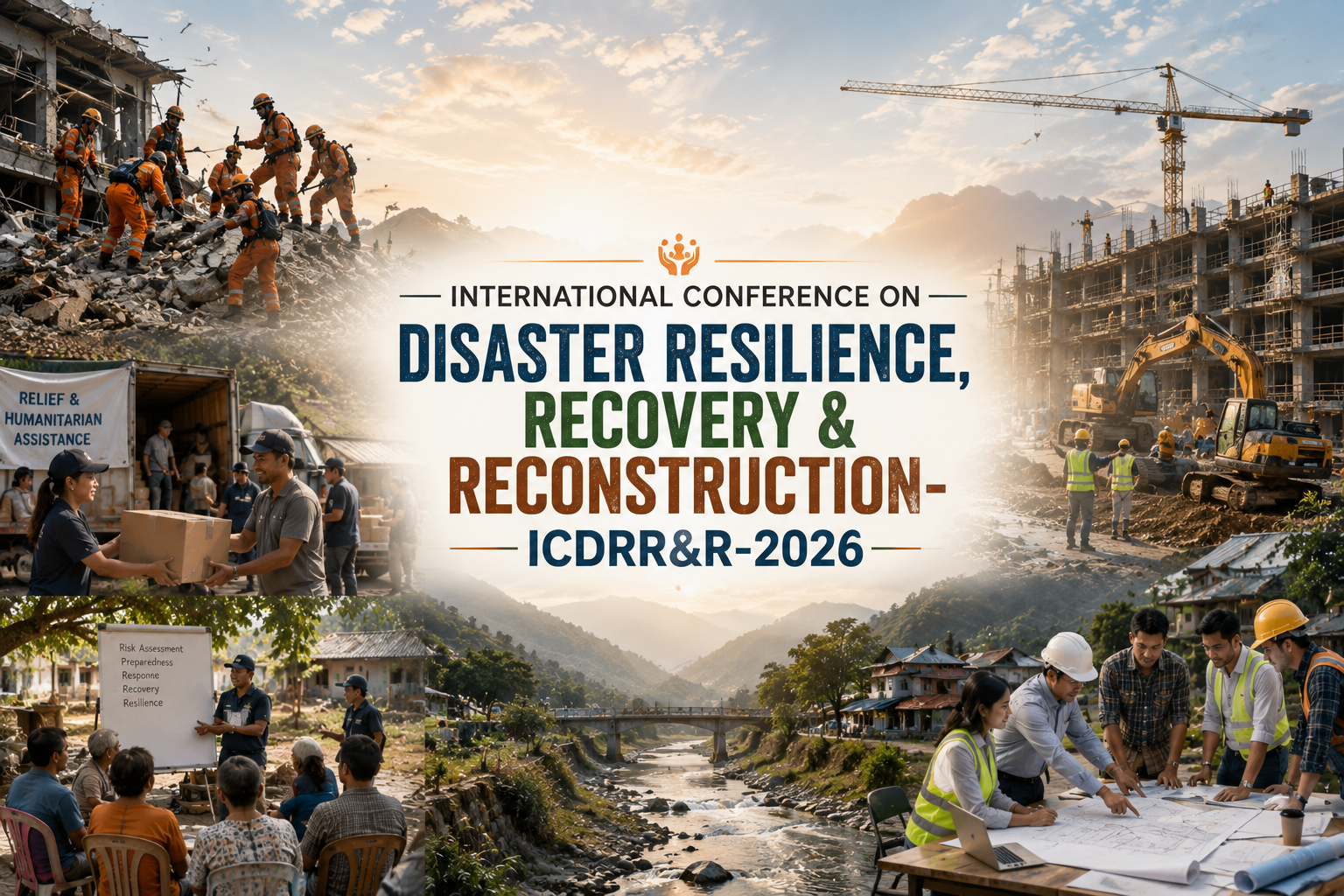
Disasters are becoming more frequent, complex, and costly across the globe. From climate-driven floods and wildfires to earthquakes, pandemics, and urban emergencies, societies face increasing challenges that require coordinated planning, innovative technologies, and resilient infrastructure. In this rapidly evolving landscape, the Disaster Resilience Recovery Reconstruction conference provides a critical platform for advancing research, policy, and practical solutions.
The International Conference on Disaster Resilience, Recovery & Reconstruction (ICDRR&R-2026) brings together researchers, engineers, urban planners, emergency management professionals, policymakers, humanitarian organizations, and students to discuss strategies for disaster preparedness, risk reduction, recovery planning, and sustainable reconstruction.
As governments and communities worldwide seek ways to build resilience against future crises, the conference offers valuable opportunities to share knowledge, explore emerging technologies, and strengthen interdisciplinary collaboration. Participants gain insights into both immediate response mechanisms and long-term recovery strategies that contribute to safer, more sustainable societies.
The International Conference on Disaster Resilience, Recovery & Reconstruction (ICDRR&R-2026) focuses on disaster risk reduction, resilience planning, emergency management, sustainable reconstruction, climate adaptation, humanitarian response, and resilient infrastructure development.
The conference serves as an interdisciplinary forum where experts examine methods for reducing disaster impacts, improving preparedness, accelerating recovery, and creating communities capable of adapting to future risks.
Research presented at the conference spans engineering, environmental science, public policy, urban planning, social sciences, technology, and humanitarian studies. By integrating these disciplines, the event encourages comprehensive approaches to resilience and sustainable development.
Why Disaster Resilience Matters More Than Ever
Featured Snippet Answer
Disaster resilience helps communities prepare for hazards, minimize losses, recover faster, and adapt to future risks while protecting lives, infrastructure, and economic stability.
Climate change is increasing the severity and frequency of many disasters. Rising sea levels, extreme weather events, droughts, and heatwaves are creating new vulnerabilities for urban and rural communities alike.
Research from the World Economic Forum consistently highlights climate-related risks among the most significant threats facing economies and societies worldwide.
As a result, resilience planning is no longer optional—it is becoming an essential component of sustainable governance and development.
Disaster Resilience Recovery Reconstruction Research Themes
Featured Snippet Answer
ICDRR&R-2026 explores disaster preparedness, climate resilience, emergency response, sustainable reconstruction, infrastructure resilience, community recovery, and disaster governance.
Key conference themes include:
Disaster Risk Reduction
Climate Change Adaptation
Emergency Management Systems
Community Resilience
Infrastructure Resilience
Sustainable Reconstruction
Humanitarian Logistics
Urban Disaster Planning
Public Health Emergencies
Risk Assessment and Modeling
Disaster Governance
Early Warning Systems
Recovery Planning
Resilient Cities and Communities
These themes reflect the growing need for integrated solutions that combine scientific research, technology, policy development, and community engagement.
Disaster Resilience Recovery Reconstruction and Sustainable Development
Featured Snippet Answer
Resilient recovery strategies support sustainable development by rebuilding communities in ways that improve environmental, social, and economic outcomes.
Modern recovery efforts increasingly embrace the principle of “Build Back Better.”
Rather than simply restoring damaged infrastructure, resilient reconstruction focuses on improving safety, sustainability, accessibility, and adaptability.
For example, reconstruction projects may include:
Traditional Reconstruction
Resilient Reconstruction
Restore previous conditions
Improve future resilience
Short-term repairs
Long-term sustainability
Infrastructure-only focus
Community-centered planning
Reactive decision-making
Risk-informed planning
Limited stakeholder engagement
Inclusive participation
Consequently, disaster recovery has evolved into a strategic opportunity to strengthen communities rather than merely replace damaged assets.
Emerging Trends in Disaster Management and Recovery
Featured Snippet Answer
Emerging technologies and data-driven approaches are transforming disaster preparedness, response, and recovery worldwide.
Several innovations are reshaping the field:
Technology
Application
Artificial Intelligence
Risk prediction and forecasting
GIS Mapping
Hazard assessment
Drones
Damage assessment
Satellite Monitoring
Disaster surveillance
IoT Sensors
Early warning systems
Big Data Analytics
Emergency planning
These technologies enable faster decision-making, improved situational awareness, and more effective allocation of resources during emergencies.
According to insights published by McKinsey & Company, advanced analytics and digital technologies are increasingly helping governments and organizations improve resilience planning and crisis response capabilities.
Community Resilience and Social Recovery
Featured Snippet Answer
Community resilience strengthens the ability of people, institutions, and local governments to withstand and recover from disasters.
Infrastructure alone cannot create resilience.
Strong social networks, effective leadership, community participation, and local knowledge are equally important components of successful recovery.
Research demonstrates that communities with higher levels of social cohesion often recover more quickly and effectively after disasters.
Important elements include:
Community engagement
Inclusive planning
Public awareness programs
Local capacity building
Social support systems
Accessible emergency communication
Therefore, resilience strategies increasingly focus on both physical infrastructure and human-centered development.
Disaster management decisions often involve complex ethical considerations.
Policymakers must balance immediate emergency needs with long-term recovery objectives while ensuring that vulnerable populations receive adequate support.
Key governance priorities include:
Risk-informed policymaking
Equity and inclusion
Accountability mechanisms
Cross-sector collaboration
International cooperation
Sustainable resource management
The growing complexity of disaster risks highlights the need for stronger governance frameworks capable of addressing interconnected environmental, social, and economic challenges.
Career Benefits of Participating in ICDRR&R-2026
Featured Snippet Answer
Participation in ICDRR&R-2026 provides valuable opportunities for networking, research dissemination, professional development, and interdisciplinary collaboration.
Attendees can benefit through:
International networking opportunities
Research visibility
Publication possibilities
Professional recognition
Policy engagement
Collaborative partnerships
Career advancement
Students and early-career professionals gain exposure to leading experts and emerging research trends, while experienced practitioners can exchange knowledge and identify innovative solutions to real-world challenges.
Expert Insight: The Future of Disaster Resilience
The future of disaster resilience will depend on the integration of technology, sustainability, governance, and community engagement.
Several transformative trends are expected to shape the next decade:
Climate-resilient infrastructure
Nature-based solutions
AI-powered risk forecasting
Smart city resilience systems
Resilience financing mechanisms
Community-led adaptation programs
Digital emergency management platforms
Research from organizations such as the OECD increasingly emphasizes resilience as a foundational component of sustainable economic development and long-term societal stability.
Conferences like ICDRR&R-2026 help translate research findings into actionable strategies that can improve resilience at local, national, and global levels.
Latest Trends & Updates
Artificial intelligence is rapidly improving disaster forecasting capabilities. Machine learning systems can analyze vast datasets to identify risk patterns, predict hazard impacts, and support emergency response planning.
Climate adaptation has become a central focus of resilience research. Governments and organizations are investing in resilient infrastructure, flood protection systems, wildfire mitigation programs, and climate-resilient urban development.
Digital public infrastructure is transforming emergency management. Integrated platforms enable real-time information sharing, resource coordination, and communication among agencies, responders, and affected communities.
Nature-based solutions continue gaining momentum worldwide. Wetland restoration, urban forests, mangrove conservation, and watershed management projects provide both environmental benefits and disaster risk reduction outcomes.
Global policy frameworks are increasingly prioritizing resilience. International agreements, climate adaptation strategies, and sustainable development initiatives are encouraging governments to adopt proactive approaches to disaster preparedness and recovery.
Real-Life Example: Building Resilience in a Flood-Prone Community
A university research team partnered with a regional government to address recurring flood risks in a vulnerable community.
Initially, efforts focused primarily on structural flood defenses. After participating in resilience-focused conferences and collaborating with international experts, the project expanded to include ecosystem restoration, community education programs, and digital early warning systems.
The integrated approach reduced flood impacts, improved emergency preparedness, and strengthened local participation in resilience planning.
Within a few years, the community experienced faster recovery times and reduced economic losses during seasonal flooding events.
This example demonstrates how interdisciplinary research and knowledge sharing can produce practical, long-term resilience outcomes.
Traditional Disaster Management vs Resilience-Based Management
Traditional Disaster Management
Resilience-Based Management
Reactive response
Proactive preparedness
Hazard-focused
Systems-focused
Short-term recovery
Long-term resilience
Infrastructure emphasis
Community and infrastructure integration
Limited stakeholder involvement
Inclusive participation
Beginners vs Experts
Beginners
Experts
Learn disaster concepts
Design resilience frameworks
Focus on emergency response
Focus on systemic resilience
Study individual hazards
Analyze interconnected risks
Understand recovery basics
Develop policy and governance solutions
Apply existing methods
Create innovative resilience strategies
Pros and Cons of Conference Participation
Pros
Cons
Global networking
Time commitment
Research exposure
Competitive submissions
Publication opportunities
Registration expenses
Professional development
Intensive schedules
Collaboration opportunities
Preparation requirements
Access to emerging technologies
Learning curve for newcomers
Common Mistakes to Avoid
Submitting Weak Abstracts
Ensure your abstract clearly explains objectives, methods, findings, and practical implications.
Ignoring Interdisciplinary Perspectives
Disaster resilience requires collaboration across engineering, environmental science, social sciences, and policy.
Focusing Only on Emergency Response
Preparedness, adaptation, and recovery are equally important components of resilience.
Neglecting Sustainability Considerations
Long-term resilience depends on environmental, social, and economic sustainability.
Poor Networking Preparation
Research speakers, institutions, and organizations beforehand to maximize collaboration opportunities.
What To Do Next
To maximize your conference experience:
Review conference themes carefully.
Identify relevant research topics.
Conduct a comprehensive literature review.
Prepare a strong abstract submission.
Register before deadlines.
Attend keynote sessions and workshops.
Engage actively in networking opportunities.
Follow emerging resilience and adaptation research.
Quick Checklist
✔ Select a research topic
✔ Draft and refine your abstract
✔ Verify submission requirements
✔ Register early
✔ Prepare presentation materials
✔ Research keynote speakers
✔ Set networking objectives
✔ Stay updated on resilience research
Conclusion
The International Conference on Disaster Resilience, Recovery & Reconstruction (ICDRR&R-2026) represents an important opportunity to address some of the most pressing challenges facing modern societies. As climate change, urbanization, and global risks continue to evolve, resilience-focused research and collaboration are becoming increasingly critical.
By bringing together experts from diverse disciplines, the conference fosters innovation, knowledge exchange, and practical solutions that can help communities prepare for, respond to, and recover from disasters more effectively. Whether you are a researcher, practitioner, policymaker, or student, ICDRR&R-2026 offers valuable insights and opportunities to contribute to a safer, more resilient future.

 June 9, 2026
 9 Min
 No Comment