June 11, 2026
 9 Min
 No Comment
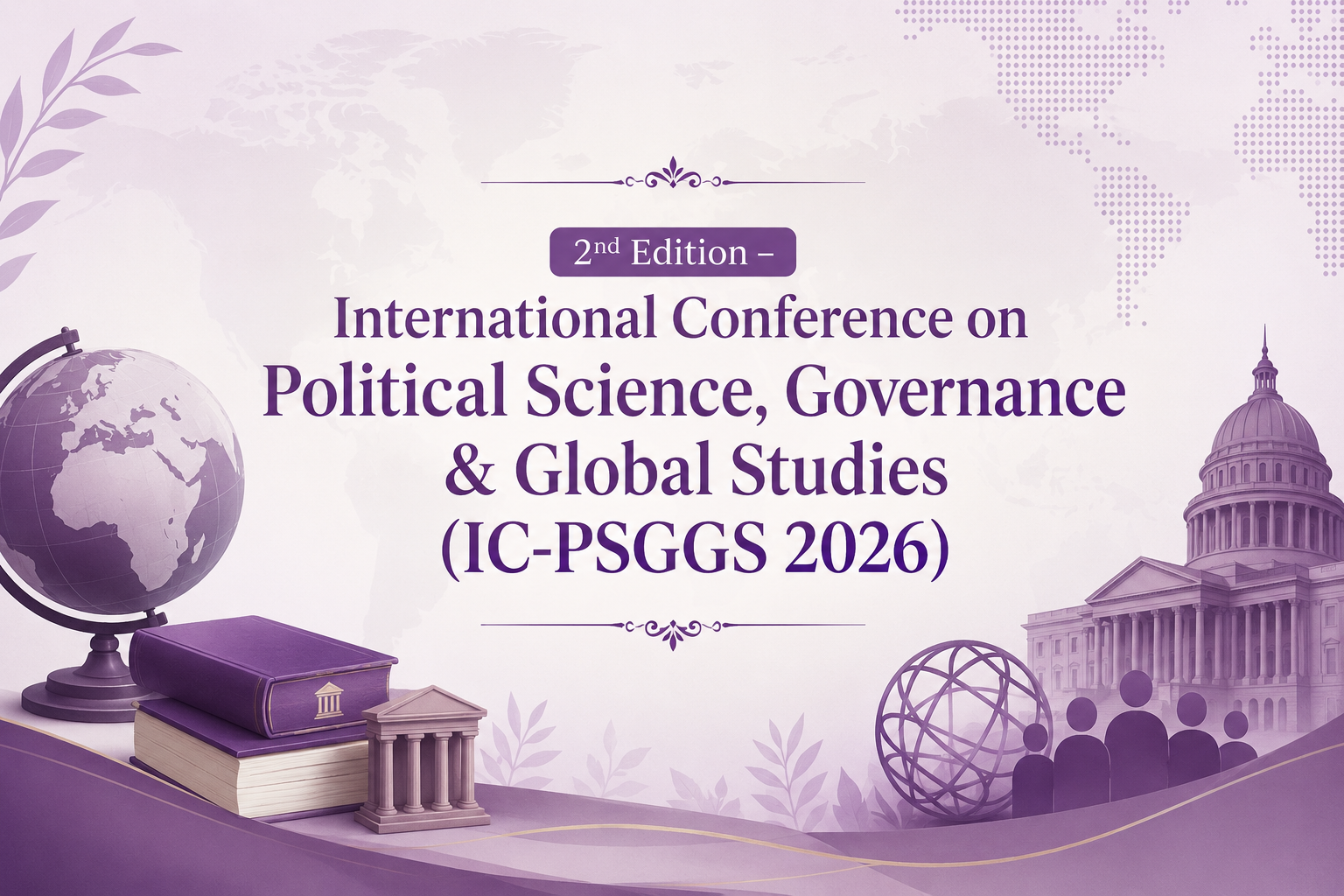
International Conference Governance brings together leading scholars and policymakers at IC-PSGGS 2026 to discuss the future of governance in a changing world.
International Conference Governance: Key Themes and Sessions
In an era defined by geopolitical uncertainty, digital transformation, climate challenges, and evolving public expectations, the relationship between politics and governance has never been more important. The Political Science Governance Global Studies community plays a critical role in helping societies understand complex global developments and design effective solutions.
The 2nd Edition International Conference on Political Science, Governance & Global Studies (IC-PSGGS 2026) arrives at a crucial moment when governments, researchers, policymakers, and international organizations are navigating unprecedented social, economic, and technological changes. This conference provides a global platform for academics, practitioners, students, and policymakers to exchange ideas, present research, and explore innovative approaches to governance and public policy.
As nations face growing challenges ranging from artificial intelligence regulation to climate governance and international security, conferences like IC-PSGGS 2026 offer opportunities to shape conversations that influence the future of societies worldwide.
Register here: https://onegrasp.com/events/social-sciences-humanities/2nd-edition-international-conference-on-political-science-governance-global-studies-ic-psggs-2026/
What the Conference Is About
IC-PSGGS 2026 is an international academic conference focused on political science, governance, public policy, international relations, and global studies.
The conference aims to bring together scholars, researchers, public administrators, diplomats, students, and policy professionals to discuss emerging issues affecting governance systems and global cooperation.
Political science conferences have increasingly expanded beyond traditional government studies to include topics such as digital governance, sustainable development, international diplomacy, cybersecurity policy, and global institutional reform. Similar global governance conferences highlight the growing need for interdisciplinary collaboration in addressing complex societal challenges.
Why Political Science Governance Global Studies Matters Today
Direct Answer: Political science and governance research help societies understand power structures, policy outcomes, institutional effectiveness, and global cooperation.
Today’s policymakers face challenges that are increasingly interconnected. Economic instability, migration, technological disruption, climate change, and international conflicts require coordinated governance approaches.
According to the United Nations Sustainable Development framework, effective institutions and good governance remain essential for achieving long-term social and economic progress.
Learn more about global governance and sustainable development initiatives at:
https://www.un.org/sustainabledevelopment
Moreover, the OECD regularly highlights the importance of public trust, institutional resilience, and evidence-based policymaking in modern governance systems:
These developments underscore why conferences dedicated to governance and political studies remain highly relevant.
Political Science Governance Global Studies Research Themes
Direct Answer: The conference covers a broad range of themes spanning governance, public administration, international relations, policy analysis, and global development.
Expected research areas include:
- Public Policy Analysis
- International Relations
- Comparative Politics
- Global Governance
- Diplomacy and Foreign Policy
- Public Administration
- Democracy and Political Institutions
- Human Rights
- Sustainable Development Governance
- Political Communication
- Digital Governance
- Geopolitical Studies
- Global Security
- Public Sector Innovation
Recent political science conferences worldwide increasingly emphasize interdisciplinary approaches combining political science, economics, sociology, technology, and environmental studies.
Governance, Public Policy, and Sustainable Development
Direct Answer: Effective governance is a cornerstone of sustainable development and institutional resilience.
The United Nations identifies strong institutions as one of the key drivers of sustainable progress through Sustainable Development Goal 16.
Governance frameworks influence:
- Public service delivery
- Economic development
- Social inclusion
- Environmental sustainability
- Crisis management
- Public trust
Research published by organizations such as the OECD and World Economic Forum consistently shows that transparent institutions contribute to stronger economic performance and societal stability.
For further insights:
Emerging Trends in Digital Transformation and Governance
Direct Answer: Digital technologies are reshaping governance, policymaking, and citizen engagement worldwide.
Governments increasingly adopt:
- Artificial Intelligence in public services
- Digital identity systems
- Smart city technologies
- Data-driven policymaking
- Digital public infrastructure
- Open government initiatives
According to research from McKinsey, governments investing in digital transformation often improve operational efficiency and citizen satisfaction.
Meanwhile, the rise of digital governance introduces new challenges involving privacy, cybersecurity, transparency, and accountability.
These issues are expected to be central topics of discussion at IC-PSGGS 2026.
Ethical Governance and Global Leadership
Direct Answer: Ethical governance ensures that technological and political innovation benefits society while protecting democratic values.
Political systems today face increasing scrutiny regarding:
- AI governance
- Digital rights
- Data privacy
- Government accountability
- Institutional transparency
- Democratic participation
Research into governance ethics has become particularly important as artificial intelligence and automated decision-making systems become integrated into public administration.
Recent scholarship examining global AI governance highlights growing international efforts to establish ethical standards and regulatory frameworks.
The conference provides an opportunity to discuss how governments can balance innovation with responsibility.
Opportunities for Researchers, Students, and Policymakers
The conference offers networking, collaboration, publication, and professional development opportunities.
Benefits include:
- Presenting original research
- Receiving expert feedback
- Building international collaborations
- Discovering funding opportunities
- Engaging with policymakers
- Exploring interdisciplinary research
For doctoral students and early-career researchers, conferences often serve as gateways to future academic partnerships and publication opportunities.
Many successful international research collaborations begin through conference networking sessions and panel discussions.
Career Benefits of Participating
Participation can provide substantial professional advantages.
Attendees may:
- Expand professional networks
- Increase academic visibility
- Improve research communication skills
- Access emerging policy debates
- Build international partnerships
- Enhance career opportunities
Employers and institutions increasingly value professionals who understand both local governance systems and global policy dynamics.
Expert Insight / Analysis
One of the most important developments in contemporary political science is the growing intersection between governance, technology, and sustainability.
Traditional governance models often focused on administrative efficiency and institutional design. Today, governments must simultaneously address digital transformation, cybersecurity risks, climate adaptation, social inclusion, and economic resilience.
This shift requires interdisciplinary thinking. Political scientists are no longer studying institutions in isolation. Instead, they examine complex socio-technical systems where policy, technology, economics, and public behavior interact continuously.
The long-term significance of IC-PSGGS 2026 lies in its ability to facilitate conversations that connect theoretical research with practical governance challenges. Such exchanges help bridge the gap between academic knowledge and real-world policymaking.
Latest Trends & Updates
Artificial intelligence governance has emerged as one of the fastest-growing research areas in political science and public administration. Governments worldwide are developing regulatory frameworks to address ethical and societal implications.

Digital public infrastructure initiatives are expanding across multiple countries, improving access to public services while creating new discussions around privacy, cybersecurity, and digital inclusion.

Climate governance continues to gain prominence as policymakers seek coordinated responses to environmental challenges, energy transitions, and sustainable development objectives.

Global institutions are increasingly focusing on resilience, emphasizing preparedness for economic shocks, geopolitical instability, public health crises, and technological disruption.

Public sector innovation is accelerating through data-driven decision-making, citizen participation platforms, and evidence-based policy approaches that improve governance outcomes.

International cooperation on cybersecurity, AI regulation, and digital governance is becoming a central theme in global policy discussions.

Researchers are increasingly examining how governance systems can balance technological innovation with democratic accountability, transparency, and public trust.
Real-Life Example / Mini Case Study
Consider a master’s student researching digital governance and citizen participation.
Initially, the student’s work focused solely on theoretical models of public administration. After attending an international governance conference, they participated in discussions involving policymakers, researchers, and technology experts.
Through these interactions, the student gained insights into practical challenges faced by governments implementing digital services. This experience inspired a collaborative research project examining citizen engagement in smart city initiatives.
The project later resulted in a publication and internship opportunity within a public policy research organization.
Traditional Governance vs Modern Governance
| Traditional Governance | Modern Governance |
|---|---|
| Hierarchical decision-making | Collaborative governance |
| Limited citizen engagement | Citizen-centered participation |
| Paper-based administration | Digital public services |
| Reactive policymaking | Data-driven policymaking |
| Isolated institutions | Networked governance ecosystems |
Beginner vs Expert Comparison
| Beginners | Experts |
|---|---|
| Focus on political theories | Apply systems thinking |
| Study isolated institutions | Analyze governance ecosystems |
| Examine policies individually | Evaluate policy interactions |
| Limited interdisciplinary view | Integrate economics, technology, and society |
| Focus on processes | Focus on long-term impact |
Pros and Cons
| Pros | Cons |
|---|---|
| Global networking opportunities | Requires preparation |
| Research exposure | Competitive environment |
| Policy engagement | Time commitment |
| Publication opportunities | Travel and registration costs |
| Career advancement | Requires active participation |
Common Mistakes to Avoid
Many participants fail to maximize conference value because of avoidable mistakes.
A common mistake is submitting abstracts without clearly demonstrating originality and policy relevance.
Another issue is focusing exclusively on theoretical discussions while ignoring practical implications and real-world applications.
Some attendees neglect networking preparation, missing opportunities to connect with researchers and policymakers.
Others overlook interdisciplinary perspectives, despite growing demand for research that integrates political science, technology, economics, and sustainability.
What to Do Next (Actionable Steps)
If you are considering participation:
- Review conference themes carefully.
- Identify a relevant research topic.
- Conduct a comprehensive literature review.
- Prepare a strong abstract.
- Register early.
- Develop a concise presentation.
- Research keynote speakers and panelists.
- Prepare networking goals.
- Follow current governance and policy trends.
- Stay engaged after the conference through professional networks.
Quick Checklist
✔ Select a research topic
✔ Review conference themes
✔ Prepare an abstract
✔ Complete registration
✔ Conduct literature review
✔ Develop presentation materials
✔ Prepare networking strategy
✔ Follow emerging governance trends
✔ Engage with policymakers and researchers
Conclusion
The 2nd Edition International Conference on Political Science, Governance & Global Studies (IC-PSGGS 2026) represents an important forum for exploring the evolving relationship between governance, public policy, technology, and global development.
As societies confront increasingly complex challenges, the need for evidence-based policymaking, ethical governance, and international collaboration continues to grow. Conferences like IC-PSGGS 2026 help researchers, practitioners, and policymakers exchange ideas that can shape the future of institutions and societies.
For students, scholars, and professionals seeking to contribute to meaningful policy discussions and governance innovation, this conference offers valuable opportunities to learn, collaborate, and advance their professional journey while contributing to solutions for some of the world’s most pressing challenges.
FAQ
Researchers, policymakers, students, academics, public administrators, and professionals interested in governance and global studies.
Yes. Students are encouraged to attend, present research, and network with experts.
No. Participants may attend as delegates, listeners, or presenters depending on conference guidelines.
Political science, governance, public policy, international relations, diplomacy, sustainability, and related interdisciplinary topics.
Participation can improve research visibility, expand professional networks, and create collaboration and publication opportunities.