Agriculture is rapidly evolving as climate change, food security concerns, environmental degradation, and population growth continue reshaping global farming systems. Traditional agricultural methods alone are no longer enough to meet rising food demands while protecting ecosystems and conserving natural resources.
Today, the sustainable agritech biotech farming field combines biotechnology, precision agriculture, climate science, AI-driven farming systems, and sustainable agricultural practices to create resilient and future-ready food production systems.
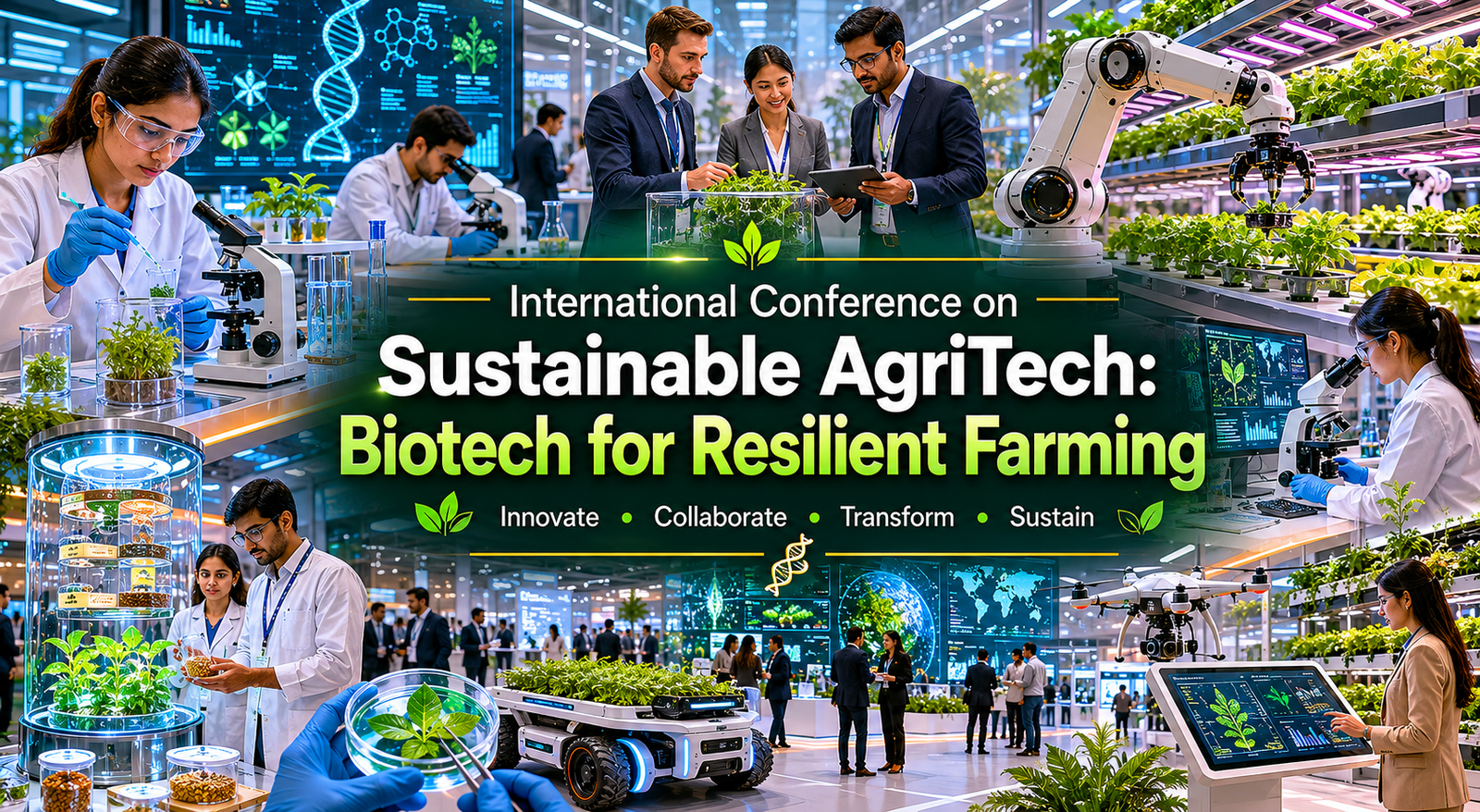
The International Conference on Sustainable AgriTech: Biotech for Resilient Farming provides a global academic platform where agricultural scientists, biotechnology researchers, environmental experts, agritech innovators, policymakers, sustainability professionals, educators, and students can explore cutting-edge advancements transforming modern agriculture.
Why Sustainable Agriculture and Biotechnology Matter Today
Global agriculture faces increasing pressure because of climate instability, soil degradation, water scarcity, biodiversity loss, and rising food demand.
These global agricultural challenges include:
Climate-driven crop failures
Soil nutrient depletion
Water resource shortages
Crop disease outbreaks
Food security concerns
Carbon emissions from farming
Declining biodiversity
Unsustainable fertilizer usage
Agricultural biotechnology and smart farming systems are helping researchers and farmers improve productivity while reducing environmental impact.
According to the Food and Agriculture Organization (FAO), climate-resilient agriculture and biotechnology innovation are becoming essential for ensuring long-term food security and sustainable agrifood systems. (FAOHome)
Meanwhile, interdisciplinary agritech research integrating AI, IoT, nanotechnology, genomics, and precision farming is rapidly transforming agricultural systems worldwide. (arXiv)
As a result, sustainable agriculture and biotechnology research are becoming increasingly important across environmental science, food systems, climate policy, engineering, and global development sectors.
What the Conference Focuses On
The International Conference on Sustainable AgriTech: Biotech for Resilient Farming focuses on climate-smart agriculture, biotechnology innovation, digital farming systems, and sustainable agricultural transformation.
Key conference themes often include:
Agricultural biotechnology and genomics
Precision and smart farming technologies
Climate-resilient crop systems
Sustainable food production
Biofertilizers and biopesticides
AI and IoT in agriculture
Soil microbiome and plant health
Regenerative agriculture systems
Agricultural sustainability and policy
Climate adaptation strategies
These discussions help researchers and agricultural professionals better understand how biotechnology and digital innovation can support resilient farming and long-term sustainability.
International agricultural conferences increasingly emphasize integrating biotechnology with sustainable farming to address climate challenges and environmental resilience. (TERI)
Sustainable AgriTech Biotech Farming in Modern Agriculture
The sustainable agritech biotech farming field has evolved significantly because of advances in AI, molecular biotechnology, climate modeling, precision agriculture, and environmental analytics.
Traditional farming systems often relied heavily on generalized agricultural practices and reactive crop management. However, modern agricultural innovation increasingly focuses on:
Precision nutrient management
Climate-smart agriculture
Genomics-assisted crop improvement
Bio-based agricultural inputs
Predictive farming analytics
Sustainable irrigation systems
AI-assisted crop monitoring
Smart environmental sensing
For example, biotechnology-based crop systems are helping improve drought tolerance, disease resistance, and nutrient efficiency in agricultural production.
Research presented at international biotechnology and agriculture conferences highlights how molecular breeding, genome editing, and smart agriculture technologies are improving agricultural resilience and sustainability. (Conference IPB University)
This transformation is reshaping farming systems and sustainable food production globally.
Why Climate-Resilient Farming Is Becoming Essential
Climate-resilient farming has become increasingly important because climate instability directly affects food production, water availability, and agricultural sustainability.
Modern climate-smart agriculture research commonly focuses on:
Drought-resistant crops
Water-efficient irrigation systems
Carbon-smart agriculture
Soil conservation strategies
Climate adaptation planning
Agroecological systems
Sustainable crop rotation
Biodiversity-focused farming
Meanwhile, governments and agricultural institutions are increasingly promoting resilient farming systems to improve environmental sustainability and food security.
For example, climate-resilient agriculture programs using regenerative farming methods, precision irrigation, and sustainable resource management are helping reduce environmental impact while improving crop productivity. (The Times of India)
This growing emphasis on resilience is transforming global agricultural policy and sustainability research.
Why Biotechnology Is Revolutionizing Agriculture
Biotechnology is rapidly improving modern farming systems by enhancing crop productivity, sustainability, and environmental resilience.
Modern agricultural biotechnology increasingly includes:
Genome editing technologies
Molecular crop breeding
Biofertilizers and biostimulants
Plant microbiome engineering
Nanobiotechnology in farming
Disease-resistant crop systems
Sustainable biopesticides
Soil microbiome management
Meanwhile, biotechnology-assisted farming systems are helping reduce chemical dependency and improve sustainable crop management.
According to international biotechnology research initiatives, next-generation agricultural biotechnologies can improve drought tolerance, disease resistance, and climate adaptability in crops. (FAOHome)
Researchers are also exploring microbial and nano-biotechnology solutions for sustainable agricultural transformation. (TERI)
As a result, biotechnology is becoming one of the most important drivers of sustainable agriculture and resilient food systems.
Why Technology Is Transforming Sustainable Farming
Technology is rapidly improving agricultural productivity, environmental monitoring, and resource optimization systems.
Modern sustainable farming increasingly includes:
AI-assisted crop management
Drone-based field surveillance
Smart irrigation systems
Satellite crop monitoring
IoT-enabled environmental sensors
Predictive climate analytics
Agricultural robotics
Blockchain-enabled traceability systems
Meanwhile, smart farming systems are helping farmers make faster and more accurate decisions while minimizing operational waste.
Research on sustainable precision agriculture shows that integrating AI, blockchain, IoT, machine learning, and biotechnology can improve disease control, crop monitoring, and resource efficiency. (arXiv)
Vertical farming and AI-driven controlled-environment agriculture are also emerging as sustainable solutions for future food systems. (arXiv)
This integration of biotechnology and digital agriculture is reshaping modern farming globally.
Why Virtual Conferences Are Important for Agricultural Innovation
Virtual conferences have significantly expanded global collaboration in agricultural science, biotechnology, sustainability, and agritech innovation.
Previously, many international agriculture conferences required expensive travel and limited participation opportunities. Today, online conferences allow researchers, agritech startups, environmental scientists, students, policymakers, and biotechnology professionals worldwide to collaborate more effectively.
This accessibility is especially valuable for:
Agricultural scientists
Biotechnology researchers
Agritech innovators
Sustainability professionals
Environmental researchers
Students and PhD scholars
Smart farming entrepreneurs
Virtual academic events also improve interdisciplinary dialogue around climate resilience, food security, sustainable farming, and biotechnology innovation.
As a result, online agriculture conferences are becoming increasingly important for scientific collaboration and technology exchange.
Call for Papers and Research Opportunities
The conference provides opportunities for participants to present original agricultural research, biotechnology innovations, climate adaptation frameworks, and smart farming systems.
Researchers can typically submit papers in areas such as:
Agricultural biotechnology
Sustainable farming systems
Precision agriculture technologies
Climate adaptation models
Smart irrigation systems
Soil and crop science
Biofertilizer and biopesticide research
AI in agriculture
Regenerative agriculture
Agricultural sustainability policy
Abstract Submission Guidelines
Participants are generally encouraged to submit:
A 300–350 word abstract
Author details and affiliations
Keywords
Research objectives and findings
Submissions commonly undergo peer-review evaluation before acceptance. Participants may also attend as listeners without presenting research papers.
Who Should Attend This Conference
This conference is valuable for professionals and researchers working across agriculture, biotechnology, sustainability, environmental science, agritech, and climate research sectors.
It is especially suitable for:
Agricultural scientists
Biotechnology researchers
Agritech engineers
Environmental scientists
Sustainability professionals
Climate researchers
Policymakers and rural development experts
Students and PhD scholars
Smart farming entrepreneurs
Even beginners can benefit because many sessions introduce foundational concepts related to biotechnology, climate-smart agriculture, digital farming, and sustainability systems.
Expert Insight / Analysis
Agriculture is becoming increasingly interdisciplinary because climate science, biotechnology, AI systems, environmental sustainability, and food security are deeply interconnected.
Experts now recognize that future farming systems must combine biotechnology innovation, AI-assisted agriculture, climate analytics, sustainable resource management, and resilient food production systems.
Meanwhile, genomics-assisted breeding, smart environmental sensing, predictive farming analytics, and regenerative agriculture frameworks are transforming agricultural systems globally.
However, long-term agricultural sustainability also depends heavily on environmental governance, farmer education, technology accessibility, and global climate adaptation strategies.
Institutions investing in sustainable agritech and biotechnology research today may significantly influence future food security systems and environmental resilience.
Latest Trends / Updates
AI-powered precision farming systems are improving crop monitoring and agricultural decision-making.

Biotechnology-assisted crop breeding is helping develop climate-resilient and disease-resistant crops.

Smart irrigation and IoT-based farming systems are reducing water waste and improving sustainability.

Biofertilizers and biostimulants are gaining importance as sustainable alternatives to chemical inputs.

Vertical farming and controlled-environment agriculture are emerging as future-ready food production systems.

Virtual agritech conferences are increasing interdisciplinary collaboration across biotechnology, sustainability, and smart farming sectors.
Common Mistakes to Avoid
Many agricultural systems and institutions make avoidable mistakes when approaching sustainable farming and biotechnology integration.
Common issues include:
Weak climate adaptation planning
Overreliance on traditional farming methods
Limited adoption of smart technologies
Poor soil sustainability management
Insufficient biotechnology integration
Weak interdisciplinary collaboration
Researchers and agricultural organizations can improve outcomes by integrating biotechnology, AI systems, environmental sustainability, and climate resilience into long-term agricultural strategies.
Real-Life Example / Mini Case Study
A farming cooperative experienced declining crop yields because of drought conditions, soil degradation, and inefficient fertilizer usage.
Initially, farmers relied mainly on conventional agricultural methods. However, operational costs and environmental stress continued increasing.
Researchers later introduced climate-resilient crop varieties, smart irrigation systems, microbial biofertilizers, AI-assisted crop monitoring, and precision nutrient management systems.
Within several growing seasons, water efficiency improved significantly while crop productivity and soil quality increased.
This example demonstrates how sustainable agritech and biotechnology systems can improve agricultural resilience and long-term sustainability.
Traditional Farming vs Sustainable AgriTech Systems
Traditional Farming
Sustainable AgriTech Systems
Generalized crop management
Precision farming analytics
High chemical dependency
Bio-based agricultural inputs
Manual monitoring systems
AI-assisted smart monitoring
Reactive farming practices
Predictive climate-smart farming
Resource-intensive irrigation
Smart water optimization
Pros and Cons of Virtual Agriculture Conferences
Pros
Cons
Global accessibility
Reduced field demonstrations
Lower participation costs
Limited practical interaction
Flexible learning opportunities
Time zone coordination challenges
Easier interdisciplinary collaboration
Technical connectivity issues
Wider access for researchers
Reduced face-to-face networking
Beginner vs Expert Approach in Sustainable Agriculture
Beginner Approach
Expert Approach
Focuses mainly on basic farming methods
Integrates biotechnology and AI systems
Limited sustainability awareness
Climate-smart strategic planning
Basic technology usage
Advanced precision agriculture systems
Passive conference participation
Active interdisciplinary collaboration
General crop management
Data-driven agricultural optimization
What to Do Next
If you are interested in sustainable agriculture, biotechnology, agritech innovation, or climate resilience research, begin preparing early for conference participation.
The International Conference on Sustainable AgriTech: Biotech for Resilient Farming highlights the growing importance of interdisciplinary agricultural research in improving sustainability, food security, climate adaptation, and smart farming systems.
As climate instability, population growth, environmental degradation, and food security pressures continue affecting global agricultural systems, biotechnology and sustainable agritech innovation will remain essential for future farming resilience. Conferences like this provide valuable opportunities for academic collaboration, professional networking, and global scientific knowledge exchange.
Whether you are an agricultural scientist, biotechnology researcher, agritech innovator, environmental expert, policymaker, sustainability professional, student, or entrepreneur, participating in this conference can deepen your understanding of modern sustainable agriculture while connecting you with a global network of farming and biotechnology experts.
FAQs
Yes, beginners can participate and learn foundational concepts related to biotechnology, smart farming, climate resilience, and sustainable agriculture systems.
Yes, participants may join as listeners without presenting papers.
Topics include agricultural biotechnology, climate-smart farming, AI in agriculture, precision farming systems, sustainable agriculture, and regenerative farming.
It helps improve food security, climate resilience, environmental sustainability, water efficiency, and long-term agricultural productivity.

 May 23, 2026
 10 Min
 No Comment