June 11, 2026
 8 Min
 No Comment
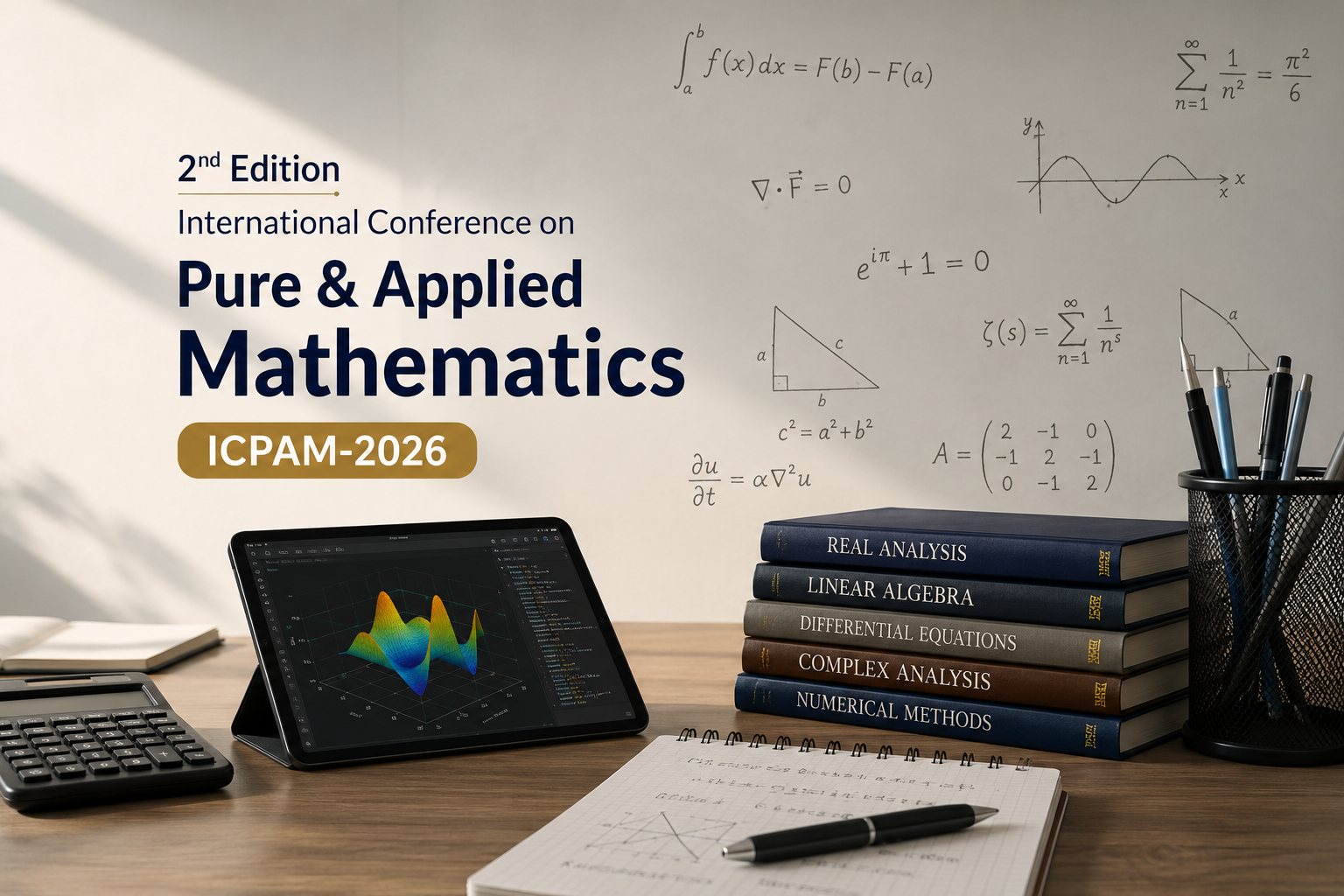
Mathematics is often called the universal language of science, and for good reason. From artificial intelligence and quantum computing to financial modeling and space exploration, mathematical principles form the foundation of modern innovation. The Pure Applied Mathematics Conference serves as an important platform where theoretical discoveries meet practical applications, creating opportunities for groundbreaking research and interdisciplinary collaboration.
The 2nd Edition International Conference on Pure & Applied Mathematics (ICP&AM-2026) brings together mathematicians, researchers, educators, scientists, engineers, and industry professionals to explore emerging developments across pure mathematics, applied mathematics, statistics, computational science, and mathematical modeling.
As global industries increasingly rely on mathematical solutions to solve complex challenges, conferences such as ICP&AM-2026 play a vital role in shaping future scientific and technological progress.
Researchers, students, and professionals interested in participating can Register Here: https://onegrasp.com/events/mathematics-data-science/2nd-edition-international-conference-on-pure-applied-mathematics-icpam-2026/
What the Conference Is About
Direct Answer: ICP&AM-2026 is an international conference dedicated to advancing research in pure mathematics, applied mathematics, computational methods, statistics, and interdisciplinary mathematical applications.
The conference provides a collaborative platform where researchers can present innovative findings, exchange ideas, and explore new approaches to mathematical challenges. International mathematics conferences continue to play a critical role in fostering collaboration between academia and industry while supporting the development of emerging mathematical technologies. (icpam.org)
Why Pure Applied Mathematics Conference Matters Today
Direct Answer: Mathematics drives innovation across science, engineering, technology, finance, healthcare, and countless other industries.
Modern advancements in artificial intelligence, machine learning, cybersecurity, climate modeling, and scientific computing depend heavily on mathematical frameworks. According to global research trends, interdisciplinary mathematics continues to expand rapidly as organizations increasingly use advanced analytics and computational techniques to solve real-world problems. (icamm2026.iiti.ac.in)
Moreover, mathematics serves as the foundation for emerging technologies that are transforming industries worldwide.
Pure Applied Mathematics Conference Research Areas
Direct Answer: The conference covers a wide range of mathematical disciplines spanning both theoretical and practical research.
Major themes include:
- Algebra and Number Theory
- Mathematical Analysis
- Differential Equations
- Topology and Geometry
- Numerical Analysis
- Probability and Statistics
- Mathematical Modeling
- Computational Mathematics
- Optimization Theory
- Scientific Computing
- Mathematical Physics
- Data Science and Analytics
- Artificial Intelligence Applications
- Operations Research
- Financial Mathematics
These topics reflect the increasing importance of mathematics in addressing scientific, industrial, and societal challenges.
The Growing Importance of Pure Mathematics
Direct Answer: Pure mathematics focuses on abstract concepts and theoretical frameworks that often become foundations for future technologies.
Historically, many mathematical discoveries initially appeared purely theoretical before finding transformative practical applications. Number theory, for example, became essential to modern cryptography and cybersecurity.
Current research in algebra, topology, geometry, and number theory continues expanding our understanding of mathematical structures while contributing to advancements across multiple scientific disciplines. Recent international mathematics conferences continue highlighting the significance of foundational research in shaping future innovation. (WikiCFP)
Applied Mathematics and Real-World Problem Solving
Direct Answer: Applied mathematics transforms theoretical concepts into practical solutions for complex challenges.
Applications include:
- Climate prediction models
- Financial risk management
- Engineering simulations
- Medical imaging
- Supply chain optimization
- Artificial intelligence systems
- Space mission planning
According to research institutions worldwide, applied mathematics remains one of the most impactful disciplines for solving large-scale societal and industrial problems. Computational methods and mathematical modeling are increasingly integrated into scientific research and technological development. (icamm2026.iiti.ac.in)
Mathematics, Artificial Intelligence, and Data Science
Direct Answer: Artificial intelligence and data science are heavily dependent on mathematical foundations.
Machine learning algorithms rely on:
- Linear algebra
- Probability theory
- Optimization methods
- Statistical analysis
- Computational mathematics
As AI adoption accelerates globally, demand for mathematical expertise continues growing. Organizations increasingly seek professionals capable of combining mathematical rigor with computational innovation.
The relationship between mathematics and emerging technologies represents one of the most exciting areas of modern research.
Pure Applied Mathematics Conference and Interdisciplinary Innovation
Direct Answer: Modern mathematical research increasingly intersects with multiple scientific disciplines.
Today’s mathematicians collaborate with experts in:
- Computer Science
- Physics
- Biology
- Economics
- Engineering
- Environmental Science
- Healthcare
This interdisciplinary approach enables researchers to tackle complex global challenges more effectively. Consequently, conferences like ICP&AM-2026 provide valuable opportunities for cross-disciplinary collaboration and knowledge exchange.
Opportunities for Researchers, Students, and Academics
Direct Answer: ICP&AM-2026 offers opportunities for publication, networking, collaboration, and professional growth.
Participants can:
- Present original research
- Learn from international experts
- Build academic partnerships
- Explore emerging mathematical trends
- Discover interdisciplinary applications
- Gain professional recognition
For students and early-career researchers, participation provides exposure to advanced research methodologies and global academic networks.
Interested participants can Join ICP&AM-2026 Here: https://onegrasp.com/events/mathematics-data-science/2nd-edition-international-conference-on-pure-applied-mathematics-icpam-2026/
Career Benefits of Participating
Participation can significantly enhance professional development.
Benefits include:
- Increased research visibility
- International networking opportunities
- Publication possibilities
- Academic collaboration
- Access to emerging research
- Career advancement opportunities
As mathematical expertise becomes increasingly valuable across industries, conference participation can strengthen both academic and professional prospects.
Expert Insight / Analysis
From an expert perspective, mathematics is entering a period of extraordinary relevance. While mathematics has always underpinned scientific progress, today’s challenges—from artificial intelligence and quantum computing to climate science and cybersecurity—require increasingly sophisticated mathematical solutions.
The long-term significance of ICP&AM-2026 lies in its ability to connect theoretical researchers with practitioners applying mathematical concepts in real-world contexts. Many future innovations will emerge from collaborations between pure mathematicians, applied researchers, and industry experts.
As computational capabilities continue expanding, mathematical research will remain central to scientific discovery and technological advancement.
Latest Trends & Updates
Artificial intelligence research is increasingly relying on advanced mathematical optimization techniques to improve model efficiency and accuracy.

Quantum computing is creating new opportunities for mathematicians working in algebra, cryptography, and computational theory.

Data science continues driving demand for expertise in probability, statistics, and mathematical modeling across multiple industries.

Researchers are developing more sophisticated numerical methods to solve complex scientific and engineering problems involving large-scale simulations.

Interdisciplinary mathematics is expanding rapidly, connecting mathematical research with biology, healthcare, environmental science, and economics.

Mathematical approaches to machine learning explainability are becoming increasingly important as organizations seek transparent AI systems.

Global research institutions are investing heavily in computational mathematics and scientific computing to support innovation across diverse sectors.
Real-Life Example / Mini Case Study
Consider a graduate student specializing in optimization theory.
Initially focused on theoretical research, the student attended a mathematics conference and connected with industry professionals working in logistics and supply chain management. Through these interactions, the student applied mathematical optimization techniques to improve transportation efficiency for a large organization.
The project resulted in measurable cost reductions, academic publications, and valuable industry collaborations, demonstrating how mathematical research can generate practical impact.
Pure Mathematics vs Applied Mathematics
| Pure Mathematics | Applied Mathematics |
|---|---|
| Focuses on abstract concepts | Solves practical problems |
| Develops mathematical theory | Applies existing theories |
| Explores fundamental structures | Addresses real-world challenges |
| Often theoretical in nature | Industry and research focused |
| Long-term innovation driver | Immediate practical impact |
Beginner vs Expert Comparison
| Beginners | Experts |
|---|---|
| Learn mathematical principles | Create new mathematical frameworks |
| Solve standard problems | Address open research questions |
| Focus on techniques | Develop methodologies |
| Study established theories | Advance mathematical knowledge |
| Apply existing models | Design innovative solutions |
Pros and Cons
| Pros | Cons |
|---|---|
| Access to advanced research | Requires strong mathematical background |
| Global networking opportunities | Competitive academic environment |
| Collaboration possibilities | Extensive preparation |
| Publication opportunities | Complex subject matter |
| Professional development | Broad range of topics |
Common Mistakes to Avoid
Many participants miss valuable opportunities due to avoidable mistakes.
One common error is focusing solely on a narrow specialization while ignoring interdisciplinary developments.
Another mistake is failing to prepare networking strategies before attending the conference.
Some researchers overlook practical applications of their work, limiting opportunities for collaboration and impact.
Others neglect emerging computational tools that are increasingly shaping mathematical research.
What to Do Next (Actionable Steps)
- Review conference themes carefully.
- Select a suitable research topic.
- Prepare an abstract or paper.
- Explore recent mathematical developments.
- Register early for participation.
- Connect with researchers in your field.
- Study interdisciplinary applications.
- Attend technical sessions and workshops.
- Build collaborative relationships.
- Continue research discussions after the conference.
Official Registration: https://onegrasp.com/events/mathematics-data-science/2nd-edition-international-conference-on-pure-applied-mathematics-icpam-2026/
Quick Checklist
✔ Review conference topics
✔ Prepare research abstract
✔ Complete registration
✔ Follow current mathematical research
✔ Explore computational tools
✔ Prepare presentation materials
✔ Network with experts
✔ Attend technical sessions
✔ Pursue collaboration opportunities
Conclusion
The 2nd Edition International Conference on Pure & Applied Mathematics (ICP&AM-2026) represents an important opportunity for researchers, educators, students, and industry professionals to engage with the latest developments in mathematical sciences.
As mathematics continues driving innovation across technology, science, healthcare, finance, and engineering, the value of interdisciplinary collaboration and advanced research becomes increasingly clear. Conferences such as ICP&AM-2026 help foster these connections while supporting the next generation of mathematical discoveries.
For anyone seeking to contribute to the advancement of mathematics and its applications, ICP&AM-2026 offers a valuable platform to learn, collaborate, and shape the future of scientific innovation.
Register Here: https://onegrasp.com/events/mathematics-data-science/2nd-edition-international-conference-on-pure-applied-mathematics-icpam-2026/
FAQ
Mathematicians, researchers, educators, students, engineers, data scientists, and professionals interested in mathematical sciences.
Yes. Students are encouraged to present research, attend sessions, and network with experts.
Topics include pure mathematics, applied mathematics, computational mathematics, statistics, optimization, and mathematical modeling.
No. Both beginners and experienced researchers can benefit from participation.
The conference provides research exposure, networking opportunities, collaboration possibilities, and professional development.