May 22, 2026
 10 Min
 No Comment
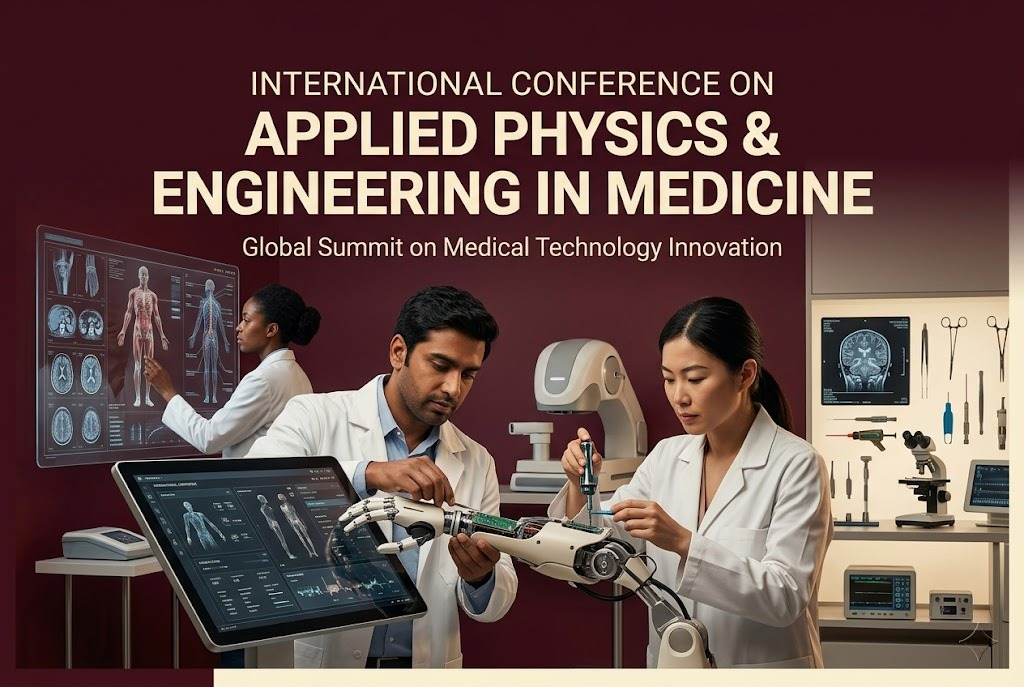
Healthcare innovation is evolving at an extraordinary pace as physics, engineering, artificial intelligence, and medical science increasingly work together to improve diagnosis, treatment, patient safety, and healthcare delivery. From advanced medical imaging systems and robotic surgery to biomedical sensors and radiation therapy technologies, interdisciplinary scientific collaboration is transforming modern medicine.
As a result, the applied physics engineering medicine field has become one of the most influential research areas in healthcare technology and medical innovation.
The International Conference on Applied Physics & Engineering in Medicine provides a global academic platform where physicists, biomedical engineers, healthcare professionals, researchers, scientists, clinicians, and technology innovators can discuss emerging healthcare technologies, interdisciplinary research, and the future of medical science.
Official registration page:
https://onegrasp.com/conference-events/international-conference-on-applied-physics-engineering-in-medicine/
Explore more international conferences and academic events here: https://onegrasp.com/events/
The conference promotes collaboration between medicine, physics, engineering, and computational science while encouraging innovation in healthcare systems and medical technology development. (Onegrasp)
Why Applied Physics and Engineering Matter in Modern Medicine
Modern healthcare increasingly depends on advanced scientific systems capable of improving diagnostic precision, treatment accuracy, patient monitoring, and medical efficiency.
Applied physics contributes to medical innovation through technologies such as:
- Medical imaging systems
- Radiation therapy
- Laser medicine
- Nuclear medicine
- Biomechanics
- Medical signal processing
Meanwhile, engineering helps design and optimize healthcare technologies including:
- Biomedical instrumentation
- Smart wearables
- AI-assisted diagnostics
- Robotic surgical systems
- Internet of Medical Things (IoMT)
- Computational healthcare systems
According to the International Conference on Physics in Medicine (ICPM 2025), medical physics and biomedical engineering continue playing critical roles in cancer management, radiology, nuclear medicine, and AI-driven healthcare technologies. (icpm-bmpa.com)
As healthcare systems become increasingly technology-driven, interdisciplinary collaboration between physics, engineering, and medicine is becoming essential for improving patient outcomes and healthcare accessibility.
What the Conference Focuses On
The International Conference on Applied Physics & Engineering in Medicine focuses on healthcare technologies, medical physics applications, biomedical engineering systems, computational medicine, and emerging medical innovations.
Key conference themes often include:
- Radiation physics and dosimetry
- Medical imaging systems (MRI, CT, PET, Ultrasound)
- Biomedical instrumentation and sensors
- Computational modeling in medicine
- Robotics and AI in healthcare
- Biomedical signal and image processing
- Smart wearables and IoMT systems
- Nanotechnology and drug delivery systems
- Biomechanics and human motion analysis
- Health physics and safety management
These discussions help researchers and healthcare professionals improve healthcare technologies, medical diagnostics, and patient treatment systems. (Onegrasp)
Applied Physics Engineering Medicine in Modern Healthcare
The applied physics engineering medicine field has evolved rapidly due to advances in digital healthcare, AI systems, precision medicine, and biomedical instrumentation.
Traditional healthcare systems often relied heavily on manual diagnostics and limited computational analysis. However, modern medicine increasingly depends on data-driven technologies and interdisciplinary scientific innovation.
Today’s healthcare environments integrate:
- AI-powered diagnostic systems
- Advanced imaging technologies
- Computational disease modeling
- Robotic surgical assistance
- Smart monitoring devices
- Radiation therapy optimization systems
For example, medical imaging technologies such as MRI, PET, and CT systems rely heavily on principles of applied physics and signal processing engineering.
Similarly, biomedical engineers design advanced devices capable of real-time patient monitoring and personalized healthcare analysis.
According to research presented at global applied physics and biomedical conferences, future healthcare systems will increasingly depend on interdisciplinary collaboration between medicine, engineering, AI, and physics research. (sruconf.co.in)
The Growing Role of AI and Robotics in Medicine
Artificial intelligence and robotics are transforming healthcare at an unprecedented pace.
Modern AI systems now support:
- Medical image analysis
- Predictive diagnostics
- Personalized treatment planning
- Surgical robotics
- Patient monitoring systems
- Healthcare data analytics
Meanwhile, robotics technologies are improving precision in minimally invasive surgeries, rehabilitation systems, and automated healthcare processes.
According to medical technology research, AI-assisted diagnostics and computational healthcare systems may significantly improve healthcare efficiency and reduce diagnostic errors over the next decade. (Onegrasp)
However, these technologies also create challenges related to:
- Ethical AI usage
- Data privacy
- Clinical validation
- Healthcare accessibility
- Safety standards
- Regulatory compliance
This is why conferences focusing on applied medical physics and healthcare engineering are becoming increasingly important worldwide.
Why Medical Imaging and Radiation Physics Are Critical
Medical imaging and radiation physics remain central pillars of modern healthcare systems.
Advanced imaging systems allow clinicians to diagnose diseases earlier, monitor treatment effectiveness, and improve patient care accuracy.
Key technologies discussed in modern healthcare conferences include:
- Magnetic Resonance Imaging (MRI)
- Computed Tomography (CT)
- Positron Emission Tomography (PET)
- Ultrasound systems
- Radiation therapy technologies
- Nuclear medicine applications
Radiation physics also plays a major role in cancer treatment, medical safety protocols, and radiation dosage optimization.
According to ICPM 2025 conference discussions, radiation oncology and medical imaging continue evolving through AI integration, precision therapy systems, and advanced computational analysis. (icpm-bmpa.com)
As a result, interdisciplinary expertise in physics, engineering, and medicine is becoming increasingly valuable in healthcare careers.
Why Virtual Conferences Are Expanding Global Healthcare Collaboration
Virtual conferences have transformed access to global scientific and medical collaboration.
Previously, international medical conferences often required expensive travel and limited participation opportunities. Today, online conferences allow researchers, clinicians, engineers, and students worldwide to collaborate more efficiently.
This accessibility is especially valuable for:
- Medical researchers
- Biomedical engineers
- Healthcare professionals
- Graduate students and PhD scholars
- Scientists from developing countries
- Interdisciplinary healthcare innovators
Virtual conferences also encourage collaboration between healthcare, engineering, physics, AI, and biotechnology sectors.
According to Harvard Business Review, digital collaboration environments continue improving international scientific networking and interdisciplinary knowledge exchange.
https://hbr.org/2020/06/what-it-takes-to-run-a-great-virtual-meeting
As a result, medical innovation communities are becoming increasingly interconnected globally.
Call for Papers and Research Opportunities
The conference provides opportunities for participants to present original research, medical technologies, computational models, healthcare innovations, and interdisciplinary scientific applications.
Researchers can typically submit papers in areas such as:
- Radiation therapy and dosimetry
- Biomedical instrumentation systems
- Medical imaging technologies
- AI applications in healthcare
- Computational medicine
- Smart healthcare devices
- Biomedical signal processing
- Nanotechnology in medicine
- Robotics and healthcare automation
- Health physics and medical safety systems
Abstract Submission Guidelines
Participants are generally encouraged to submit:
- A 300–350 word abstract
- Author details and affiliations
- Keywords
- Research objectives and findings
Submissions typically undergo peer-review evaluation processes. Participants may also attend as listeners without presenting research papers. (Onegrasp)
Who Should Attend This Conference
This conference is valuable for professionals and researchers working across healthcare, engineering, medical physics, and technology sectors.
It is especially suitable for:
- Medical physicists
- Biomedical engineers
- Healthcare technology researchers
- Radiologists and clinicians
- AI healthcare specialists
- Biomedical instrumentation developers
- Graduate students and PhD scholars
- Medical imaging researchers
- Computational medicine scientists
Even beginners can benefit because many sessions introduce foundational concepts related to medical physics and healthcare engineering technologies.
Expert Insight / Analysis
Applied physics and engineering are becoming central drivers of healthcare transformation.
Experts increasingly recognize that future healthcare systems will depend heavily on interdisciplinary technologies capable of improving precision, automation, safety, and accessibility simultaneously.
Meanwhile, AI-assisted diagnostics, wearable healthcare systems, and smart biomedical devices are reshaping how healthcare is delivered globally.
However, innovation alone is not enough. Future healthcare technologies must also prioritize safety validation, regulatory compliance, ethical AI governance, and patient-centered system design.
Long-term, healthcare institutions investing in advanced medical technologies and interdisciplinary scientific collaboration may achieve major advantages in patient outcomes, operational efficiency, and medical innovation capability.
Latest Trends / Updates
AI-powered diagnostic systems are becoming increasingly common in radiology and medical imaging environments.

Wearable healthcare technologies and Internet of Medical Things (IoMT) systems are improving real-time patient monitoring.

Robotic-assisted surgery systems are expanding across hospitals and specialized healthcare centers worldwide.

Nanotechnology-based drug delivery systems are improving targeted treatment precision and reducing side effects.

Computational medicine and digital twin healthcare models are transforming disease prediction and personalized treatment planning.

Smart biomedical sensors are enabling faster, more accurate, and remote healthcare diagnostics.
Common Mistakes to Avoid
Many researchers and healthcare innovators make avoidable mistakes when developing medical technologies and interdisciplinary healthcare systems.
Common issues include:
- Weak clinical validation processes
- Ignoring healthcare safety standards
- Overreliance on AI without human oversight
- Limited interdisciplinary collaboration
- Poor regulatory compliance planning
- Inadequate patient-centered design considerations
Researchers can improve outcomes by combining engineering innovation with strong medical validation and healthcare ethics frameworks.
Real-Life Example / Mini Case Study
A hospital research team implemented an AI-assisted imaging platform designed to improve early cancer detection accuracy.
Initially, the system showed strong diagnostic performance in laboratory testing. However, clinical deployment revealed inconsistencies due to incomplete training data and workflow integration challenges.
The hospital collaborated with biomedical engineers, medical physicists, and clinicians to redesign the system using larger patient datasets and improved calibration standards.
Within one year, diagnostic accuracy improved significantly while reducing radiology workflow delays.
This example demonstrates how interdisciplinary collaboration between engineering, medicine, and applied physics can improve healthcare innovation outcomes.
Traditional Healthcare Systems vs Modern Technology-Driven Medicine
| Traditional Healthcare Systems | Modern Technology-Driven Medicine |
|---|---|
| Manual diagnostics | AI-assisted diagnostics |
| Limited patient monitoring | Real-time smart monitoring |
| Isolated healthcare systems | Connected digital healthcare ecosystems |
| Reactive treatment models | Predictive healthcare systems |
| Conventional imaging analysis | Advanced computational imaging |
Pros and Cons of Virtual Medical Conferences
| Pros | Cons |
|---|---|
| Global accessibility | Reduced face-to-face networking |
| Lower participation costs | Screen fatigue |
| Easier interdisciplinary collaboration | Time zone challenges |
| Flexible attendance | Technical connectivity issues |
| Wider student participation | Limited hands-on demonstrations |
Beginner vs Expert Approach in Medical Physics Research
| Beginner Approach | Expert Approach |
|---|---|
| Focuses mainly on theoretical concepts | Integrates clinical and engineering applications |
| Basic medical imaging knowledge | Advanced computational healthcare systems |
| Limited interdisciplinary awareness | Cross-sector healthcare collaboration |
| General healthcare discussions | Specialized medical technology research |
| Passive conference participation | Strategic research networking |
What to Do Next
If you are interested in medical physics, healthcare engineering, or biomedical innovation, begin preparing early for conference participation.
Actionable next steps include:
- Select a focused healthcare technology topic
- Explore recent AI healthcare developments
- Study medical imaging innovations
- Prepare a concise research abstract
- Participate in virtual networking sessions
- Collaborate with interdisciplinary researchers
Official registration page:
https://onegrasp.com/conference-events/international-conference-on-applied-physics-engineering-in-medicine/
Explore additional international conferences here: https://onegrasp.com/events/
Quick Checklist
- Choose a focused medical technology topic
- Review healthcare engineering trends
- Study AI and medical imaging innovations
- Prepare a strong abstract
- Participate in networking discussions
- Explore interdisciplinary collaboration
- Follow submission guidelines
- Connect with global healthcare researchers
Conclusion
The International Conference on Applied Physics & Engineering in Medicine highlights the growing importance of interdisciplinary scientific collaboration in transforming modern healthcare systems.
As healthcare increasingly depends on AI, advanced imaging technologies, biomedical engineering, and computational medicine, applied physics and engineering will remain central to future medical innovation. Conferences like this provide valuable opportunities for collaboration, research exchange, and global healthcare advancement.
Whether you are a researcher, clinician, biomedical engineer, physicist, student, or healthcare innovator, participating in this conference can deepen your understanding of emerging medical technologies while connecting you with a global network of healthcare and scientific professionals.
FAQs
Yes, beginners can participate and learn foundational concepts related to medical physics, biomedical engineering, and healthcare technology systems.
Yes, participants may join as listeners without presenting papers.
Topics include medical imaging, biomedical instrumentation, AI in healthcare, radiation physics, robotics in medicine, and computational healthcare systems.
Applied physics supports technologies such as MRI, CT scans, radiation therapy, and medical imaging systems that improve diagnosis and treatment accuracy.
Official registration link: https://onegrasp.com/conference-events/international-conference-on-applied-physics-engineering-in-medicine/