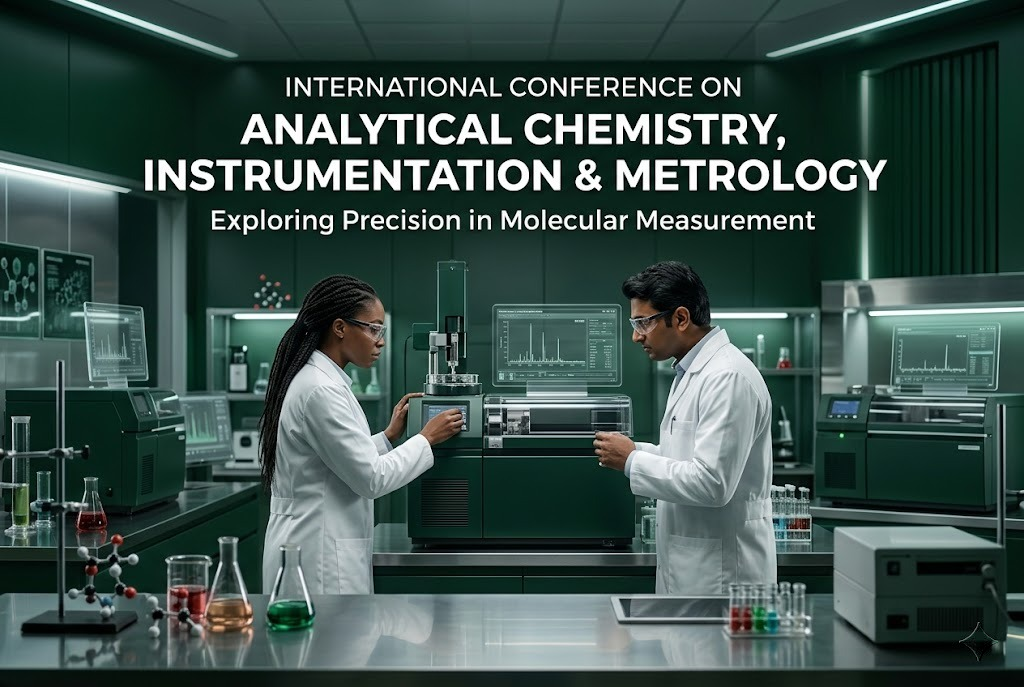
Scientific research and industrial innovation increasingly depend on accurate measurement, high-precision instrumentation, and reliable analytical systems. From pharmaceutical laboratories and environmental monitoring to food safety, biomedical diagnostics, and nanotechnology, analytical chemistry and metrology now play a central role in modern science and technology.
As industries demand faster, more precise, and highly automated laboratory systems, the analytical chemistry instrumentation metrology field has become one of the most important interdisciplinary research areas worldwide.
The International Conference on Analytical Chemistry, Instrumentation & Metrology provides a global academic platform where researchers, chemists, laboratory professionals, engineers, scientists, and industry experts can discuss modern analytical techniques, advanced instrumentation systems, calibration science, laboratory automation, and emerging trends in measurement technologies.
The conference encourages interdisciplinary collaboration while helping researchers and professionals improve scientific accuracy, laboratory innovation, and quality assurance systems.
Why Analytical Chemistry and Metrology Matter Today
Modern scientific research depends heavily on accurate analytical measurements.
Industries such as healthcare, pharmaceuticals, environmental science, biotechnology, energy, and food safety require highly reliable testing systems capable of delivering precise and reproducible results.
Analytical chemistry helps scientists identify chemical compositions, molecular structures, contaminants, and biological markers using advanced laboratory methods and instrumentation.
Meanwhile, metrology focuses on the science of measurement, calibration, accuracy, and quality assurance.
According to the IEEE International Instrumentation and Measurement Technology Conference (I2MTC), modern measurement science and instrumentation systems are becoming increasingly important across science, engineering, healthcare, energy, and industrial applications. (ieee-ims.org)
As industries continue adopting automation, AI-driven analytics, and nanotechnology, precision measurement systems are becoming even more essential.
What the Conference Focuses On
The International Conference on Analytical Chemistry, Instrumentation & Metrology focuses on laboratory innovation, precision measurement science, analytical technologies, instrumentation systems, and modern scientific applications.
Key conference themes often include:
Analytical chemistry methods and applications
Spectroscopy and chromatography technologies
Laboratory instrumentation systems
Calibration science and metrology
Chemical and biosensors
Nanotechnology in analytical science
Quality assurance and laboratory standards
Mass spectrometry and spectrometric analysis
Environmental and biomedical analysis
AI and automation in laboratory systems
These discussions help researchers and professionals improve laboratory accuracy, scientific reliability, and innovation across multiple industries.
Analytical Chemistry Instrumentation Metrology in Modern Science
The analytical chemistry instrumentation metrology field has evolved significantly due to advances in digital technologies, automation, and high-performance laboratory systems.
Traditional analytical laboratories often relied heavily on manual procedures and isolated testing systems. However, modern research environments now integrate:
AI-powered analytical platforms
Automated sample preparation systems
Smart laboratory instruments
Real-time monitoring technologies
High-throughput screening systems
Cloud-connected laboratory infrastructure
According to research presented at international instrumentation and analysis conferences, analytical chemistry increasingly combines chemistry, materials science, engineering, AI, and data analytics to improve scientific accuracy and efficiency. (Speciation)
This interdisciplinary approach is transforming both academic research and industrial laboratory operations.
The Growing Role of Advanced Instrumentation
Scientific instrumentation continues to advance rapidly across research and industrial sectors.
Modern analytical instruments now support extremely precise detection and measurement capabilities, allowing researchers to analyze molecular structures, contaminants, nanoparticles, biological systems, and environmental samples with unprecedented sensitivity.
Common technologies discussed in analytical chemistry conferences include:
Mass spectrometry
Chromatography systems
Electrochemical analysis
Spectroscopic methods
Biosensors and nanosensors
Lab-on-a-chip technologies
AI-assisted analytical systems
Automated calibration systems
According to the International Conference on Instrumental Methods of Analysis, modern analytical systems increasingly focus on miniaturization, smart automation, and interdisciplinary laboratory applications. (Speciation)
As a result, instrumentation research is becoming more connected to healthcare, environmental monitoring, food quality control, and advanced manufacturing.
Why Metrology Is Essential for Scientific Accuracy
Metrology ensures that scientific measurements remain reliable, reproducible, and internationally standardized.
Without strong metrology systems, laboratory results may become inconsistent, affecting research reliability, industrial manufacturing, medical diagnostics, and regulatory compliance.
Modern metrology research focuses on:
Calibration standards
Measurement uncertainty analysis
Precision testing systems
Instrument validation
International measurement standards
Quality control frameworks
Nanometrology
Digital metrology systems
According to the International Conference on Measurement of Energy (ICME 2026), modern metrology is increasingly important for energy systems, smart manufacturing, calibration technologies, and sustainability research. (Icme2026)
As scientific systems become more advanced, accurate measurement science remains critical for maintaining trust and consistency in research outcomes.
Why Virtual Conferences Are Important for Scientific Collaboration
Virtual conferences have transformed global scientific collaboration and knowledge sharing.
Previously, many international scientific conferences required expensive travel and limited participation opportunities. Today, online conferences allow researchers, laboratory professionals, students, and scientists worldwide to collaborate more efficiently.
This accessibility is especially valuable for:
Graduate students
Early-career researchers
Laboratory professionals
Scientists from developing countries
Independent researchers
Interdisciplinary research teams
Virtual conferences also encourage broader collaboration between chemistry, engineering, biotechnology, healthcare, and industrial research communities.
According to Harvard Business Review, digital collaboration environments continue improving global scientific networking and interdisciplinary research exchange. https://hbr.org/2020/06/what-it-takes-to-run-a-great-virtual-meeting
As a result, scientific research communities are becoming increasingly interconnected and collaborative.
Call for Papers and Research Opportunities
The conference provides opportunities for participants to present research papers, laboratory innovations, analytical methodologies, and instrumentation developments.
Researchers can typically submit papers in areas such as:
Spectrometric and chromatographic analysis
Laboratory automation systems
Biosensors and nanotechnology
Environmental and food analysis
Biomedical analytical chemistry
Quality assurance systems
AI applications in analytical science
Instrument calibration and validation
Advanced measurement systems
Metrology and standards development
Abstract Submission Guidelines
Participants are generally encouraged to submit:
A 300–350 word abstract
Author details and affiliations
Keywords
Research objectives and findings
Participants who do not wish to present papers may also attend as listeners.
Who Should Attend This Conference
This conference is valuable for professionals working across chemistry, laboratory science, engineering, healthcare, and industrial research sectors.
It is especially suitable for:
Analytical chemists
Laboratory scientists
Instrumentation engineers
Metrology researchers
Pharmaceutical researchers
Environmental scientists
Quality assurance professionals
Graduate students and PhD scholars
Biomedical researchers
Even beginners can benefit because many sessions introduce foundational analytical techniques and instrumentation concepts.
Expert Insight / Analysis
Analytical chemistry and metrology are becoming increasingly critical as industries rely more heavily on automation, precision manufacturing, and data-driven scientific systems.
Experts now recognize that future laboratory systems must combine speed, automation, precision, and regulatory reliability simultaneously.
Meanwhile, AI-powered analytical platforms and smart laboratory systems are improving efficiency while also introducing new challenges related to calibration, quality assurance, and validation.
Long-term, institutions and industries investing in advanced instrumentation and precision metrology may gain major advantages in research quality, innovation capability, and industrial competitiveness.
Latest Trends / Updates
AI-powered laboratory automation systems are becoming increasingly common in analytical chemistry research.

Miniaturized lab-on-a-chip devices are improving portability and efficiency in chemical analysis.

Advanced biosensors and nanosensors are expanding applications in healthcare diagnostics and environmental monitoring.

Digital metrology systems are improving calibration accuracy and measurement standardization worldwide.

Automation and robotics are transforming high-throughput laboratory testing environments.

Cloud-connected laboratory instruments are enabling real-time collaboration and remote scientific monitoring.
Common Mistakes to Avoid
Many researchers and laboratories make avoidable mistakes that reduce analytical accuracy and research reliability.
Common issues include:
Poor instrument calibration
Weak quality assurance procedures
Inadequate sample preparation
Overreliance on automation without validation
Ignoring measurement uncertainty analysis
Limited interdisciplinary collaboration
Researchers can improve outcomes by combining strong metrology practices with rigorous analytical validation systems.
Real-Life Example / Mini Case Study
A pharmaceutical laboratory introduced automated chromatography and AI-assisted analytical systems to improve drug quality testing efficiency.
Initially, the laboratory experienced inconsistencies due to calibration errors and incomplete validation protocols.
The research team responded by implementing advanced metrology standards, automated calibration routines, and stricter quality assurance frameworks.
Within one year, the laboratory significantly improved testing accuracy, reduced operational delays, and enhanced regulatory compliance.
This example demonstrates how instrumentation innovation and precision metrology work together to improve scientific reliability.
Traditional Laboratory Systems vs Modern Analytical Laboratories
Traditional Laboratory Systems
Modern Analytical Laboratories
Manual testing procedures
Automated analytical workflows
Limited data integration
AI-assisted data analysis
Standalone instruments
Connected smart laboratory systems
Basic calibration methods
Advanced digital metrology
Slower analytical processes
High-throughput automated analysis
Pros and Cons of Virtual Scientific Conferences
Pros
Cons
Global accessibility
Reduced in-person networking
Lower participation costs
Screen fatigue
Easier international collaboration
Time zone differences
Flexible attendance
Technical connectivity issues
Wider interdisciplinary interaction
Limited hands-on demonstrations
Beginner vs Expert Approach in Analytical Chemistry Research
Beginner Approach
Expert Approach
Focuses mainly on laboratory theory
Integrates instrumentation and metrology
Basic analytical techniques
Advanced multi-platform systems
Limited calibration awareness
Precision validation expertise
General chemistry discussions
Specialized measurement science
Passive conference participation
Strategic research collaboration
What to Do Next
If you are interested in analytical chemistry, instrumentation systems, or metrology research, begin preparing early for conference participation.
The International Conference on Analytical Chemistry, Instrumentation & Metrology highlights the growing importance of precision measurement, laboratory innovation, and advanced analytical systems in modern science and industry.
As research environments continue adopting AI, automation, and smart instrumentation technologies, metrology and analytical chemistry will remain essential for ensuring scientific accuracy, quality assurance, and technological advancement. Conferences like this provide valuable opportunities for collaboration, interdisciplinary innovation, and global scientific exchange.
Whether you are a researcher, laboratory professional, chemist, engineer, student, or industry expert, participating in this conference can deepen your understanding of analytical science while connecting you with a global network of scientific innovators and measurement specialists.
FAQs
Yes, beginners can participate and learn foundational concepts related to analytical chemistry, laboratory instrumentation, and metrology systems.
Yes, participants may join as listeners without presenting papers.
Topics include spectroscopy, chromatography, laboratory automation, metrology, biosensors, calibration science, and quality assurance systems.
Metrology ensures scientific measurements remain accurate, standardized, reproducible, and reliable across laboratories and industries.

 May 22, 2026
 9 Min
 No Comment