May 22, 2026
 9 Min
 No Comment
Modern engineering and industrial innovation increasingly depend on advanced materials capable of improving performance, durability, sustainability, and technological adaptability. From aerospace engineering and biomedical devices to smart electronics and renewable energy systems, advanced materials science is transforming how industries design products and solve complex engineering challenges.
As industries seek lighter, stronger, more intelligent, and environmentally sustainable materials, the polymer composite smart materials field has become one of the most important interdisciplinary research areas in modern science and engineering.
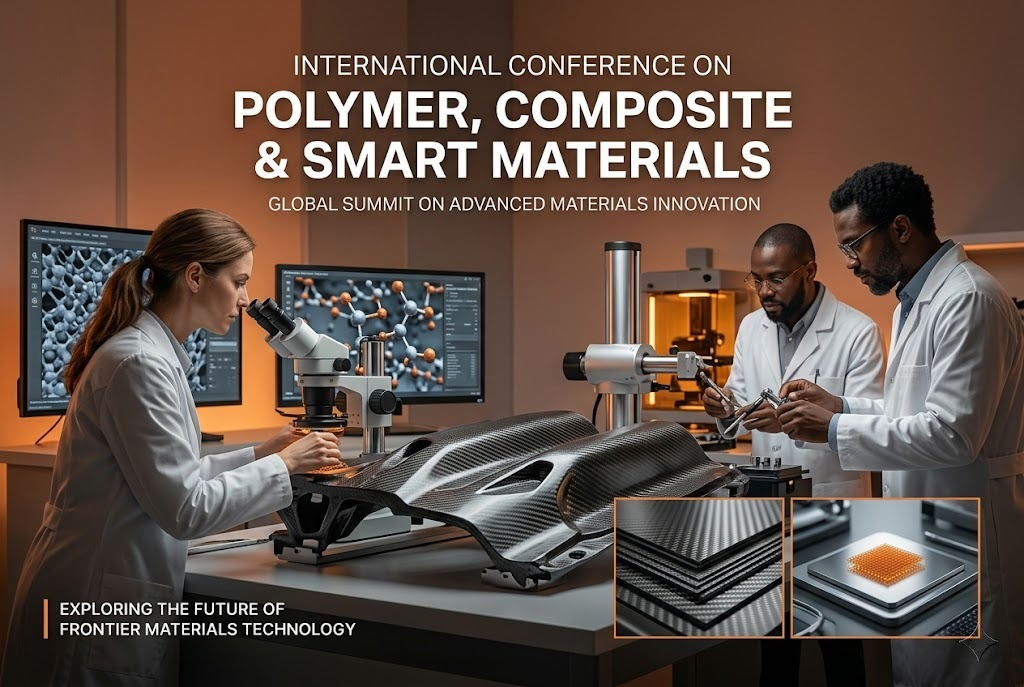
The International Conference on Polymer, Composite & Smart Materials provides a global academic platform where material scientists, engineers, researchers, industrial innovators, academicians, and technology professionals can discuss advanced material systems, nanotechnology applications, smart manufacturing, and the future of intelligent materials engineering.
Official registration page: https://onegrasp.com/events/physical-life-sciences/international-conference-on-polymer-composite-smart-materials/
Explore additional academic conferences and global events here: https://onegrasp.com/events/
The conference encourages interdisciplinary collaboration while supporting innovation in sustainable materials, high-performance composites, and intelligent engineering systems.
Why Polymer and Composite Materials Matter Today
Modern industries require materials that can perform under extreme conditions while remaining lightweight, durable, energy-efficient, and environmentally sustainable.
Traditional materials such as metals and conventional plastics often face limitations related to weight, corrosion, flexibility, and adaptability. However, advanced polymers and composite materials are helping industries overcome these challenges.
Polymer materials are widely used because of their:
- Lightweight properties
- Chemical resistance
- Design flexibility
- Electrical insulation capabilities
- Cost-effectiveness
- Durability
Meanwhile, composite materials combine multiple materials to create systems with enhanced mechanical, thermal, and structural performance.
According to materials science research from the American Chemical Society (ACS), advanced polymers and smart composite materials are playing increasingly important roles in aerospace, automotive engineering, electronics, healthcare, and renewable energy technologies.
https://www.acs.org/
As a result, industries worldwide are investing heavily in advanced materials innovation and smart manufacturing systems.
What the Conference Focuses On
The International Conference on Polymer, Composite & Smart Materials focuses on advanced materials engineering, nanotechnology, smart material systems, sustainable material innovation, and industrial applications.
Key conference themes often include:
- Polymer science and engineering
- Composite material technologies
- Smart and functional materials
- Nanomaterials and nanotechnology
- Sustainable material systems
- Biomaterials and biomedical applications
- Aerospace and automotive composites
- Smart coatings and sensors
- Energy storage materials
- Additive manufacturing and 3D printing
These discussions help researchers and industries improve material performance, sustainability, and technological innovation across multiple sectors.
Polymer Composite Smart Materials in Modern Engineering
The polymer composite smart materials field has evolved rapidly due to advances in nanotechnology, automation, AI-driven manufacturing, and sustainable engineering systems.
Traditional engineering materials often focused mainly on strength and cost efficiency. However, modern industries now require materials capable of adapting to environmental conditions, sensing structural changes, and improving energy efficiency.
Today’s advanced material systems may include:
- Self-healing polymers
- Shape-memory materials
- Conductive composites
- Smart coatings
- Nano-engineered polymers
- Lightweight aerospace composites
- Biodegradable material systems
For example, aerospace industries increasingly use carbon-fiber composites because they reduce aircraft weight while maintaining structural strength.
Similarly, biomedical engineers use smart polymers in drug delivery systems, wearable healthcare devices, and tissue engineering applications.
According to research published by the Materials Research Society (MRS), smart materials and functional composites are becoming essential for future energy systems, healthcare technologies, and intelligent manufacturing environments.
https://www.mrs.org/
This interdisciplinary approach is reshaping material science, industrial production, and product innovation globally.
The Growing Role of Smart Materials and Nanotechnology
Smart materials are designed to respond dynamically to environmental conditions such as temperature, pressure, electrical signals, magnetic fields, or mechanical stress.
These materials are increasingly used in:
- Robotics systems
- Aerospace engineering
- Smart infrastructure
- Biomedical devices
- Renewable energy systems
- Flexible electronics
- Wearable technologies
Nanotechnology further improves material performance by enhancing mechanical strength, electrical conductivity, thermal resistance, and chemical functionality at microscopic scales.
For example, nano-engineered composites can significantly improve energy storage systems used in electric vehicles and renewable energy technologies.
According to research from the National Institute of Standards and Technology (NIST), advanced materials and nanotechnology are expected to play major roles in future manufacturing systems and sustainable industrial development.
https://www.nist.gov/
As industries continue adopting smart manufacturing systems, intelligent material technologies will become increasingly important.
Why Sustainable Materials Are Becoming Essential
Sustainability has become a major priority in modern materials engineering.
Industries are increasingly seeking environmentally responsible alternatives to traditional manufacturing systems and non-recyclable materials.
Researchers are now developing:
- Biodegradable polymers
- Recyclable composites
- Green manufacturing materials
- Sustainable packaging systems
- Bio-based polymers
- Energy-efficient production methods
These innovations help reduce industrial waste, carbon emissions, and environmental impact while improving long-term resource efficiency.
According to global sustainability studies, sustainable materials engineering will become one of the most important drivers of industrial innovation over the next decade.
This is why conferences focused on smart materials and sustainable engineering are attracting increasing global attention.
Why Virtual Conferences Are Important for Materials Research
Virtual conferences have transformed global collaboration in materials science and engineering research.
Previously, many international engineering conferences required expensive travel and limited participation opportunities. Today, online conferences allow researchers, engineers, students, and industry professionals worldwide to collaborate more efficiently.
This accessibility is especially valuable for:
- Graduate students
- Early-career researchers
- Industrial engineers
- Materials scientists
- Researchers from developing countries
- Interdisciplinary innovation teams
Virtual conferences also encourage collaboration between chemistry, engineering, nanotechnology, manufacturing, healthcare, and sustainability sectors.
According to Harvard Business Review, digital collaboration systems continue improving international scientific networking and interdisciplinary research exchange.
https://hbr.org/2020/06/what-it-takes-to-run-a-great-virtual-meeting
As a result, global materials research communities are becoming increasingly interconnected and innovation-driven.
Call for Papers and Research Opportunities
The conference provides opportunities for participants to present original research, advanced material systems, industrial applications, and sustainable engineering innovations.
Researchers can typically submit papers in areas such as:
- Polymer engineering and chemistry
- Composite material systems
- Nanotechnology and nanocomposites
- Smart functional materials
- Sustainable materials engineering
- Biomedical material applications
- Additive manufacturing technologies
- Smart coatings and sensors
- Aerospace and automotive composites
- Energy storage materials
Abstract Submission Guidelines
Participants are generally encouraged to submit:
- A 300–350 word abstract
- Author details and affiliations
- Keywords
- Research objectives and findings
Participants who do not wish to present papers may also attend as listeners.
Who Should Attend This Conference
This conference is valuable for professionals and researchers working across engineering, materials science, nanotechnology, and industrial innovation sectors.
It is especially suitable for:
- Materials scientists
- Polymer engineers
- Composite materials researchers
- Nanotechnology specialists
- Aerospace engineers
- Biomedical engineers
- Manufacturing professionals
- Graduate students and PhD scholars
- Sustainability researchers
Even beginners can benefit because many sessions introduce foundational concepts related to polymers, composites, and smart materials technologies.
Expert Insight / Analysis
Advanced materials are becoming one of the most critical foundations of future industrial innovation.
Experts increasingly recognize that industries must develop materials capable of balancing performance, intelligence, sustainability, and cost efficiency simultaneously.
Meanwhile, AI-assisted material discovery systems and smart manufacturing technologies are accelerating innovation cycles across engineering sectors.
However, future material systems must also address challenges related to recyclability, environmental impact, manufacturing scalability, and regulatory compliance.
Long-term, industries investing in smart materials and sustainable composite technologies may gain major advantages in energy efficiency, manufacturing performance, and product innovation.
Latest Trends / Updates
AI-powered material discovery platforms are accelerating the development of advanced polymers and smart composite systems.

Self-healing materials and shape-memory polymers are gaining attention in aerospace and biomedical engineering.

Nano-engineered composites are improving energy storage systems for electric vehicles and renewable energy technologies.

Smart manufacturing and additive manufacturing technologies are reshaping industrial materials production.

Sustainable biodegradable polymers are becoming increasingly important in packaging and healthcare industries.

Flexible electronics and wearable smart materials are expanding rapidly across consumer technology sectors.
Common Mistakes to Avoid
Many researchers and manufacturers make avoidable mistakes when developing advanced material systems.
Common issues include:
- Ignoring scalability in laboratory research
- Weak sustainability planning
- Inadequate material testing procedures
- Limited interdisciplinary collaboration
- Poor manufacturing integration strategies
- Overlooking recyclability and lifecycle analysis
Researchers can improve outcomes by combining innovation with strong engineering validation and sustainability frameworks.
Real-Life Example / Mini Case Study
An automotive manufacturer introduced lightweight carbon-fiber composite materials to improve electric vehicle efficiency and battery performance.
Initially, production costs and manufacturing complexity created operational challenges.
The company collaborated with materials scientists and manufacturing engineers to redesign production workflows using automated composite fabrication systems and recyclable polymer technologies.
Within two years, the manufacturer reduced vehicle weight, improved energy efficiency, and lowered long-term production costs.
This example demonstrates how smart materials and advanced composites can drive industrial innovation and sustainability simultaneously.
Traditional Materials vs Smart Material Systems
| Traditional Materials | Smart Material Systems |
|---|---|
| Static material behavior | Adaptive and responsive behavior |
| Heavier structural systems | Lightweight high-performance systems |
| Limited functionality | Multi-functional intelligent materials |
| Conventional manufacturing | Smart automated production |
| Lower energy efficiency | Enhanced sustainable performance |
Pros and Cons of Virtual Engineering Conferences
| Pros | Cons |
|---|---|
| Global accessibility | Reduced hands-on demonstrations |
| Lower participation costs | Limited face-to-face networking |
| Flexible attendance | Time zone challenges |
| Easier international collaboration | Technical connectivity issues |
| Wider student participation | Reduced informal discussions |
Beginner vs Expert Approach in Materials Research
| Beginner Approach | Expert Approach |
|---|---|
| Focuses mainly on material theory | Integrates industrial applications |
| General polymer discussions | Specialized smart material systems |
| Limited sustainability analysis | Lifecycle and recyclability evaluation |
| Basic laboratory testing | Advanced performance optimization |
| Passive conference participation | Strategic research collaboration |
What to Do Next
If you are interested in polymers, smart materials, nanotechnology, or advanced engineering systems, begin preparing early for conference participation.
Actionable next steps include:
- Select a focused materials research topic
- Explore recent nanotechnology developments
- Study sustainable manufacturing trends
- Prepare a concise research abstract
- Participate in virtual networking sessions
- Collaborate with interdisciplinary researchers
Official registration page:
https://onegrasp.com/conference-events/international-conference-on-polymer-composite-smart-materials/
Explore additional international conferences here: https://onegrasp.com/events/
Quick Checklist
- Choose a focused materials science topic
- Review smart materials trends
- Study nanotechnology innovations
- Prepare a strong abstract
- Participate in networking discussions
- Explore interdisciplinary collaboration
- Follow submission guidelines
- Connect with global materials researchers
Conclusion
The International Conference on Polymer, Composite & Smart Materials highlights the growing importance of advanced materials innovation in shaping the future of engineering, manufacturing, healthcare, aerospace, and sustainable technology systems.
As industries continue adopting AI-driven manufacturing, nanotechnology, and sustainable engineering practices, smart materials and advanced composites will remain essential for future industrial progress. Conferences like this provide valuable opportunities for interdisciplinary collaboration, scientific exchange, and global innovation.
Whether you are a materials scientist, engineer, researcher, student, or industrial innovator, participating in this conference can deepen your understanding of advanced materials technologies while connecting you with a global network of scientific and engineering professionals.
FAQs
Yes, beginners can participate and learn foundational concepts related to polymers, composites, and smart materials engineering.
Yes, participants may join as listeners without presenting papers.
Topics include polymer engineering, smart materials, nanotechnology, sustainable composites, biomedical materials, and additive manufacturing systems.
Smart materials can adapt to environmental changes and improve performance, efficiency, and functionality across multiple industrial applications.
Official registration link: https://onegrasp.com/conference-events/international-conference-on-polymer-composite-smart-materials/