May 22, 2026
 10 Min
 No Comment
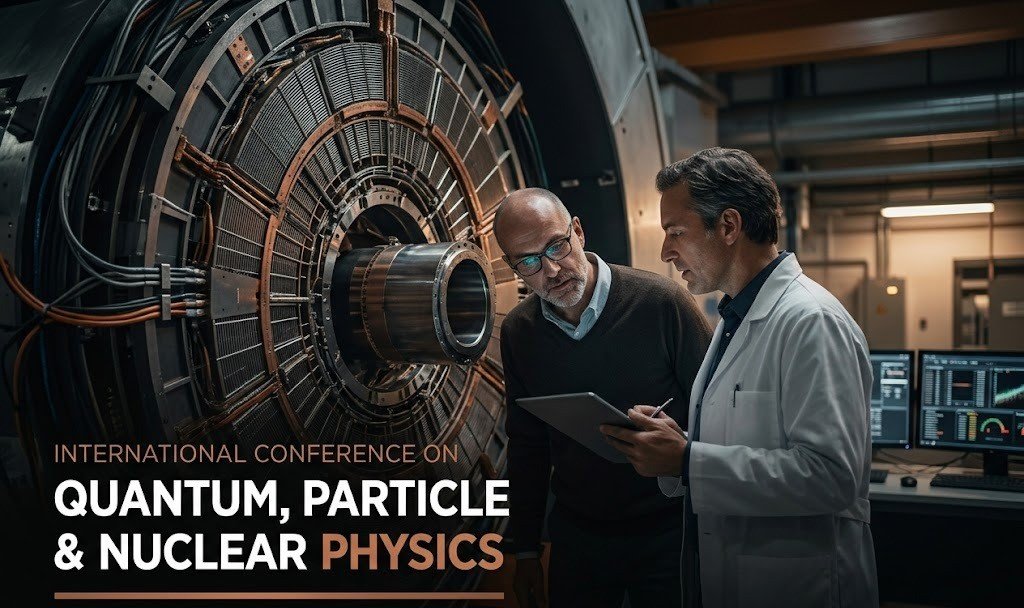
The universe continues to challenge humanity’s understanding of matter, energy, space, and time. From quantum entanglement and dark matter to nuclear fusion and particle accelerators, modern physics is exploring questions that could redefine science, technology, and the future of civilization itself.
As researchers push the boundaries of theoretical and experimental science, the quantum particle nuclear physics field has become one of the most advanced and intellectually transformative areas of modern research.
The International Conference on Quantum, Particle & Nuclear Physics provides a global academic platform where physicists, researchers, academicians, students, engineers, and scientific innovators can discuss breakthroughs in quantum mechanics, particle interactions, nuclear technologies, cosmology, and high-energy physics.
Official registration page: https://onegrasp.com/events/physical-life-sciences/international-conference-on-quantum-particle-nuclear-physics/
Explore additional international conferences and academic events here: OneGrasp Events
The conference promotes interdisciplinary scientific collaboration while encouraging innovation in theoretical physics, computational modeling, quantum technologies, and nuclear research. (Onegrasp)
Why Quantum Physics and Nuclear Research Matter Today
Modern physics is shaping technologies that were once considered purely theoretical.
Quantum mechanics now supports advances in:
- Quantum computing
- Quantum cryptography
- Precision sensing
- Quantum communication systems
- Semiconductor engineering
- Advanced materials science
Meanwhile, particle physics and nuclear science continue driving innovation in:
- Medical imaging technologies
- Nuclear energy systems
- Radiation therapy
- Particle accelerators
- Space science
- Cosmology research
According to the International Conference on High Energy Physics (ICHEP), particle physics remains one of the world’s most important scientific fields for understanding fundamental forces and the structure of matter. (Wikipedia)
As governments and research institutions increase investment in quantum technologies and nuclear science, interdisciplinary physics research is becoming increasingly important worldwide.
What the Conference Focuses On
The International Conference on Quantum, Particle & Nuclear Physics focuses on advanced theoretical physics, experimental particle science, quantum technologies, nuclear systems, and computational scientific innovation.
Key conference themes often include:
- Quantum mechanics and quantum field theory
- Particle physics and collider experiments
- Nuclear physics and atomic structure
- High-energy theoretical physics
- Quantum computing and information science
- Quantum optics and photonics
- Neutrino physics and dark matter research
- Relativity, cosmology, and astrophysics
- Nuclear fusion and fission systems
- Detector technologies and instrumentation
These discussions help researchers better understand the fundamental principles governing matter, energy, and the universe. (Onegrasp)
Quantum Particle Nuclear Physics and the Future of Science
The quantum particle nuclear physics field has evolved dramatically due to advances in computational modeling, experimental instrumentation, AI-assisted analysis, and quantum technology systems.
Traditional physics research often depended on isolated theoretical studies and limited experimental capabilities. However, modern physics increasingly integrates:
- Quantum simulation systems
- AI-driven particle analysis
- Supercomputing infrastructure
- Large Hadron Collider experiments
- Quantum communication technologies
- Nuclear energy modeling
- Advanced detector instrumentation
For example, CERN’s quantum technology initiatives are exploring how quantum systems can improve high-energy physics research, sensing technologies, and computational analysis. (Reddit)
Similarly, quantum computing research is opening new possibilities in cryptography, materials science, optimization systems, and computational physics.
This interdisciplinary approach is transforming both theoretical science and real-world technological innovation.
The Growing Role of Quantum Computing and Quantum Technologies
Quantum technologies are rapidly moving from experimental research into practical applications.
Modern quantum systems are now being explored for:
- Ultra-fast computing
- Secure communication systems
- Precision sensing
- Financial modeling
- Drug discovery
- Climate simulation
- Artificial intelligence acceleration
According to Quantum Physics and Logic conference research, mathematical and computational frameworks are becoming increasingly important in quantum information science and advanced physics systems. (arXiv)
Meanwhile, quantum-enabled technologies are expected to influence industries such as cybersecurity, healthcare, logistics, aerospace, and advanced manufacturing over the next decade.
However, major challenges still remain, including:
- Qubit stability
- Error correction systems
- Scalability limitations
- Hardware complexity
- High computational costs
This is why interdisciplinary collaboration between physicists, engineers, computer scientists, and mathematicians is becoming increasingly important.
Why Particle Physics and Collider Research Are Important
Particle physics helps scientists understand the most fundamental building blocks of the universe.
Modern collider experiments study:
- Subatomic particles
- Higgs boson interactions
- Dark matter theories
- Neutrino behavior
- Quantum field interactions
- Matter-antimatter asymmetry
Large research facilities such as CERN continue leading experimental discoveries that shape modern physics understanding.
According to international particle physics conferences, detector systems, accelerator technologies, and computational simulations are becoming increasingly advanced in high-energy experimental research. (Wikipedia)
As a result, particle physics research remains central to scientific discovery and advanced technological development.
Nuclear Physics and Future Energy Innovation
Nuclear physics continues playing a major role in energy research, medicine, national infrastructure, and industrial technologies.
Modern nuclear research focuses heavily on:
- Nuclear fusion systems
- Reactor safety
- Radiation science
- Medical isotope production
- Nuclear instrumentation
- Clean energy technologies
Researchers worldwide are exploring fusion energy systems capable of generating large-scale clean energy with reduced environmental impact.
Meanwhile, nuclear technologies remain essential for:
- Cancer treatment
- Industrial imaging
- Space exploration
- Scientific instrumentation
- Environmental monitoring
According to nuclear physics conference research, future nuclear innovation may significantly influence global energy sustainability and scientific infrastructure development. (icnpa2024du.in)
Why Virtual Conferences Are Important for Physics Research
Virtual conferences have transformed global scientific collaboration in advanced physics research.
Previously, many international scientific conferences required expensive travel and limited participation opportunities. Today, online conferences allow researchers, students, scientists, and academicians worldwide to collaborate more efficiently.
This accessibility is especially valuable for:
- Graduate students
- Early-career researchers
- Theoretical physicists
- Experimental scientists
- International research teams
- Scientists from developing countries
Virtual conferences also encourage interdisciplinary collaboration between physics, mathematics, engineering, computer science, and cosmology researchers.
According to research discussions within global quantum and particle physics communities, online scientific collaboration is helping expand access to advanced scientific knowledge and interdisciplinary networking. (Reddit)
As a result, virtual scientific communities are becoming increasingly important in global physics innovation.
Call for Papers and Research Opportunities
The conference provides opportunities for participants to present original research, theoretical models, computational simulations, and experimental findings.
Researchers can typically submit papers in areas such as:
- Quantum mechanics and quantum computing
- Nuclear reactions and fusion science
- Particle detector technologies
- Quantum optics and photonics
- Dark matter and neutrino physics
- Astrophysics and cosmology
- Computational and simulation physics
- Nuclear instrumentation systems
- High-energy particle interactions
- Relativity and advanced theoretical models
Abstract Submission Guidelines
Participants are generally encouraged to submit:
- A 300–350 word abstract
- Author details and affiliations
- Keywords
- Research objectives and findings
Submissions commonly undergo peer-review evaluation processes before acceptance. Participants may also attend as listeners without presenting papers. (Onegrasp)
Who Should Attend This Conference
This conference is valuable for professionals and researchers working across physics, engineering, computational science, and advanced technology sectors.
It is especially suitable for:
- Quantum physicists
- Nuclear physicists
- Particle physics researchers
- Computational scientists
- Quantum computing specialists
- Astrophysics researchers
- Engineering physicists
- Graduate students and PhD scholars
- Scientific instrumentation researchers
Even beginners can benefit because many sessions introduce foundational concepts related to quantum systems and particle physics research.
Expert Insight / Analysis
Quantum science and high-energy physics are increasingly influencing future technological innovation.
Experts now recognize that quantum computing, nuclear fusion systems, and particle research may reshape industries ranging from cybersecurity and healthcare to energy infrastructure and space exploration.
Meanwhile, AI-assisted physics simulations and advanced detector technologies are accelerating scientific discovery at unprecedented speeds.
However, long-term progress depends heavily on international scientific collaboration, advanced research infrastructure, and interdisciplinary education systems.
Institutions investing in quantum technologies and advanced physics research today may play major roles in future scientific and technological breakthroughs.
Latest Trends / Updates
Quantum computing systems are rapidly improving through advancements in qubit stability and quantum error correction technologies.

AI-assisted particle physics simulations are accelerating experimental analysis and theoretical modeling.

Nuclear fusion research is gaining global investment as scientists pursue cleaner large-scale energy solutions.

Quantum sensing and precision measurement technologies are expanding applications in medicine, defense, and space science.

Advanced particle detectors and collider instrumentation are improving high-energy experimental research capabilities.

Interdisciplinary collaboration between physics, AI, and computational science is reshaping modern scientific discovery.
Common Mistakes to Avoid
Many researchers and students make avoidable mistakes when approaching advanced physics research.
Common issues include:
- Weak mathematical foundations
- Limited computational skills
- Ignoring interdisciplinary collaboration
- Overlooking experimental validation
- Poor research communication
- Lack of networking within scientific communities
Researchers can improve outcomes by combining theoretical expertise with computational analysis, experimental understanding, and collaborative scientific engagement.
Real-Life Example / Mini Case Study
A university physics research group developed a quantum simulation platform designed to improve particle interaction modeling.
Initially, the project faced major computational limitations due to hardware instability and simulation complexity.
The team collaborated with quantum computing specialists, AI researchers, and theoretical physicists to optimize algorithms and improve simulation accuracy.
Within two years, the platform successfully improved large-scale particle interaction modeling efficiency while supporting advanced theoretical research.
This example demonstrates how interdisciplinary collaboration can accelerate scientific innovation in modern physics.
Traditional Physics Research vs Modern Computational Physics
| Traditional Physics Research | Modern Computational Physics |
|---|---|
| Manual theoretical calculations | AI-assisted simulations |
| Limited experimental analysis | Large-scale data-driven research |
| Isolated scientific disciplines | Interdisciplinary collaboration |
| Conventional detector systems | Advanced quantum instrumentation |
| Slower computational capabilities | High-performance supercomputing |
Pros and Cons of Virtual Physics Conferences
| Pros | Cons |
|---|---|
| Global accessibility | Reduced laboratory interaction |
| Lower participation costs | Limited face-to-face networking |
| Easier interdisciplinary collaboration | Time zone challenges |
| Wider student participation | Technical connectivity issues |
| Faster knowledge exchange | Limited experimental demonstrations |
Beginner vs Expert Approach in Physics Research
| Beginner Approach | Expert Approach |
|---|---|
| Focuses mainly on theory | Integrates theory and experimentation |
| Limited computational analysis | Advanced simulation expertise |
| Basic quantum concepts | Specialized high-energy research |
| Passive conference participation | Strategic scientific collaboration |
| General scientific discussions | Focused interdisciplinary innovation |
What to Do Next
If you are interested in quantum science, nuclear physics, or particle research, begin preparing early for conference participation.
Actionable next steps include:
- Select a focused physics research topic
- Explore recent quantum technology developments
- Study computational physics tools
- Prepare a concise research abstract
- Participate in virtual networking sessions
- Collaborate with interdisciplinary researchers
Official registration page: Register for the Conference
Explore additional international conferences here: Explore More Events
Quick Checklist
- Choose a focused physics topic
- Review quantum and nuclear research trends
- Strengthen computational physics skills
- Prepare a strong abstract
- Participate in networking discussions
- Explore interdisciplinary collaboration
- Follow submission guidelines
- Connect with global physics researchers
Conclusion
The International Conference on Quantum, Particle & Nuclear Physics highlights the growing importance of advanced physics research in shaping the future of science, technology, energy systems, and computational innovation.
As quantum technologies, nuclear research, and particle science continue advancing rapidly, interdisciplinary collaboration will remain essential for future discoveries and scientific breakthroughs. Conferences like this provide valuable opportunities for knowledge exchange, global networking, and cutting-edge research collaboration.
Whether you are a physicist, researcher, engineer, computational scientist, student, or technology innovator, participating in this conference can deepen your understanding of modern physics while connecting you with a global network of scientific experts and advanced research communities.
FAQs
Yes, beginners can participate and learn foundational concepts related to quantum mechanics, particle physics, and nuclear science.
Yes, participants may join as listeners without presenting papers.
Topics include quantum computing, particle physics, nuclear reactions, cosmology, quantum optics, and detector technologies.
Quantum physics supports emerging technologies such as quantum computing, quantum communication, precision sensing, and advanced materials science.
Official registration link: Conference Registration Page