Materials shape the modern world. From lightweight aircraft components and electric vehicle batteries to wearable health devices and biodegradable packaging, the performance of today’s technologies increasingly depends on advanced materials engineering. As industries pursue sustainability, durability, intelligence, and efficiency, the importance of Polymer Composite Smart Materials research continues to grow.
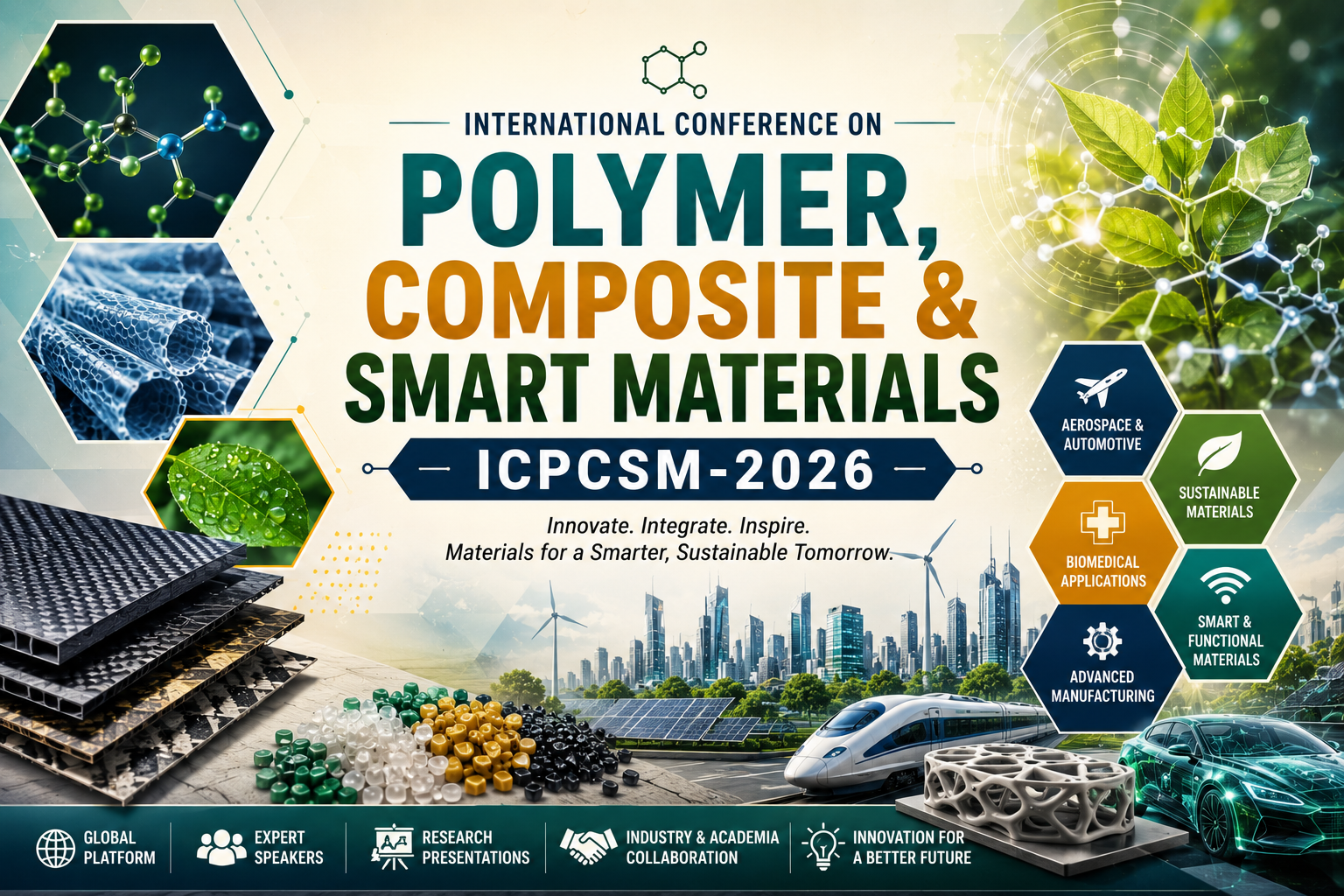
The International Conference on Polymer, Composite & Smart Materials (ICPCSM-2026) provides a global platform for scientists, engineers, industry professionals, and researchers to explore emerging developments in polymer science, composite engineering, and intelligent materials systems. The conference focuses on sustainable polymers, advanced composites, nanostructured materials, and smart materials capable of responding to environmental or mechanical changes.
The International Conference on Polymer, Composite & Smart Materials (ICPCSM-2026) focuses on innovations in polymer technology, composite engineering, nanomaterials, smart materials, sustainable manufacturing, and advanced materials applications across industries.
The conference aims to bridge academia and industry by creating opportunities for knowledge sharing and collaboration. Researchers and professionals will discuss breakthroughs in material design, performance optimization, manufacturing processes, and sustainability challenges.
As global industries seek stronger, lighter, smarter, and more sustainable materials, interdisciplinary collaboration becomes increasingly important. ICPCSM-2026 serves as a platform where material scientists, chemists, engineers, and industrial innovators can exchange ideas that may influence the next generation of products and technologies.
Polymer composite smart materials are transforming industries by offering lightweight structures, enhanced performance, environmental sustainability, adaptive functionality, and improved manufacturing efficiency.
The global demand for advanced materials continues to increase across aerospace, automotive, healthcare, electronics, renewable energy, and infrastructure sectors.
According to the World Economic Forum, sustainable innovation and advanced manufacturing technologies will play critical roles in achieving future economic growth and environmental goals.
Smart materials can respond to external stimuli such as temperature, pressure, light, moisture, or electric fields. This capability creates opportunities for self-healing materials, adaptive structures, intelligent sensors, and responsive medical devices.
As a result, material science is becoming a key driver of technological transformation worldwide.
Consequently, sustainable materials research is no longer optional—it is essential for future industrial competitiveness.
Digital Manufacturing and Advanced Materials
Featured Snippet Answer
Digital manufacturing technologies such as additive manufacturing and computational materials design are accelerating innovation in polymer and composite engineering.
Industry 4.0 technologies have transformed materials development.
Advanced simulation tools now allow researchers to predict material performance before physical production. Artificial intelligence and machine learning are increasingly used to optimize formulations and manufacturing processes.
According to McKinsey, digital technologies are accelerating product development cycles while reducing operational costs.
This combination of computational intelligence and advanced materials engineering is creating entirely new possibilities for innovation.
Career Benefits of Participating in ICPCSM-2026
Featured Snippet Answer
Participation in ICPCSM-2026 can enhance research visibility, expand professional networks, improve technical expertise, and create collaboration opportunities.
Conference participants benefit from:
Research publication opportunities
International networking
Industry-academia collaboration
Technical knowledge exchange
Career development
Professional recognition
Emerging technology exposure
The conference includes technical paper presentations, industry-academia discussions, a Young Innovator Forum, keynote sessions, and research-focused networking opportunities.
Students and early-career researchers can gain valuable exposure to emerging research directions and industrial challenges.
Expert Insight: The Future of Advanced Materials
The next decade will likely be defined by intelligent and sustainable materials systems.
Several major trends are expected to shape the future:
Self-healing materials
Bio-inspired materials engineering
Smart wearable technologies
Advanced energy storage materials
Sustainable composite systems
AI-driven materials discovery
Multifunctional nanocomposites
Research organizations worldwide are investing heavily in advanced materials because these innovations influence nearly every technological sector.
Harvard Business Review has highlighted how innovation ecosystems increasingly depend on interdisciplinary collaboration involving engineering, materials science, sustainability, and digital technologies.
Conferences such as ICPCSM-2026 play a crucial role in facilitating these collaborations.
Latest Trends & Updates
Artificial intelligence is increasingly transforming materials discovery. Machine learning models can now predict material properties, identify promising formulations, and accelerate experimentation processes that traditionally required years of laboratory work.
Sustainable polymers are becoming a major research priority. Scientists are developing bio-based alternatives that reduce dependence on petroleum-derived materials while maintaining performance standards required by industry.
Additive manufacturing continues to expand beyond prototyping. Advanced polymer and composite materials are enabling 3D printing applications in aerospace, healthcare, automotive engineering, and infrastructure development.
Smart wearable materials are gaining significant attention. Researchers are integrating sensors, conductive polymers, and flexible composites into wearable devices that monitor health, movement, and environmental conditions in real time.
Global policy initiatives focused on sustainability and carbon reduction are influencing materials innovation strategies. Governments and industries increasingly prioritize recyclable materials, circular economy principles, and environmentally responsible manufacturing practices.
Real-Life Example: A Sustainable Materials Research Project
Consider a postgraduate engineering student researching biodegradable packaging materials.
Initially, the project focused solely on polymer chemistry. After participating in a materials science conference, the student gained exposure to composite reinforcement techniques, lifecycle assessment methods, and sustainable manufacturing principles.
By combining these insights, the student developed a biodegradable composite material with improved mechanical performance and environmental benefits.
The research later attracted industry interest and resulted in collaborative opportunities with packaging manufacturers.
This example illustrates how conference participation can expand research impact and professional opportunities.
Traditional Materials vs Smart Materials
Traditional Materials
Smart Materials
Passive behavior
Adaptive behavior
Fixed functionality
Responsive functionality
Limited monitoring capability
Self-monitoring capability
Reactive maintenance
Predictive maintenance
Single-purpose design
Multifunctional design
Beginners vs Experts
Beginners
Experts
Learn material properties
Design material systems
Study individual polymers
Develop multifunctional composites
Focus on laboratory testing
Focus on industrial applications
Analyze performance
Optimize lifecycle impact
Explore concepts
Drive innovation strategies
Pros and Cons of Conference Participation
Pros
Cons
International networking
Time commitment
Research visibility
Competitive submissions
Publication opportunities
Registration costs
Industry engagement
Preparation requirements
Knowledge sharing
Technical complexity
Career advancement
Learning curve for newcomers
Common Mistakes to Avoid
Submitting Weak Abstracts
Ensure objectives, methodology, findings, and significance are clearly defined.
Ignoring Sustainability Dimensions
Modern materials research increasingly requires environmental considerations.
Focusing Only on Theory
Industry relevance and practical applications strengthen research impact.
Overlooking Interdisciplinary Collaboration
Materials innovation often requires expertise from chemistry, engineering, physics, and manufacturing.
Poor Networking Preparation
Identify key researchers and industry representatives before attending.
What To Do Next
To maximize conference participation:
Review conference tracks thoroughly.
Identify research gaps in your field.
Conduct a comprehensive literature review.
Prepare a high-quality abstract.
Register before deadlines.
Attend industry-academia discussions.
Participate in networking sessions.
Follow emerging smart materials trends.
Quick Checklist
✔ Select a research topic
✔ Prepare an abstract
✔ Verify submission guidelines
✔ Register before deadlines
✔ Review conference sessions
✔ Prepare presentation materials
✔ Research key speakers
✔ Build networking goals
Conclusion
The International Conference on Polymer, Composite & Smart Materials (ICPCSM-2026) highlights one of the most exciting areas of modern science and engineering. As industries demand smarter, lighter, stronger, and more sustainable materials, innovation in polymer science and composite technology will remain a critical driver of progress.
By bringing together researchers, engineers, students, and industry professionals, ICPCSM-2026 creates an environment where ideas become collaborations and research becomes real-world impact. Whether your interest lies in sustainable polymers, advanced composites, smart materials, or digital manufacturing, this conference offers valuable opportunities to learn, contribute, and advance your career in materials innovation.
FAQ
Researchers, students, engineers, chemists, materials scientists, manufacturing professionals, and industry innovators.
Yes. The conference specifically welcomes students and emerging researchers through dedicated research forums.
Topics include polymer science, smart materials, nanocomposites, sustainable materials, additive manufacturing, biomedical materials, and related fields.
Accepted abstracts may be included in indexed proceedings, depending on conference policies and review outcomes.
It provides networking opportunities, research visibility, publication exposure, industry engagement, and professional development.

 June 8, 2026
  8 Min
8 Min  No Comment