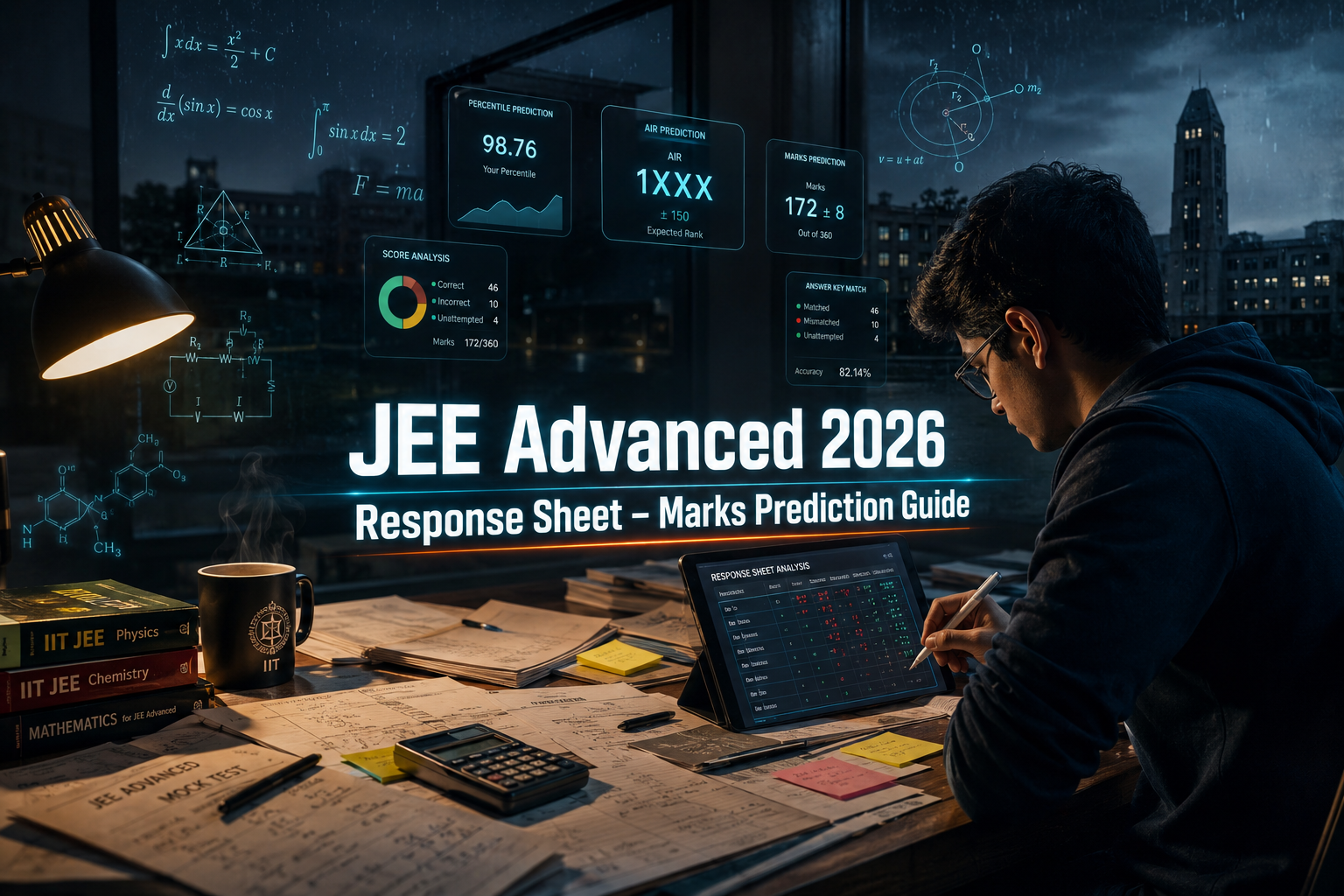
For thousands of IIT aspirants, the release of the JEE Advanced Response Sheet is often more emotional than the exam itself. The moment students log in and see their marked responses, reality starts replacing assumptions. Some feel relieved. Others panic instantly. Meanwhile, many begin obsessively calculating marks, predicting ranks, and estimating IIT chances within minutes.
This year, the pressure feels even higher.
The JEE Advanced 2026 response sheet was officially released on May 21, 2026, following the examination conducted by IIT Roorkee on May 17. Candidates can now compare their responses with the upcoming provisional answer key to estimate their scores before the final result declaration. (The Economic Times)
However, raw marks alone do not tell the full story.
Paper difficulty, normalization trends, competition intensity, and subject-wise performance patterns all influence the final rank outcome. That is exactly why smart analysis matters more than emotional reactions.
The response sheet is an official document released on the JEE Advanced portal showing the answers marked by candidates during the exam.
Students can use it to:
Verify attempted questions
Cross-check answers with the official key
Estimate probable marks
Predict approximate rank range
Prepare for JoSAA counselling early
According to updates published by major education portals, IIT Roorkee will release the provisional answer key on May 25, followed by the objection window and final result announcement on June 1, 2026. (IE Education)
Therefore, blindly estimating marks can become risky.
Several educational platforms have also released score calculators and prediction tools to help students estimate ranks more accurately. (Collegedunia)
JEE Advanced 2026 Paper Difficulty Analysis
One of the biggest reasons marks prediction becomes difficult is varying paper difficulty.
Initial student reactions across coaching institutes and online communities suggest:
Physics was lengthy and calculation-heavy
Chemistry felt tricky and unpredictable
Mathematics had mixed difficulty but manageable sections
Interestingly, many aspirants on Reddit and coaching discussion forums described the overall paper as comparable to tougher recent editions. Some students reported scoring significantly lower than their mock test averages. (Reddit)
This matters because tougher papers usually lower cutoff trends.
Meanwhile, experts are observing that accuracy, rather than attempts, may become the key differentiator in 2026.
Expected Marks vs Rank for JEE Advanced 2026
While official ranks will only be confirmed after results, early analysis and previous-year trends allow reasonable predictions.
Here’s an estimated marks vs rank projection based on current paper feedback and historical trends:
Expected Marks
Predicted Rank Range
280+
Under 500
250–280
500–1500
220–250
1500–3500
180–220
3500–7000
140–180
7000–12000
100–140
12000–20000
Below 100
Qualification depends on category cutoff
These are only estimated projections, not official rankings.
Recent reports from Careers360 and CollegeDekho also indicate that the marks-vs-rank curve may shift this year due to overall paper toughness and lower scoring patterns. (Careers360)
Why Students Often Misjudge Their Predicted Rank
One common mistake is assuming raw marks automatically translate into expected ranks.
That rarely happens accurately.
Here’s why:
Paper Difficulty Changes Every Year
A score of 150 in one year may produce a completely different rank in another year.
Competition Quality Is Increasing
Top aspirants now begin preparation much earlier with advanced test analytics and AI-powered platforms.
Negative Marking Impacts More Than Expected
Many students overestimate scores because they forget partial negative marking patterns.
Emotional Bias Distorts Analysis
After stressful exams, candidates often remember correct answers more clearly than mistakes.
As a result, predicted marks frequently differ from actual results.
Expert Insight: What 2026 Trends Reveal
From an expert perspective, JEE Advanced is gradually rewarding problem-solving maturity more than aggressive attempt strategies.
That shift is extremely important.
Earlier, students often attempted maximum questions aggressively. However, recent trends show that controlled accuracy is producing better ranks.
Educational analysts are also noticing:
More conceptual integration across chapters
Higher unpredictability in Chemistry
Increasing emphasis on multi-step reasoning
Reduced benefit from rote memorization
According to discussions emerging from student communities, many aspirants who scored 200+ consistently in mock tests struggled to maintain similar performance in the actual paper. (Reddit)
That suggests exam temperament is becoming just as important as preparation level.
Latest Trends & Updates
AI-powered rank prediction tools are becoming increasingly popular among JEE aspirants in 2026.

Many coaching institutes now use live response-sheet analytics to estimate cutoff shifts within hours of release.

Students are also relying heavily on crowd-sourced marks vs rank discussions across Reddit, Telegram, and YouTube communities.

Another emerging trend is early JoSAA planning before final results, helping students reduce counselling confusion later.

Meanwhile, advanced mock-test ecosystems are training aspirants to optimize accuracy instead of maximizing blind attempts.
Common Mistakes to Avoid After Checking the Response Sheet
Panic Calculating
Many students repeatedly calculate marks every few minutes, increasing stress unnecessarily.
Trusting Random Rank Predictors
Not every online predictor uses accurate datasets.
Ignoring Category-Wise Cutoffs
Different categories have significantly different qualification thresholds.
Comparing Marks Excessively
Social media comparisons often create unnecessary anxiety.
Delaying JoSAA Research
Students should start researching IIT branches and cutoff trends immediately after score estimation.
Real-Life Example: How One Student Used Early Analysis Smartly
A student from Hyderabad scored approximately 165 marks in JEE Advanced 2025 and initially felt disappointed after seeing social media discussions predicting high cutoffs.
Instead of panicking, he carefully analyzed:
Previous year trends
Subject difficulty
Expected normalization patterns
JoSAA opening-closing ranks
Eventually, he secured admission into a strong engineering branch at a second-generation IIT through strategic counselling choices.
His experience highlights an important lesson:
Marks matter, but smart decision-making after the exam matters too.
Beginner vs Expert Response Sheet Analysis
Beginner Approach
Expert Approach
Emotional reactions
Data-driven analysis
Checks social media rumors
Uses official sources
Predicts unrealistic ranks
Considers difficulty trends
Panics after low marks
Evaluates broader context
Ignores counselling planning
Starts JoSAA research early
Pros and Cons of Early Marks Prediction
Pros
Cons
Reduces uncertainty
Can create stress
Helps counselling preparation
Predictions may be inaccurate
Gives realistic expectations
Social media rumors spread panic
Allows strategy adjustments
Emotional comparison affects confidence
Encourages early planning
Overanalysis causes anxiety
What to Do Next After Calculating Your Marks
If you have already estimated your score, follow these next steps carefully:
Save a copy of your response sheet
Compare only with official answer keys
Track provisional cutoff trends
Research IIT branch cutoffs
Prepare JoSAA counselling documents
Avoid excessive social media speculation
Keep backup college options ready
Most importantly, stay emotionally balanced until official ranks are announced.
Quick Checklist
Download response sheet safely
Verify all attempted questions
Calculate marks accurately
Check official answer key only
Track expected cutoff trends
Research IIT options early
Prepare JoSAA strategy
Stay calm and avoid panic comparisons
Conclusion
The release of the JEE Advanced Response Sheet marks the beginning of one of the most emotionally intense phases for IIT aspirants. However, this stage should not be driven by panic or rumors. Smart analysis, realistic expectations, and strategic planning matter far more than emotional reactions.
JEE Advanced 2026 appears to have followed a tougher and more analytical pattern compared to what many students expected. Therefore, raw marks alone may not reflect actual rank outcomes accurately.
Focus on verified data, official updates, and structured counselling preparation. Whether your estimated marks feel excellent or disappointing today, remember that smart decisions after the exam can still shape an exceptional engineering future.
FAQs
The response sheet was released on May 21, 2026.
You can calculate marks by comparing your responses with the official answer key and applying the marking scheme correctly.
Predictions are approximate and depend heavily on paper difficulty and competition trends.
The final result is expected on June 1, 2026.
Yes. Early counselling research helps candidates make smarter admission decisions later.

 May 21, 2026
 7 Min
 No Comment