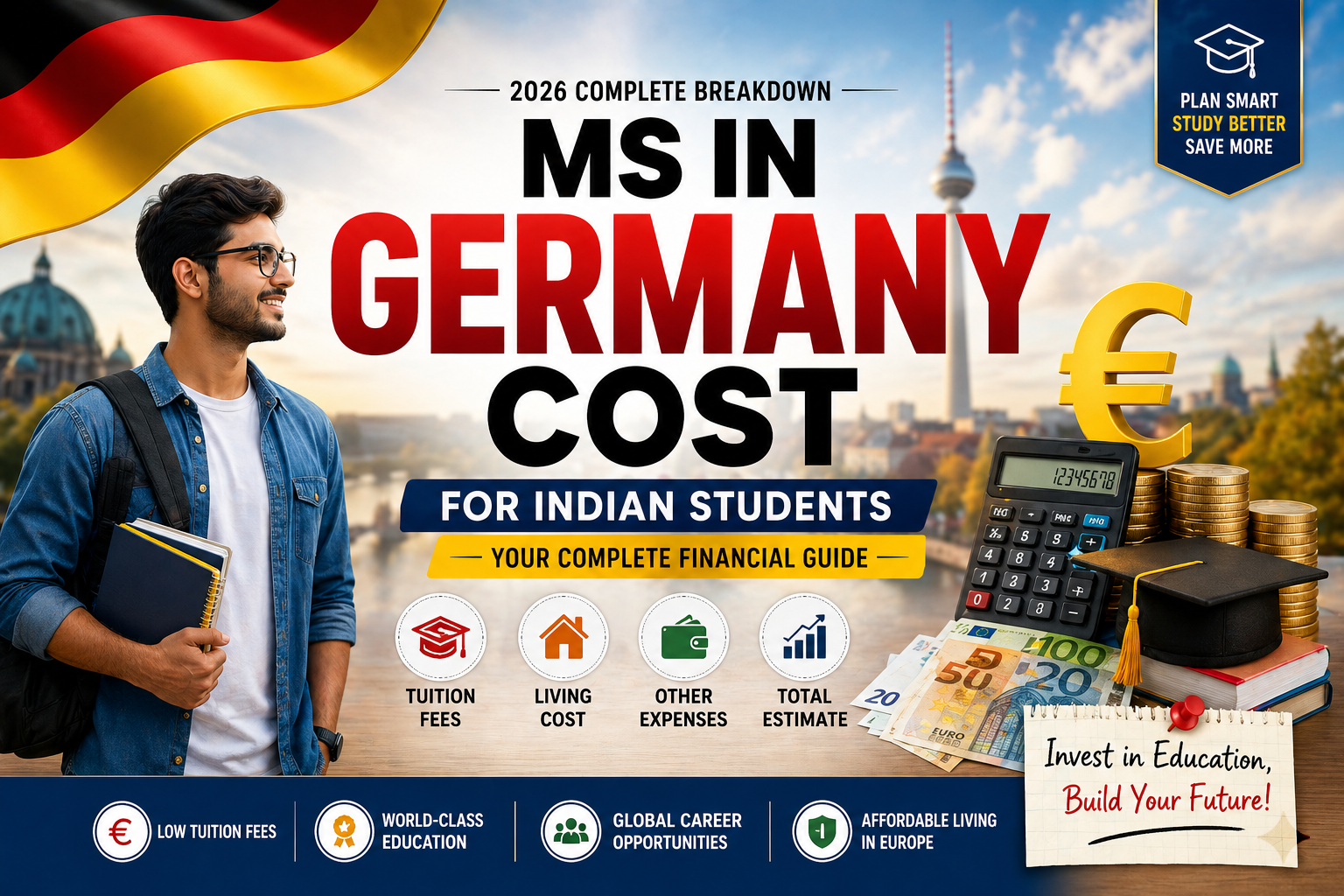
Germany has become one of the most affordable and high-value destinations for Indian students pursuing a master’s degree abroad. Unlike countries where tuition fees alone can cross ₹40–₹60 lakhs, Germany offers globally respected education at surprisingly low academic costs — especially at public universities.
However, many students still misunderstand the real financial picture.
The Germany MS cost students discussion is not only about tuition fees. Students also need to calculate:
Blocked account requirements
Living expenses
Visa costs
Accommodation deposits
Insurance
Flight tickets
Daily lifestyle spending
In 2026, rising inflation and housing demand across Europe are making financial planning even more important for international students.
According to the DAAD Germany Official Website, Germany continues attracting a growing number of international students because of its affordable public education system and strong career opportunities.
The good news? Germany still remains dramatically cheaper than countries like:
For most Indian students, the realistic total cost of completing a 2-year MS degree in Germany generally ranges between:
₹18\text{ Lakhs to }₹35\text{ Lakhs}
The final amount depends heavily on:
Public vs private university
City of residence
Lifestyle choices
Accommodation type
Part-time work income
Students in public universities and affordable cities usually spend far less than those choosing private institutions or expensive metropolitan areas.
Tuition Fees in Germany
One of Germany’s biggest advantages is its low tuition fee structure.
Most public universities charge:
No tuition fees
Only semester contributions
Average semester contribution:
150\text{ EUR to }350\text{ EUR per semester}
According to EEC Global Germany MS Guide, public universities in most German states remain tuition-free for international students. (EEC)
However, there are exceptions.
Private universities may charge:
€5,000–€20,000 annually
Meanwhile, Baden-Württemberg public universities charge tuition fees for many non-EU students.
Germany MS Cost Students: Blocked Account Requirement
The blocked account is one of the most important visa-related expenses.
As of 2026, Indian students generally need:
11,904\ \text{EUR per year}
This amount serves as proof that students can financially support themselves during studies. (MS in Germany)
Students usually receive monthly access of:
992\ \text{EUR per month}
The blocked account is not an additional fee. It is your own money held under regulated withdrawal conditions.
Popular blocked account providers include:
Expatrio
Fintiba
Deutsche Bank
Coracle
Living Expenses in Germany
Living costs depend heavily on the city.
Average monthly expenses include:
Expense Category
Monthly Cost
Accommodation
€300–€800
Food & Groceries
€150–€300
Health Insurance
€120–€150
Transportation
€30–€80
Internet & Mobile
€20–€50
Miscellaneous
€100–€250
According to MS in Germany Financial Guide, students in smaller cities often manage expenses below €1,000 monthly, while cities like Munich and Frankfurt are significantly more expensive. (MS in Germany)
Cheapest and Most Expensive Cities for Students
Choosing the right city can dramatically change your overall budget.
Affordable Cities
Expensive Cities
Leipzig
Munich
Dresden
Frankfurt
Aachen
Hamburg
Magdeburg
Berlin
Saarbrücken
Stuttgart
Students often save thousands of euros over two years by selecting affordable student-friendly cities.
One-Time Pre-Departure Costs
Many students forget these expenses during budgeting.
Common one-time costs include:
APS certificate
IELTS exam
University application fees
Visa fees
Flight tickets
Laptop purchases
Initial accommodation deposits
Estimated pre-departure budget:
Expense
Estimated Cost
APS Certificate
₹18,000+
IELTS/PTE
₹15,000–₹18,000
Visa Fees
€75
Flight Tickets
₹35,000–₹70,000
Initial Setup
₹50,000–₹1,50,000
According to discussions among Indian students on Reddit, many underestimate startup expenses beyond the blocked account requirement. (Reddit)
Can Part-Time Jobs Reduce MS Costs?
Yes — significantly.
International students in Germany can legally work part-time while studying.
Popular student jobs include:
University assistant jobs
Retail work
Logistics
Delivery services
IT support
Research assistant roles
Typical earnings:
12\text{ EUR to }20\text{ EUR per hour}
Many students partially cover second-year living expenses through internships and working student roles.
Reddit discussions among Indian students also indicate that careful budgeting combined with part-time work helps many students manage second-year costs successfully. (Reddit)
Scholarships That Reduce MS Costs
Several scholarships help reduce financial burden.
Expert Insight: Germany Is Affordable — But Not “Free”
One of the biggest myths online is that Germany is completely free for international students.
In reality:
Tuition may be low
Living costs are still significant
Students who succeed financially usually:
Choose affordable cities
Share accommodation
Cook regularly
Work part-time strategically
Budget carefully
Meanwhile, students who:
Ignore housing competition
Overspend initially
Depend only on blocked account funds
often face financial pressure later.
Germany rewards financial discipline and planning.
Latest Trends and Updates
Germany’s public universities continue attracting international students because of their low tuition fee structure and strong global reputation in engineering, technology, and research.

However, rising inflation and increasing housing demand are making accommodation one of the biggest financial challenges for students in major cities.

Digital blocked account providers like Expatrio and Fintiba are simplifying visa financial documentation and onboarding processes for Indian students.

Meanwhile, more students are choosing smaller German cities because they offer lower living costs while still maintaining strong academic quality.

Part-time work opportunities in logistics, IT, AI, and delivery sectors are also increasing due to ongoing labor shortages across Germany.
Real-Life Example: How Smart Planning Reduced Overall Costs
Rohit planned to pursue MS in Computer Science in Germany with a limited budget of ₹18 lakhs.
Instead of targeting expensive cities like Munich, he selected a public university in Saarbrücken and shared accommodation with other students.
He also:
Worked part-time
Cooked regularly
Used student discounts
Secured a working student internship during second year
As a result, he completed his MS without major financial stress while gaining valuable German work experience.
Germany remains one of the smartest study abroad investments for Indian students because it combines affordable education with strong career opportunities and global-quality universities.
However, successful financial planning requires understanding the full picture — not just tuition fees.
Students who:
Budget carefully
Choose cities strategically
Work part-time wisely
Plan emergency funds
Research costs early
usually experience far smoother academic and financial journeys.
Germany is affordable — but strategic planning is what truly makes the experience sustainable and rewarding.
FAQs
Most students spend between ₹18–₹35 lakhs for a complete 2-year MS depending on city and university type.
Public universities are mostly tuition-free, but students still pay living expenses and semester contributions.
Students generally need €11,904 as financial proof for one year.
Yes. Many students reduce second-year expenses through internships and part-time work.
Leipzig, Aachen, Dresden, and Saarbrücken are among the more affordable student cities.

 May 19, 2026
 7 Min
 No Comment