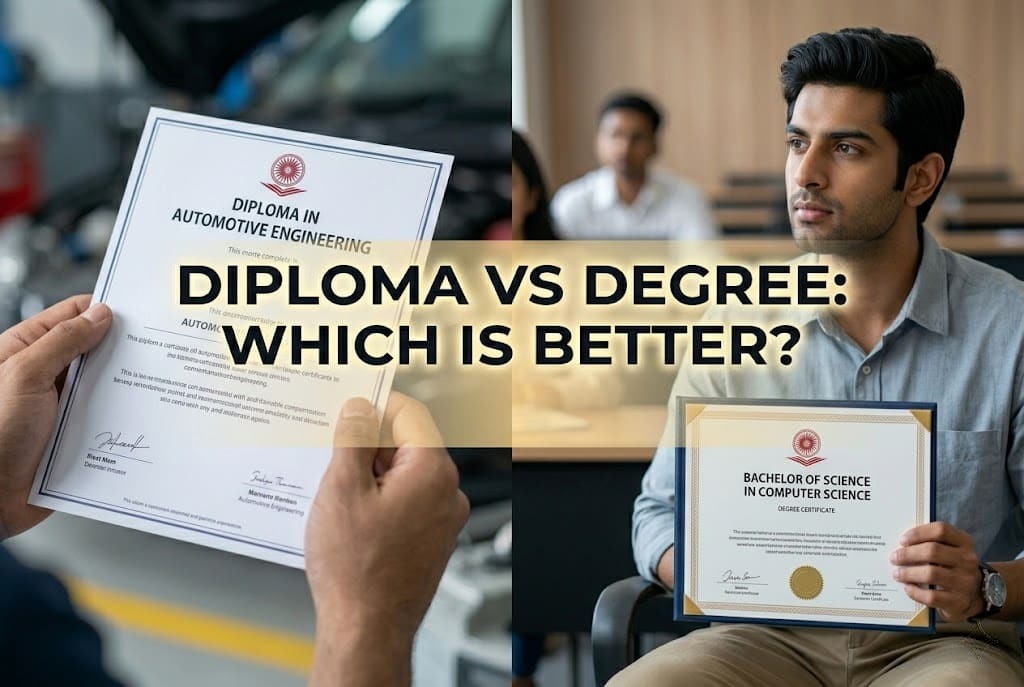
Students today have more educational choices than ever before. After completing 12th grade or even graduation, many learners struggle with one major question:
“Should I choose a diploma or a degree?”
At first glance, both options may seem similar because they help students gain qualifications and improve career opportunities. However, diploma and degree programs differ significantly in duration, academic depth, cost, career scope, salary growth, and long-term value.
Understanding the real difference between diploma vs degree India options has become increasingly important because employers now value both practical skills and academic qualifications depending on the industry.
This guide explains everything students and working professionals should know before making a decision in 2026.
According to workforce and education trends, skill-based and flexible learning pathways are becoming increasingly important in modern hiring markets. (timesofindia.indiatimes.com)
A diploma is usually a shorter, skill-focused educational program designed to prepare students for practical job roles.
Diploma programs generally focus on:
Hands-on learning
Industry skills
Faster employability
Technical training
Career-specific knowledge
Diplomas are available in areas such as:
Engineering
Digital marketing
Graphic design
Hotel management
Web development
Data analytics
Healthcare support
Diploma programs are often completed faster than traditional degrees.
What Is a Degree?
A degree is a formal academic qualification offered by universities and colleges.
Degree programs usually provide:
Broader academic learning
Theoretical understanding
Research exposure
Long-term career flexibility
Higher education opportunities
Common degree programs include:
BBA
BCA
BCom
BA
BTech
MBA
MCA
Degrees generally take more time but may offer stronger long-term career scalability.
For students exploring career-focused online learning, certifications, and education guidance, OneGrasp’s education resources also provide useful insights related to skill development and modern education pathways.
Diploma vs Degree India: Main Differences
Factor
Diploma
Degree
Duration
Shorter (6 months–3 years)
Longer (3–4 years)
Focus
Practical skills
Academic + practical
Cost
Lower
Higher
Career Entry
Faster
Broader opportunities
Higher Studies
Limited in some cases
Stronger academic pathways
Industry Focus
Job-oriented
Comprehensive education
Salary Growth
Moderate initially
Often stronger long-term
The right choice depends on career goals and learning preferences.
Which Is Better After 12th?
The answer depends on student priorities.
Choose Diploma If You Want:
Faster job entry
Lower education costs
Skill-based learning
Short-term specialization
Early earning opportunities
Choose Degree If You Want:
Long-term career growth
Higher education options
Broader career flexibility
Corporate leadership opportunities
Competitive exam eligibility
Both options can create successful careers when chosen strategically.
Diploma vs Degree Salary Comparison
Initially, diploma holders may enter jobs faster because of shorter course duration.
However, long-term salary growth often differs.
Qualification
Typical Early Salary
Long-Term Growth
Diploma
Faster entry-level jobs
Moderate
Degree
Slower start sometimes
Higher long-term scalability
This difference varies heavily by industry and skill level.
For example:
Skilled diploma holders in technology may earn very well.
Weak degree holders without practical skills may struggle.
Therefore, skills still matter significantly.
Industries Where Diplomas Perform Very Well
Diploma programs perform strongly in skill-driven industries such as:
Graphic design
Animation
UI/UX
Web development
Video editing
Digital marketing
Networking
Hardware support
These industries prioritize portfolio quality and practical implementation.
Industries Where Degrees Are Usually Preferred
Many traditional sectors still prefer degrees for:
Corporate management
Government jobs
Banking
Engineering
Teaching
Higher education
Administrative roles
Degrees often become mandatory for promotions and leadership positions.
Diploma vs Degree: Which Has Better ROI?
Diplomas usually offer:
Lower fees
Faster completion
Quicker earning potential
Degrees usually offer:
Higher long-term salary growth
Broader career options
Stronger academic recognition
The best ROI depends on:
Industry demand
Skill quality
Career planning
Learning ability
Expert Insight: Skills Are Redefining Education Value
One major shift in 2026 is the growing importance of practical implementation.
Employers increasingly evaluate:
Portfolio quality
Real projects
Communication ability
Problem-solving
Adaptability
This means:
A highly skilled diploma holder can outperform an unskilled graduate.
However:
A strong degree combined with practical skills often creates the most powerful career advantage.
The future increasingly rewards hybrid learners who combine education with implementation.
According to workforce trend research from McKinsey Career Insights, continuous learning and adaptability are becoming major drivers of long-term employability.
Latest Trends and Updates
Skill-based education is growing rapidly because employers increasingly prioritize practical implementation and project experience.

Online diploma programs in AI, cybersecurity, analytics, and digital marketing are becoming highly popular among working professionals.

Universities are increasingly integrating industry certifications into traditional degree programs.

Hybrid learning models combining online education with practical workshops are becoming mainstream.

Students are becoming more ROI-focused and comparing salary potential, flexibility, and career scalability before choosing programs.
Real-Life Example: Two Different Career Paths
Aman chose a diploma in web development after 12th grade and started freelancing within one year.
Meanwhile, Priya pursued a BCA degree and later specialized in cloud computing certifications.
Both succeeded because they aligned education with career strategy rather than blindly following trends.
Common Mistakes Students Should Avoid
Choosing Based Only on Duration
Shorter courses are not automatically better.
Ignoring Career Goals
Education should align with long-term plans.
Depending Only on Certificates
Skills and projects matter heavily.
Following Social Pressure
Different students succeed through different pathways.
Ignoring Accreditation
Recognition and credibility still matter significantly.
Beginner vs Smart Learner Approach
Beginner Approach
Smart Learner Approach
Chooses randomly
Aligns with career goals
Focuses only on salary
Evaluates long-term growth
Ignores practical skills
Builds strong portfolios
Follows trends blindly
Researches industry demand
Depends only on degree name
Focuses on implementation
Pros and Cons of Diplomas
Pros
Cons
Faster completion
Limited academic depth
Lower cost
Some roles require degrees
Skill-focused learning
Long-term scalability varies
Early earning potential
Fewer higher education pathways
Practical implementation
Industry recognition differs
Pros and Cons of Degrees
Pros
Cons
Strong academic recognition
Higher costs
Better long-term growth
Longer duration
Broader career options
Slower earning start
Eligibility for higher studies
More theoretical content
Stronger corporate pathways
Opportunity cost higher
What to Do Next (Actionable Steps)
Before choosing diploma or degree:
Define career goals clearly
Research industry demand
Compare long-term ROI
Analyze financial situation
Verify accreditation
Build practical skills continuously
Focus on future adaptability
Most importantly, avoid choosing based only on trends or social pressure.
Quick Checklist
Define career goals
Compare course duration
Research salary potential
Verify accreditation
Analyze ROI carefully
Build practical skills
Focus on industry demand
Stay adaptable
Conclusion
The debate around diploma vs degree India options does not have one universal answer. Both pathways can create successful careers when aligned with the right goals, industries, and learning strategies.
Diplomas offer faster, skill-focused learning and quicker employability, while degrees usually provide broader career flexibility, stronger academic recognition, and higher long-term scalability.
In 2026, the smartest students are not choosing education based only on duration or popularity. They are carefully evaluating career goals, industry trends, practical skill development, and future opportunities.
Ultimately, success depends less on the label of diploma or degree — and more on how effectively students apply what they learn.
FAQs
It depends on career goals, industry, budget, and learning preferences.
Yes, especially in skill-focused industries like IT, design, marketing, and development.
In many industries, degrees offer broader long-term opportunities and promotion potential.
Diploma programs are generally more affordable and shorter.
Yes, many students continue higher education after completing diplomas.

 May 20, 2026
 6 Min
 No Comment