May 20, 2026
 6 Min
 No Comment
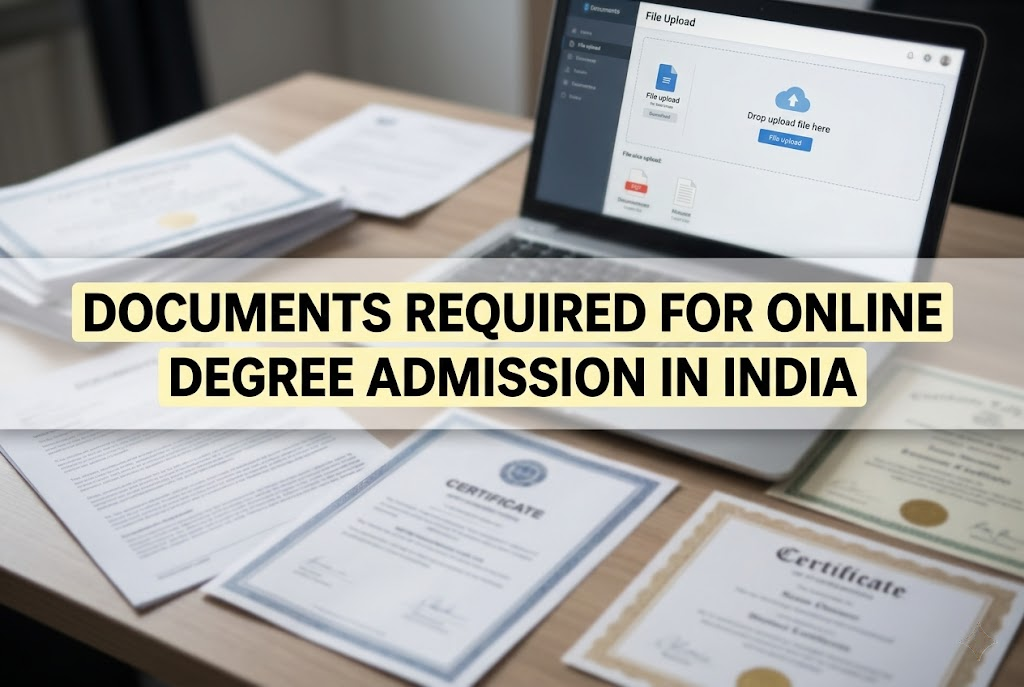
Online education in India has made the admission process much faster and more convenient. Students can now apply for UG, PG, diploma, and certification programs directly from home without visiting campuses physically.
However, one important step often creates confusion:
“What documents are required for online degree admission?”
Many students delay applications because they are unsure about eligibility documents, scanned copies, identity proofs, or academic certificates required by universities.
This guide explains the complete list of documents online degree admission processes usually require in India for 2026.
According to UGC online education guidelines, students must provide valid academic and identity documentation during admission verification. (ugc.gov.in)
Why Proper Documentation Matters
Online universities verify documents to confirm:
- Student identity
- Academic eligibility
- Previous qualifications
- Legal authenticity
- Reservation eligibility (if applicable)
Incorrect or incomplete documentation can delay:
- Admission approval
- LMS access
- Examination registration
- Degree issuance
Therefore, preparing documents properly before applying is extremely important.
For students exploring trusted online education guidance, admission help, and career-focused learning pathways, OneGrasp’s education resources also provide useful information related to online education and admissions.
Basic Documents Required for Online Degree Admission
Most universities commonly ask for the following documents.
10th Marks Memo / Certificate
This is required for:
- Date of birth verification
- Basic educational proof
Students should upload:
- Clear scanned copy
- Original certificate copy
- Readable document format
12th Marks Memo / Intermediate Certificate
For UG admissions, universities usually require:
- 12th marks memo
- Passing certificate
- Board details
This confirms eligibility for undergraduate programs.
Graduation Certificates (For PG Admissions)
Students applying for:
- MBA
- MCA
- MCom
- MA
- MSc
usually need:
- Degree certificate
- Semester marksheets
- Provisional certificate (if final certificate unavailable)
Aadhaar Card or Government ID Proof
Identity verification is mandatory.
Accepted documents usually include:
- Aadhaar card
- PAN card
- Passport
- Voter ID
Most universities prefer Aadhaar for Indian students.
Passport Size Photograph
Students typically upload:
- Recent passport-size photo
- White or plain background
- JPEG or PNG format
Universities may specify file size requirements.
Signature Copy
Many online application forms require:
- Scanned signature
- Plain white paper signature
- Digital upload format
Improper signatures can cause verification issues.
Category or Reservation Certificate (If Applicable)
Students applying under reserved categories may need:
- Caste certificate
- EWS certificate
- Disability certificate
Documents should usually follow government-approved formats.
Migration Certificate (Sometimes Required)
Some universities request migration certificates during admission transfer processes.
This is more common when students shift between boards or universities.
Work Experience Documents (For Executive Programs)
Certain online MBA or executive programs may ask for:
- Experience letters
- Salary slips
- Employer verification
This usually applies to management or executive education programs.
Common Document Format Requirements
| Requirement | Typical Format |
|---|---|
| Photograph | JPG / PNG |
| Academic Certificates | |
| Signature | JPG / PNG |
| ID Proof | PDF / JPG |
| File Size | Usually under 1–5 MB |
Always check university-specific instructions carefully.
Documents Online Degree Admission Process Usually Follows
Step 1: Online Registration
Students fill the application form.
Step 2: Document Upload
Scanned documents are uploaded digitally.
Step 3: Verification
Universities verify:
- Eligibility
- Authenticity
- Identity proof
Step 4: Fee Payment
Students pay application or semester fees.
Step 5: Admission Confirmation
After approval, students receive:
- Enrollment number
- LMS access
- Student login credentials
Important Tips Before Uploading Documents
Use Clear Scanned Copies
Blurred images often cause rejection.
Match Name Consistency
Student names should match across:
- Aadhaar
- Marksheets
- Certificates
Check File Size Properly
Large files may fail during upload.
Keep Multiple Copies Ready
Store backup copies in:
- Google Drive
- Pendrive
This prevents future problems.
Expert Insight: Documentation Errors Delay Admissions More Than Students Realize
One major issue universities frequently face is incorrect student documentation.
Common problems include:
- Wrong file formats
- Blurred certificates
- Mismatched names
- Expired certificates
- Incomplete marksheets
Students often assume admissions are “automatic” in online education. However, verification remains extremely important because universities must comply with UGC and academic regulations.
Therefore, careful preparation saves time and avoids admission delays.
According to digital education discussions and university admission updates, online universities are increasingly automating document verification systems using AI-powered screening tools. (timesofindia.indiatimes.com)
Latest Trends and Updates
Online universities are increasingly using AI-based verification systems to speed up admission approvals and reduce document fraud.

Digital locker integration and Aadhaar-based verification are simplifying online admission processes across India.

Mobile-friendly admission portals are allowing students to upload documents directly from smartphones.

Universities are reducing physical verification requirements for fully online programs.

Students are increasingly preferring paperless admissions because of convenience, flexibility, and faster processing.
Real-Life Example: Simple Preparation Avoiding Admission Delays
Nisha applied for an online MBA program but initially uploaded blurred marksheets and incorrect file sizes.
As a result:
- Her application remained pending
- LMS access was delayed
- Semester registration got postponed
After properly scanning and organizing documents, her admission was approved quickly.
Her experience shows why preparing documents carefully before applying is extremely important.
Common Mistakes Students Should Avoid
Uploading Blurred Documents
Unreadable certificates often cause rejection.
Ignoring File Size Instructions
Large files may fail during submission.
Using Incorrect Information
Names and dates must match official records.
Waiting Until Last Date
Technical issues often increase near deadlines.
Not Verifying Accreditation
Always verify university recognition before submitting documents.
Beginner vs Smart Student Approach
| Beginner Approach | Smart Student Approach |
|---|---|
| Uploads documents randomly | Organizes documents properly |
| Ignores instructions | Checks format carefully |
| Waits until deadlines | Applies early |
| Uses unclear scans | Uploads high-quality copies |
| Depends only on admissions team | Verifies details independently |
Pros and Cons of Online Admission Systems
| Pros | Cons |
|---|---|
| Faster applications | Technical upload issues |
| Paperless process | Requires digital awareness |
| Apply from anywhere | Verification delays possible |
| Flexible admissions | Internet dependency |
| Convenient document handling | File format confusion |
What to Do Next (Actionable Steps)
Before applying for online degree admissions:
- Scan all documents clearly
- Keep PDFs organized
- Verify name consistency
- Check university approval
- Read admission instructions carefully
- Apply before deadlines
- Save backup copies securely
Most importantly, avoid rushing the application process.
Quick Checklist
- 10th certificate ready
- 12th marks memo ready
- Graduation documents ready
- Aadhaar/PAN uploaded
- Passport photo prepared
- Signature scanned
- File size checked
- Backup copies saved
Conclusion
Online degree admissions have made higher education more flexible and accessible for students across India. However, smooth admission approval still depends heavily on proper documentation and accurate verification.
Preparing academic certificates, ID proofs, photographs, and digital files properly can prevent unnecessary delays and technical issues during admission.
In 2026, online universities are increasingly simplifying paperless admissions through AI-powered verification systems and digital platforms. Still, students who stay organized and proactive enjoy the smoothest application experience.
A well-prepared admission process not only saves time — it also creates a stress-free start to online learning.
FAQs
Most universities require 10th, 12th, graduation certificates, ID proof, photograph, and signature copies.
Most Indian universities prefer Aadhaar for identity verification.
Yes, most universities accept mobile-scanned PDF and image uploads if clear and readable.
Many fully online universities now complete verification digitally, though some may request originals later if needed.
Incorrect or unclear documents can delay admission approval and LMS access.