May 25, 2026
 8 Min
 No Comment
As online education becomes more mainstream across India, one question continues to concern students, employers, and government recruiters alike: “How can an online degree be verified?”
This concern is understandable. With the rapid growth of digital education, universities now issue electronic certificates, online mark sheets, and digitally signed academic records. At the same time, the rise of fake universities and fraudulent certificates has made proper verification more important than ever.
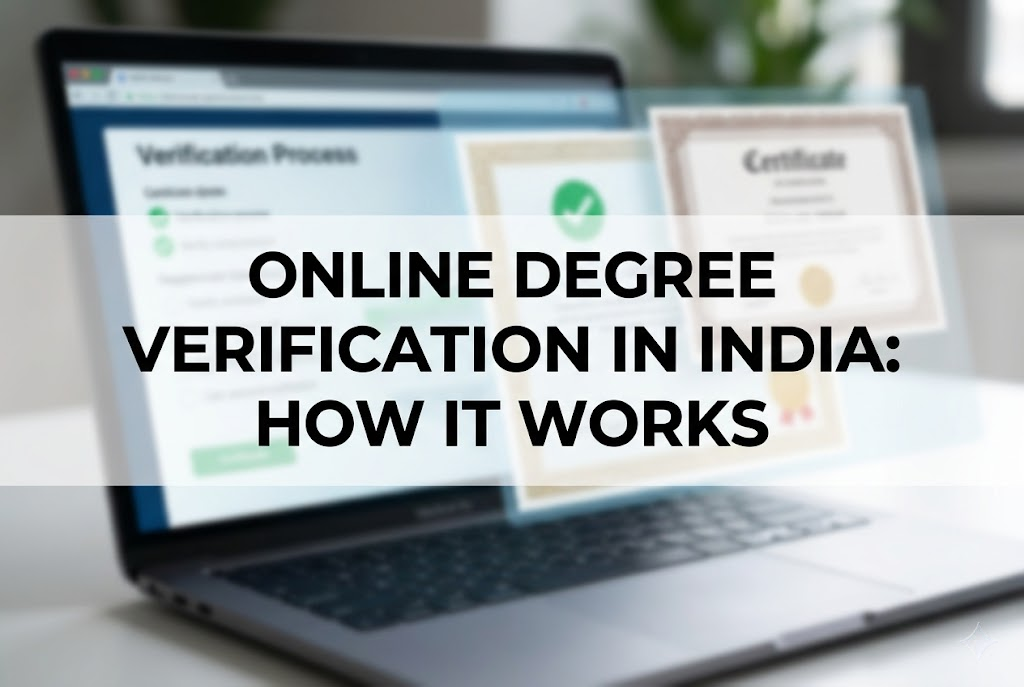
Today, the online degree verification India system plays a critical role in maintaining trust across higher education and employment sectors. Whether someone is applying for a government job, private company role, visa process, or higher education program, degree verification has become a standard procedure.
Fortunately, India’s education ecosystem is becoming increasingly digitized. Universities, employers, and government agencies now use online portals, digital databases, QR-based certificates, and centralized verification systems to confirm academic authenticity quickly and securely.
Understanding how this process works can help students avoid fraud, choose recognized universities, and prepare properly for future career opportunities.
What Is Online Degree Verification?
Online degree verification is the process of digitally confirming whether an academic qualification issued by a university or institution is genuine and officially recognized.
Verification typically checks:
- Student identity
- University legitimacy
- Degree authenticity
- Course approval status
- Year of graduation
- Marks and academic records
Employers, universities, recruitment agencies, and government organizations commonly conduct these checks before accepting educational qualifications.
According to the University Grants Commission, students should always pursue education from officially recognized institutions to ensure degree validity and verification eligibility.
Students can also explore educational guidance and admission-related resources through OneGrasp Education Resources for better academic planning.
Why Degree Verification Has Become So Important
The importance of online verification has increased dramatically in recent years.
Several reasons explain this shift:
| Earlier System | Modern Verification System |
|---|---|
| Physical certificate checks | Digital verification portals |
| Manual university contact | Automated databases |
| Slow processing | Instant validation |
| Paper-based records | QR-enabled certificates |
| Limited fraud detection | AI-supported verification |
India’s higher education sector has expanded rapidly, and digital learning platforms have made academic accessibility easier than ever before.
However, this growth has also increased the risk of:
- Fake universities
- Forged certificates
- Unauthorized online programs
- Fraudulent academic claims
As a result, employers and institutions now prioritize fast and reliable verification systems.
Online Degree Verification India: Step-by-Step Process
University Verification Portals
Many universities now provide dedicated online verification portals where employers or students can verify:
- Degree certificates
- Enrollment records
- Mark sheets
- Convocation details
Typically, verification requires:
- Registration number
- Roll number
- Certificate ID
- Graduation year
DigiLocker Integration
India’s digital infrastructure has improved significantly through platforms like DigiLocker.
Many universities now issue digitally signed academic documents directly through DigiLocker, making verification faster and more secure.
According to DigiLocker Official Portal, millions of academic certificates are now accessible digitally across India.
QR Code-Based Verification
Several institutions now include QR codes on degree certificates.
When scanned, these codes can reveal:
- Student details
- University records
- Verification status
- Certificate authenticity
This reduces the risk of forged certificates significantly.
Employer Background Verification
Private companies and government organizations often use third-party verification agencies.
These agencies may:
- Contact universities directly
- Cross-check records digitally
- Validate enrollment history
- Verify degree recognition status
This process is especially common for high-level recruitment and international employment opportunities.
How Students Can Verify University Recognition
Before enrolling in any online or offline degree program, students should verify whether the university is officially recognized.
Check UGC Approval
The most important step is verifying recognition through the official UGC website.
Students should confirm:
- University recognition status
- Online program approval
- Accreditation details
Verify NAAC Accreditation
Institutions with better accreditation generally carry stronger credibility.
Students can verify accreditation through National Assessment and Accreditation Council (NAAC).
Review Official University Websites
Recognized universities usually publish:
- Approval details
- Accreditation certificates
- Program authorizations
- Regulatory compliance information
Students should avoid relying solely on advertisements or unofficial social media claims.
Common Problems During Degree Verification
Despite digital systems improving rapidly, verification issues still occur.
Incorrect Student Information
Minor spelling errors in names or dates can create complications during verification.
Fake Universities
Some institutions falsely claim recognition or approval status.
Delayed Record Updates
Universities may sometimes delay uploading recent graduation records to digital systems.
Technical Portal Issues
Verification websites occasionally experience downtime or incomplete database synchronization.
According to India’s Ministry of Education Digital Education Initiatives, digital academic infrastructure is expanding rapidly, but integration challenges still exist across some institutions.
Expert Insight: The Future of Academic Verification
Academic verification systems in India are evolving rapidly through automation and AI integration.
Experts believe future verification systems may include:
- Blockchain-secured certificates
- AI-powered fraud detection
- Real-time global verification systems
- Unified student academic databases
- Biometric-linked academic credentials
These advancements could significantly reduce fake degree scams while simplifying recruitment and admission procedures.
Moreover, employers increasingly prefer digital verification because it saves time, reduces manual paperwork, and improves hiring accuracy.
As India continues expanding its digital governance ecosystem, academic verification systems will likely become faster, smarter, and more secure.
Common Mistakes Students Should Avoid
Students often create problems for themselves by ignoring verification basics.
| Mistake | Consequence |
|---|---|
| Joining unrecognized universities | Degree validity issues |
| Ignoring accreditation status | Reduced credibility |
| Losing digital certificates | Verification delays |
| Sharing incomplete information | Failed verification |
| Trusting unofficial portals | Fraud risks |
Students should maintain both physical and digital copies of all academic records carefully.
Latest Trends and Updates
Artificial intelligence and automation are increasingly being integrated into academic verification systems across India.

Several universities now issue blockchain-enabled and QR-based certificates to reduce fraud and simplify verification procedures.

Government-backed digital platforms like DigiLocker are expanding rapidly, allowing students to access verified academic records instantly online.

Employers are also adopting automated background verification systems that can validate educational credentials much faster than traditional manual processes.

Meanwhile, centralized academic databases and cloud-based verification systems are improving transparency, security, and nationwide accessibility for students and recruiters alike.
Real-Life Example: Verification During Job Recruitment
Consider the example of Priya, a commerce graduate applying for a multinational company role in Bengaluru.
During the recruitment process, the employer requested online degree verification. Since her university had integrated with DigiLocker, she shared digitally verified documents instantly without needing physical attestation.
The employer verified:
- Degree authenticity
- University recognition
- Graduation details
The process was completed within a few days, saving both time and administrative effort.
Her experience reflects how digital verification systems are simplifying modern recruitment processes.
Beginner vs Expert Approach to Degree Verification
| Beginner Approach | Expert Approach |
|---|---|
| Trusts advertisements blindly | Verifies official recognition |
| Ignores accreditation | Checks UGC and NAAC status |
| Stores documents carelessly | Maintains digital backups |
| Uses unofficial portals | Uses verified platforms |
| Delays verification checks | Confirms recognition before admission |
Experienced students prioritize legitimacy and documentation from the beginning.
Pros and Cons of Online Degree Verification
| Pros | Cons |
|---|---|
| Faster verification process | Technical issues may occur |
| Reduced paperwork | Data synchronization delays |
| Better fraud prevention | Digital literacy required |
| Nationwide accessibility | Some institutions still lag digitally |
| Secure document management | Internet dependency |
What Students Should Do Next
Students planning higher education or employment should proactively manage their academic records.
Practical next steps include:
- Verify university recognition before admission
- Store digital copies securely
- Use DigiLocker for document access
- Monitor university record updates
- Check spelling consistency across documents
- Verify accreditation regularly
- Avoid unauthorized institutions
Students should also regularly review official educational updates through UGC Official Website to stay informed about recognition policies and approved institutions.
Quick Checklist
- Verify UGC approval
- Check NAAC accreditation
- Store digital certificates safely
- Use DigiLocker access
- Maintain accurate personal details
- Verify online degree validity
- Avoid unrecognized institutions
Conclusion
The growth of digital education and online learning has made academic verification more important than ever before. Today, the online degree verification India system plays a critical role in maintaining trust across universities, employers, and government recruitment processes.
Modern verification systems using digital portals, QR-enabled certificates, DigiLocker integration, and automated background checks are making academic validation faster, safer, and more transparent.
However, students must still take responsibility for verifying university recognition, maintaining accurate records, and protecting their academic documents carefully.
As AI, blockchain technology, and centralized academic databases continue evolving, online degree verification in India is expected to become even more secure and efficient in the coming years.
For students, the smartest strategy is simple: choose recognized institutions, maintain proper documentation, and verify educational legitimacy before making important academic decisions.
FAQs
It is the digital process of confirming whether a degree certificate and university are genuine and officially recognized.
Students can verify recognition through official UGC and NAAC websites.
Yes, many universities issue digitally verified certificates through DigiLocker.
Yes, modern verification systems use digital databases, QR codes, and university records to identify fraudulent certificates.
Employers verify degrees to confirm educational authenticity and reduce recruitment fraud risks.