May 23, 2026
 7 Min
 No Comment
Online education in India has moved far beyond being a backup option. Today, UGC-approved online degrees are accepted for private jobs, higher education, and even many government recruitment exams. As digital learning becomes mainstream, students are increasingly comparing government private online degree options to find the best balance between affordability, credibility, and career value.
The biggest question most students ask is simple:
Should you choose a low-cost government online degree or invest in a more expensive private university program?
The answer depends on your goals, budget, career plans, and learning expectations.
According to recent higher education reports, India now has more than 100 UGC-approved universities offering online degree programs. (College King)
Students researching affordable career options and educational planning can also explore resources on OneGrasp Education Insights.
Why Online Degrees Are Growing Rapidly in India
Online learning has become popular because it offers:
- Flexible schedules
- Lower education costs
- Remote accessibility
- Career continuity for working professionals
- Affordable skill development
Moreover, UGC regulations now treat recognized online degrees similarly to regular degrees for employment and higher studies. (College King)
This shift has dramatically increased student confidence in online education.
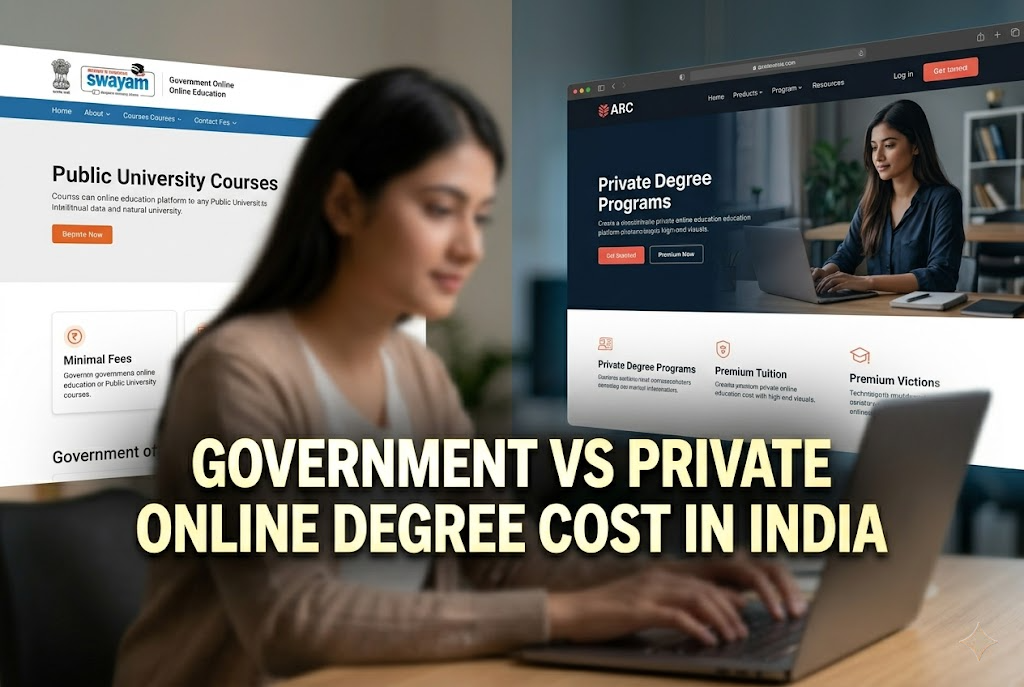
Government vs Private Online Degree Cost Comparison
The biggest difference between government and private online universities is cost.
Government institutions focus on affordability and accessibility, while private universities often emphasize branding, technology platforms, and placement support.
| Degree Type | Government Online Universities | Private Online Universities |
|---|---|---|
| Average UG Degree Cost | ₹8,000 – ₹40,000 | ₹80,000 – ₹3 Lakhs |
| Average MBA Cost | ₹30,000 – ₹60,000 | ₹1.2 Lakhs – ₹4.5 Lakhs |
| EMI Options | Limited | Commonly Available |
| Placement Support | Basic | Advanced |
| Learning Technology | Moderate | Modern Interactive Platforms |
| Brand Marketing | Lower | Aggressive |
Data from online university fee comparisons shows IGNOU remains among the cheapest UGC-recognized options in India. (FindMyCollege)
Government Online Universities: Affordable but Simple
Government universities are ideal for students who prioritize affordability and degree validity over premium branding.
Popular government online universities include:
- Indira Gandhi National Open University
- Delhi University School of Open Learning
- Netaji Subhas Open University
Key Advantages of Government Online Degrees
Government online programs usually offer:
- Extremely low fees
- UGC recognition
- Government job eligibility
- Flexible schedules
- Wide accessibility
For example, IGNOU undergraduate degrees can cost below ₹10,000–₹15,000 total in some programs. (IGNOU Admissions)
That makes government universities especially attractive for:
- Rural students
- Working professionals
- UPSC and SSC aspirants
- Budget-conscious families
However, government online programs may have:
- Slower administrative systems
- Limited placement support
- Less interactive learning platforms
- Fewer industry collaborations
Private Online Universities: Expensive but Career-Focused
Private universities usually focus heavily on student experience and employability.
Popular private online universities include:
- Amity University Online
- Manipal University Jaipur
- NMIMS Global Access School for Continuing Education
These universities often provide:
- Live virtual classes
- Career counseling
- Placement assistance
- Industry certifications
- Modern LMS platforms
- Networking opportunities
However, the price difference is significant.
Some private online MBAs cost ₹1.5–₹4 lakhs depending on specialization and branding. (Geetha.org.in)
Which Online Degree Has Better ROI?
ROI depends heavily on your career objective.
Government Online Degree ROI
Government online degrees offer better ROI when:
- Your budget is limited
- You need degree eligibility for exams
- You already have work experience
- You want low-risk education investment
For example, spending ₹30,000 on an online MBA while preparing for government exams may provide better financial efficiency than spending ₹3 lakhs on a premium private degree.
Private Online Degree ROI
Private universities may provide stronger ROI if:
- You need placement support
- You value university branding
- You want corporate networking
- You prefer structured learning systems
- You plan international career growth
In corporate hiring, brand visibility sometimes influences recruiter perception, especially for freshers.
However, experienced professionals are usually evaluated more on skills and work experience than university branding.
Are Government and Private Online Degrees Equally Valid?
Yes — if the university is UGC-DEB approved.
According to UGC online education regulations, recognized online degrees are valid for:
- Government jobs
- Private sector jobs
- UPSC and SSC eligibility
- Higher education admissions
However, students must verify approval status carefully before admission. (FindMyCollege)
Many students also discuss degree validity and affordability extensively on Reddit education communities. (Reddit)
Expert Insight / Analysis
The biggest misconception about online degrees is that expensive automatically means better.
That is not always true.
A government online degree from a trusted institution may deliver stronger long-term ROI for students focused on:
- Competitive exams
- Promotions
- Eligibility credentials
- Skill-building alongside employment
Meanwhile, premium private online universities often deliver better digital infrastructure, networking, and placement support.
The smarter approach is to evaluate:
- Career goal
- Financial situation
- Placement expectations
- Industry relevance
- Flexibility needs
Experts increasingly recommend focusing on skill acquisition alongside the degree itself.
Common Mistakes Students Make
Many students choose online universities based purely on advertisements.
Common mistakes include:
- Ignoring UGC approval status
- Choosing expensive degrees unnecessarily
- Focusing only on brand name
- Ignoring placement reality
- Not researching alumni outcomes
- Confusing distance learning with online learning
Another major mistake is expecting the degree alone to guarantee employment.
Skills, internships, certifications, and communication ability remain equally important.
Latest Trends / Updates
India’s online education market is expanding rapidly due to UGC recognition and increased digital adoption.

Government universities are gradually improving digital learning platforms and student support systems.

Private online universities are investing heavily in AI-powered learning management systems and virtual classrooms.

Working professionals are increasingly choosing online degrees to upskill without leaving their jobs.

Hybrid hiring models in India now accept many UGC-approved online degrees for corporate recruitment.

Affordable online degrees under ₹1 lakh are becoming highly popular among middle-class students and competitive exam aspirants.
Real-Life Example / Mini Case Study
Consider the example of Sneha, a commerce graduate from Hyderabad.
Initially, she planned to enroll in a ₹2.5 lakh private online MBA. However, after evaluating her goals, she realized she mainly needed an MBA credential for promotion eligibility in her current company.
Instead, she chose a lower-cost UGC-recognized government online MBA program and simultaneously completed digital marketing certifications.
Within two years, her combined degree and practical skills helped her secure a managerial role while avoiding heavy education debt.
Her decision highlights how career clarity often matters more than expensive branding.
Pros and Cons of Government vs Private Online Degrees
| Government Online Degrees | Private Online Degrees |
|---|---|
| Very affordable | Expensive |
| Strong degree validity | Better branding |
| Ideal for govt exam aspirants | Better placement support |
| Flexible and accessible | Modern LMS platforms |
| Lower financial risk | Higher networking opportunities |
| Slower support systems | Higher education investment |
Beginner vs Expert Decision-Making
| Beginner Thinking | Expert Thinking |
|---|---|
| Chooses based on ads | Evaluates ROI carefully |
| Focuses only on brand | Focuses on career outcomes |
| Ignores approval status | Verifies UGC recognition |
| Assumes expensive is better | Compares value realistically |
| Depends only on degree | Builds additional skills |
What to Do Next (Actionable Steps)
Before selecting an online degree, follow these steps:
- Verify UGC-DEB approval status.
- Compare total fees carefully.
- Check placement support realistically.
- Research alumni reviews and outcomes.
- Match the degree with your career goals.
- Avoid unnecessary education debt.
- Build practical skills alongside your degree.
Students can also stay updated on career trends and education planning through OneGrasp Career Resources.
Quick Checklist
- Verify UGC approval
- Compare total degree cost
- Research placement support
- Check curriculum quality
- Avoid fake universities
- Build additional certifications
- Focus on long-term ROI
Conclusion
The debate between government and private online degrees in India ultimately comes down to value, not just price.
Government universities provide unmatched affordability and reliable recognition, making them ideal for budget-conscious students and competitive exam aspirants. On the other hand, private online universities often deliver better digital infrastructure, placement support, and industry exposure.
The smartest choice depends on your career goals, financial situation, and learning preferences. Instead of blindly following marketing hype, students should focus on long-term ROI, practical skill development, and degree validity.
Platforms like OneGrasp can also help students stay informed about education trends, career planning, and future-ready opportunities in India.
FAQs
Government online degrees are significantly cheaper than private online universities in India.
IGNOU offers excellent affordability and government recognition, while private universities often provide stronger placement and networking support.
Yes, UGC-approved online degrees are valid for many government jobs and competitive exams. (FindMyCollege)
For affordability, government universities usually offer better ROI. For placements and branding, private universities may offer stronger value.
Many employers now accept UGC-approved online degrees, especially when candidates also demonstrate practical skills and work experience. (Dheya)