May 23, 2026
 7 Min
 No Comment
Higher education in India is expanding rapidly, especially with the rise of online learning, distance education, and private universities. While this has created more opportunities for students, it has also increased the number of fraudulent institutions operating illegally. That is why understanding how to avoid fake universities india students commonly encounter has become extremely important.
Every year, thousands of students unknowingly enroll in unrecognized colleges and fake online universities. Many realize the problem only after graduation when employers reject their degrees or government authorities refuse document verification.
The financial and emotional damage can be severe. Students may lose years of study time, tuition fees, and career opportunities because of one wrong admission decision.
According to official government warnings, India continues to identify institutions falsely claiming university status without proper authorization.
Students exploring genuine education and career planning guidance can also stay updated through OneGrasp Education Insights.
What Is a Fake University?
A fake university is an institution that illegally claims to offer valid degrees without proper government approval or accreditation.
These institutions may:
- Operate without UGC authorization
- Offer unrecognized online degrees
- Promise instant admissions
- Provide fake certificates
- Mislead students using aggressive advertising
Some fake universities even copy the names and branding of legitimate institutions to confuse students.
Therefore, verification is essential before taking admission.
Why Fake Universities Are Increasing in India
Several factors are driving the growth of fraudulent institutions:
- Rising demand for higher education
- Growing popularity of online learning
- Lack of student awareness
- Aggressive digital marketing
- Easy creation of fake websites
- Demand for quick degrees and certifications
Online education scams have especially increased because students often apply remotely without physically visiting campuses.
The Most Common Warning Signs of Fake Universities
Students can often identify suspicious institutions by watching for major red flags.
Unrealistic Admission Promises
Fake universities frequently advertise:
- “Guaranteed jobs”
- “100% placement”
- “Instant degree approval”
- “No exams required”
- “Degree in few months”
Legitimate universities rarely make unrealistic guarantees.
Lack of UGC Recognition
The University Grants Commission (UGC) is one of the most important education regulatory bodies in India.
Students should always verify university recognition through the official UGC website:
UGC Official Website
UGC also regularly publishes fake university warning lists:
UGC Fake Universities List
If a university does not appear in official approval lists, students should avoid it immediately.
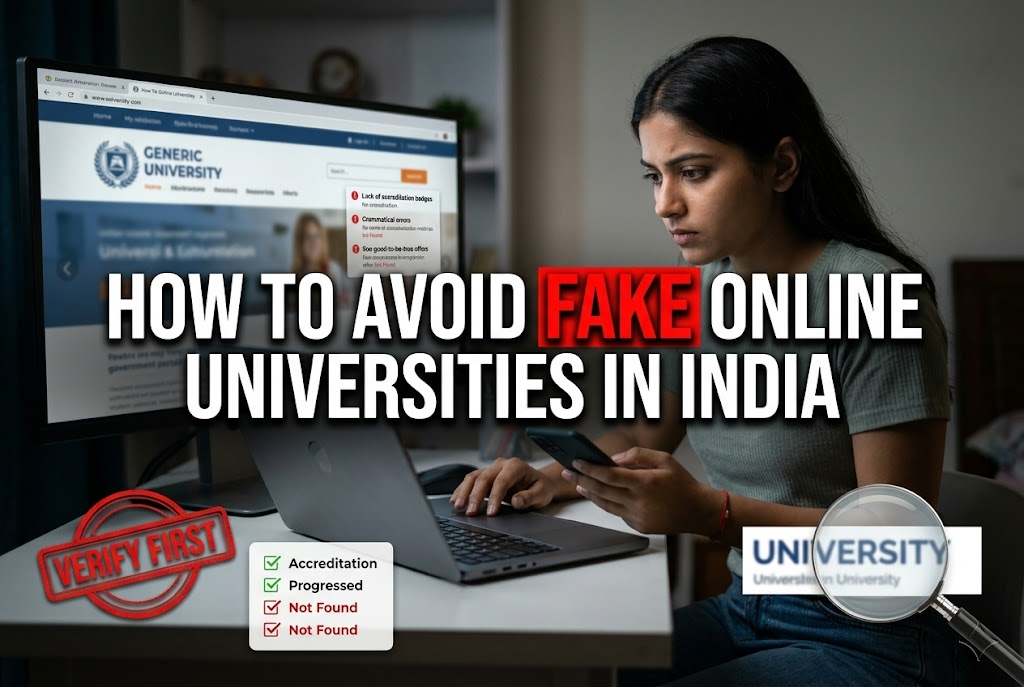
Poor Website Transparency
Fake universities often have weak or suspicious websites.
Common warning signs include:
| Red Flag | Why It Matters |
|---|---|
| No official address | Difficult to verify existence |
| No accreditation details | Possible illegal operation |
| Broken website pages | Poor credibility |
| Generic faculty information | Fake academic claims |
| No official contact support | Risk of fraud |
Legitimate universities usually maintain professional, transparent digital platforms.
Aggressive Marketing and Pressure Tactics
Many fraudulent institutions create urgency through:
- Continuous calls
- “Limited seat” pressure
- Unrealistic discounts
- Instant admission approvals
Some even use fake ranking claims to appear trustworthy.
Students should never make rushed admission decisions under pressure.
How to Verify a University Properly
Step 1: Check UGC Approval
Always verify whether the university appears on the official UGC list.
For online and distance education, students should additionally verify DEB approval:
UGC Distance Education Bureau
Step 2: Verify NAAC Accreditation
NAAC accreditation helps measure educational quality.
Although not every institution has top ratings, accreditation still adds credibility.
Students should verify:
- NAAC grade
- Accreditation validity
- Institutional recognition
Step 3: Research Student Reviews Carefully
Student reviews provide valuable insights.
However, students should avoid trusting only testimonials displayed on university websites.
Instead, check:
- Reddit discussions
- LinkedIn alumni
- Google reviews
- Education forums
- YouTube student experiences
Real student experiences often reveal hidden issues.
Step 4: Verify Degree Acceptance
Before admission, students should confirm whether the degree is accepted for:
- Government jobs
- Higher education
- Competitive exams
- International applications
- Corporate hiring
This becomes especially important for online and distance learning programs.
Step 5: Compare Fees Realistically
Extremely low fees may sometimes indicate poor quality or fake operations.
At the same time, expensive branding alone does not guarantee legitimacy.
Students should compare:
- Fee transparency
- Hidden charges
- Refund policies
- Placement support
- Infrastructure quality
Career-focused learners researching trusted educational guidance can also explore resources through OneGrasp Career Resources.
Expert Insight / Analysis
One of the biggest mistakes students make is confusing aggressive marketing with educational quality.
Modern fake universities often look highly professional online. Some use:
- Paid advertisements
- Fake student testimonials
- Manipulated rankings
- Artificial placement statistics
This makes fraud detection more difficult than before.
Another major trend is the rise of fake online universities targeting working professionals and students from smaller cities.
Experts strongly recommend verifying every institution directly through government-approved databases instead of trusting social media ads or random education consultants.
The safest approach is always independent verification.
Common Mistakes Students Should Avoid
Many students unintentionally increase fraud risk.
Common mistakes include:
- Ignoring UGC verification
- Trusting unknown admission agents
- Choosing based only on low fees
- Falling for guaranteed placement promises
- Applying without researching reviews
- Ignoring hidden charges
- Believing fake rankings
Another dangerous mistake is paying large fees before document verification.
Students should never make rushed financial decisions.
Latest Trends / Updates
UGC continues increasing crackdowns against unauthorized institutions and fake degree providers across India.

Online education scams are rising as more students shift toward digital learning platforms.

Students are increasingly verifying university approvals through government portals before applying.

AI-generated fake websites and manipulated rankings are making education fraud detection more challenging.

Employers are becoming stricter about degree verification and institutional legitimacy checks.

Hybrid and online learning models are improving, but students must carefully verify program accreditation and recognition.
Real-Life Example / Mini Case Study
Consider the example of Sameer, a student from Uttar Pradesh who enrolled in an online MBA after seeing attractive social media advertisements promising guaranteed placements.
The university website appeared professional, and admission approval came within hours without proper verification.
However, after paying fees, Sameer later discovered the institution lacked valid UGC approval. Employers rejected the degree during job applications.
Fortunately, he identified the issue early enough to restart with a recognized university later. His experience highlights why verification is critical before admission.
Pros and Cons of Private and Online Universities
| Pros | Cons |
|---|---|
| Flexible learning opportunities | Risk of fake institutions |
| Wider course availability | Quality varies significantly |
| Accessible education nationwide | Aggressive marketing scams |
| Affordable online programs | Hidden fees in some cases |
| Career-focused certifications | Placement claims may be misleading |
Beginner vs Expert Verification Approach
| Beginner Thinking | Expert Thinking |
|---|---|
| Trusts advertisements blindly | Verifies government approval |
| Chooses based on discounts | Evaluates long-term ROI |
| Ignores accreditation details | Checks recognition carefully |
| Rushes admission decisions | Researches student outcomes |
| Depends on consultants only | Performs independent verification |
How Students Can Stay Safe
To avoid fake universities effectively:
- Verify UGC and DEB approval.
- Research NAAC accreditation.
- Read independent student reviews.
- Avoid unrealistic promises.
- Compare multiple universities carefully.
- Check degree acceptance for jobs and exams.
- Never rush fee payments.
Students should also stay updated on education trends and verified career guidance through OneGrasp Education Insights.
Quick Checklist
- Verify UGC recognition
- Check DEB approval for online courses
- Research student reviews independently
- Avoid guaranteed placement claims
- Review fee transparency
- Verify official website authenticity
- Compare universities carefully
Conclusion
Fake universities remain a serious problem in India’s rapidly expanding education sector. However, students who verify approvals carefully, research independently, and avoid unrealistic promises can protect themselves from educational fraud.
The smartest admission strategy is not choosing universities based only on marketing or low fees. Instead, students should focus on legitimacy, accreditation, transparency, and long-term career value.
Careful research today can prevent years of financial loss and career setbacks later. Platforms like OneGrasp can also help students stay informed about trusted education options, career planning, and future-ready learning opportunities in India.
FAQs
Students should verify UGC approval and check official government recognition databases before admission.
Yes, many are safe if they are UGC-DEB approved and properly accredited.
Unrealistic promises such as guaranteed jobs, instant degrees, or admissions without eligibility checks are major warning signs.
Yes. UGC regularly updates and publishes fake university warning lists on its official website.
Yes. Employers and government organizations may reject unrecognized degrees during verification.