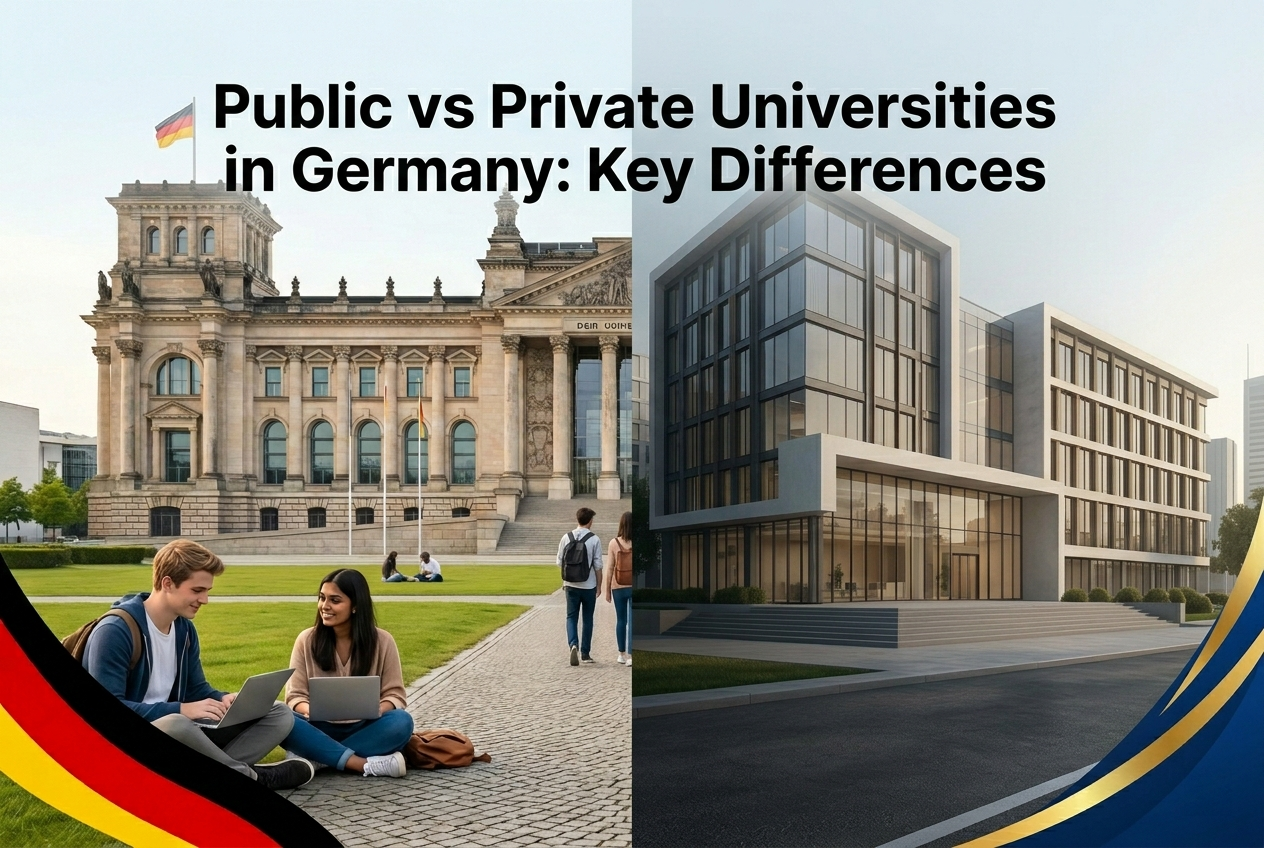
Germany has become one of the most attractive study abroad destinations for Indian students because of its affordable education system, strong universities, and excellent career opportunities. However, one major question continues confusing students during the application process:
Should you choose a public university or a private university in Germany?
The Germany public private universities debate is especially important in 2026 because international students now have access to:
Hundreds of public university programs
Growing numbers of private institutions
English-taught courses
Specialized business schools
Flexible admission pathways
Many students assume private universities are automatically better because of higher tuition fees. Others believe public universities are always the smartest choice.
The reality is more balanced.
Germany’s education system works differently from countries like:
USA
UK
India
where private institutions often dominate prestige rankings.
According to the Study in Germany Official Portal, Germany’s public universities form the foundation of the country’s global academic reputation, especially in engineering, science, and research.
At the same time, some private universities are becoming increasingly respected for:
Business education
International management
Entrepreneurship
Applied industry learning
Understanding the key differences can help students make smarter long-term decisions.
Public universities are government-funded institutions.
These universities receive state financial support, which allows them to offer:
Very low tuition fees
Strong research infrastructure
High academic quality
Germany’s globally recognized universities are mostly public institutions.
Examples include:
Technical University of Munich (TUM)
RWTH Aachen
Heidelberg University
LMU Munich
TU Berlin
Public universities are especially respected for:
Engineering
Computer science
Research
Medicine
Natural sciences
Many of these institutions consistently rank among the world’s best universities.
What Are Private Universities in Germany?
Private universities are independently funded institutions that rely primarily on tuition fees.
These universities usually focus more on:
Business education
Applied learning
Industry-oriented teaching
Smaller class sizes
Flexible administration
Popular private universities include:
WHU – Otto Beisheim School of Management
ESMT Berlin
Frankfurt School of Finance & Management
HHL Leipzig Graduate School of Management
Private institutions are often more common in:
MBA programs
Finance
International business
Management education
However, quality varies significantly between institutions.
Tuition Fee Differences
This is one of the biggest deciding factors.
Public universities usually charge:
No tuition fees
Only semester contributions
Average semester contribution:
150\text{ EUR to }350\text{ EUR per semester}
Meanwhile, private universities can charge:
8,000\text{ EUR to }35,000\text{ EUR yearly}
MBA programs at elite private business schools may cost even more.
For Indian students, this creates a major ROI consideration.
Germany Public Private Universities: Admission Difficulty
Public universities are generally:
More competitive
More academically strict
More selective
Students often need:
Strong CGPA
Relevant academic background
Language proficiency
Technical prerequisites
Meanwhile, private universities may offer:
Flexible admissions
Faster application processing
Lower GPA requirements
More intake options
This is one reason many international students consider private institutions after public university rejections.
Research vs Industry Orientation
Public universities in Germany are highly research-focused.
Students often experience:
Academic independence
Strong theoretical depth
Research-driven learning
This is especially beneficial for:
Engineering
Scientific research
PhD pathways
Technical careers
Private universities usually focus more on:
Practical business learning
Industry collaboration
Career readiness
Networking opportunities
For example, private business schools may offer:
Smaller classrooms
Corporate workshops
Startup incubators
Industry mentorship
The right choice depends heavily on career goals.
Class Size and Student Experience
Classroom environments differ significantly.
Factor
Public Universities
Private Universities
Class Size
Larger
Smaller
Student Support
Moderate
Usually Stronger
Faculty Interaction
Limited at times
More Personalized
Administration
Bureaucratic
Faster Support
Teaching Style
Research-Focused
Career-Oriented
Some students thrive in independent public university systems.
Others prefer structured environments with closer faculty support.
Job Opportunities After Graduation
One major myth is that private universities automatically guarantee better jobs.
In Germany, employers often prioritize:
Skills
Practical experience
Internships
German language ability
Technical competence
Public universities still dominate employer recognition in:
Engineering
Technology
Research-heavy sectors
However, elite private business schools can provide strong advantages in:
Consulting
Finance
Entrepreneurship
International management
According to the Make it in Germany Official Portal, Germany continues facing strong demand for skilled graduates across technical and business sectors.
Ultimately, employability depends more on:
Internship experience
Networking
Skill development
than tuition fees alone.
Which Option Is Better for Indian Students?
The answer depends on your profile and goals.
Public universities may suit students who:
Want low-cost education
Have strong academics
Prefer research-focused learning
Target engineering or technical fields
Private universities may suit students who:
Need flexible admissions
Want business-focused programs
Prefer smaller classes
Need structured support systems
Students should evaluate:
ROI
Career outcomes
University reputation
Internship access
Alumni success
before deciding.
Expert Insight: Germany’s Reputation Was Built on Public Universities
One important reality students should understand is this:
Germany’s international academic prestige comes mainly from its public university system.
That does not mean private universities are bad.
However, students should avoid assuming:
Higher tuition automatically means higher quality
In Germany, many public universities are academically stronger than numerous expensive private institutions.
At the same time, specialized private business schools can still provide excellent:
Industry access
Consulting opportunities
Entrepreneurial ecosystems
The smartest students evaluate universities individually instead of emotionally choosing “public” or “private.”
Latest Trends and Updates
Germany’s public universities continue dominating global rankings in engineering, AI, manufacturing, and scientific research because of strong government funding and research infrastructure.

Meanwhile, private universities are rapidly expanding English-taught management, finance, and entrepreneurship programs to attract international students.

Industry partnerships, startup incubators, and hybrid business-tech programs are becoming major selling points for elite private business schools.

At the same time, international students are becoming more cautious about ROI because some lesser-known private institutions charge high tuition fees without strong employer recognition.

German employers increasingly prioritize internships, practical skills, and communication ability over university type alone.
Real-Life Example: Two Students, Two Different Strategies
Priya applied to public universities for computer science because she wanted affordable tuition and research-focused education.
Meanwhile, Rohan chose a private business school because he preferred:
Smaller classrooms
International business networking
MBA-style teaching
Both succeeded — but through different paths.
Priya built strong technical research experience and later joined an AI company.
Rohan leveraged industry networking and internships to secure a consulting role.
Their success depended more on strategy and preparation than university type alone.
Germany offers both excellent public universities and specialized private institutions, but the right choice depends entirely on your goals, budget, academic profile, and career plans.
Public universities remain Germany’s strongest academic foundation, especially for engineering, science, and research-focused education. Meanwhile, certain private business schools provide strong industry exposure and career-oriented learning.
Students who:
Research carefully
Compare ROI realistically
Focus on employability
Build internships and networking
usually make the best long-term decisions.
In Germany, success depends less on whether a university is public or private — and far more on how strategically you use the opportunities available.
FAQs
In many technical and research fields, public universities generally have stronger global reputation.
Yes. Many private universities offer more flexible admission criteria.
Most public universities charge very low semester contributions instead of high tuition fees.
Some elite private business schools offer strong MBA and consulting opportunities.
Employers often prioritize skills, internships, and practical experience more than university type alone.

 May 19, 2026
 7 Min
 No Comment