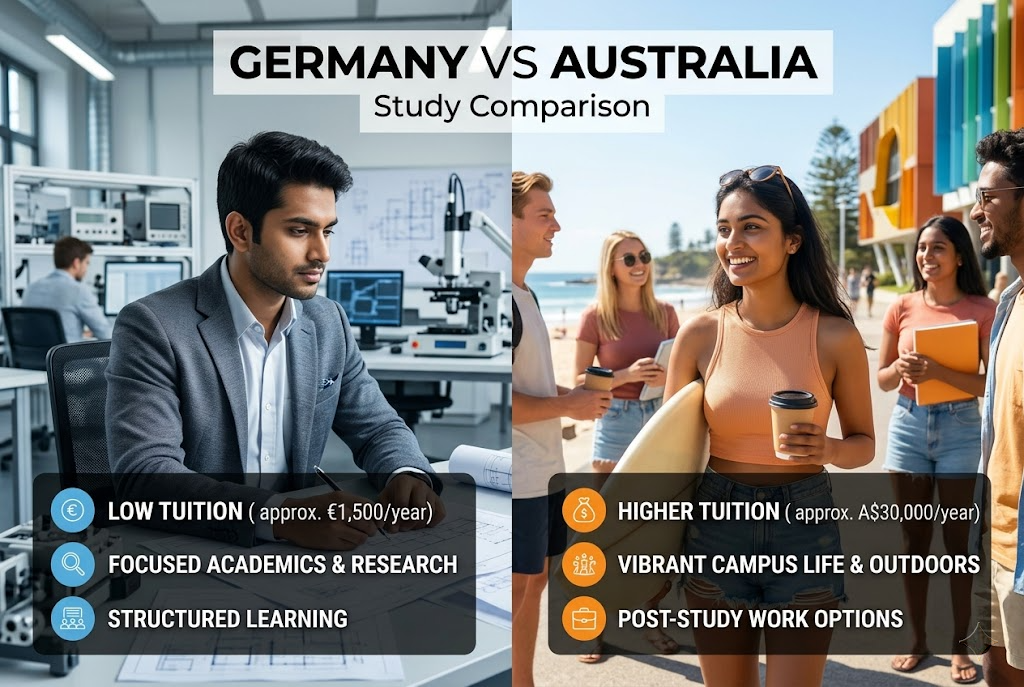
Choosing between Germany and Australia is no longer just about picking a country for education. For Indian students in 2026, it has become a life-shaping decision involving career growth, immigration opportunities, financial pressure, global exposure, and long-term settlement plans. The Germany Australia study comparison has therefore become one of the most searched topics among students planning international education.
At first glance, both countries look attractive. Germany offers world-class public education with little or no tuition fees, while Australia provides globally ranked universities, English-speaking convenience, and strong post-study work pathways. However, the right choice depends entirely on your goals, budget, career field, and lifestyle expectations.
According to the DAAD Germany Official Portal and Australian Government Study Portal, Indian student enrollment in both countries has surged dramatically in recent years. Meanwhile, rising competition, changing immigration policies, and global job market shifts are reshaping how students evaluate study destinations.
This detailed comparison will help you understand the real differences — not just promotional brochure claims.
Germany is widely known for affordable higher education, especially in public universities.
Most German public universities charge either zero tuition fees or a small semester contribution ranging between €150 and €350. This makes Germany one of the most cost-effective destinations globally for engineering, technology, and research-based programs.
Australia, however, follows a premium education model.
International students in Australia typically pay:
AUD 20,000–45,000 annually for undergraduate programs
AUD 22,000–50,000 for postgraduate programs
Here is a quick comparison:
Expense Category
Germany
Australia
Public University Tuition
Very Low
High
Living Costs
Moderate
Expensive
Health Insurance
Affordable
Higher
Visa Costs
Lower
Higher
Part-Time Earnings
Moderate
Strong
For students with tight financial budgets, Germany often becomes the preferred option.
However, Australia may offer faster returns through higher immediate earning opportunities.
Germany Australia Study Comparison for Career Opportunities
Both countries provide strong employment prospects, but the industries differ significantly.
Germany dominates in:
Mechanical engineering
Automotive technology
Manufacturing
Artificial intelligence
Renewable energy
Robotics
Meanwhile, Australia performs strongly in:
Healthcare
Business analytics
Finance
Hospitality
Mining
Cybersecurity
Germany’s economy heavily supports technical and industrial roles. Therefore, STEM students often find excellent long-term opportunities there.
Australia, on the other hand, provides broader flexibility for international graduates because English-speaking workplaces reduce language barriers.
According to Statista Global Education Data, Australia consistently ranks among the top countries for graduate employability among international students.
Student Visa Process and Approval Rates
Germany’s visa process is documentation-heavy and slower.
Students usually need:
APS certificate
Blocked account proof
University admission
Health insurance
Motivation letter
Visa processing can take several weeks, especially during peak intakes.
Australia’s visa system is more digitized and generally faster. Genuine Student (GS) requirements remain important, but overall application workflows are smoother.
Here’s a practical comparison:
Factor
Germany
Australia
Processing Speed
Moderate to Slow
Faster
Financial Proof
Strict
Strict
Interview Requirement
Sometimes
Usually Not Mandatory
Visa Approval Complexity
Higher
Moderate
Documentation Volume
Extensive
Moderate
Students who prefer a simplified process often lean toward Australia.
Cost of Living: Real Monthly Expenses
Living expenses vary dramatically depending on the city.
In Germany:
Monthly living costs: €850–€1,300
Student housing is affordable but competitive
Public transportation discounts are excellent
In Australia:
Monthly living costs: AUD 1,800–3,000
Rent is the largest expense
Major cities like Sydney and Melbourne are expensive
However, Australian students generally earn higher wages from part-time jobs.
Germany allows 140 full days or 280 half days of work annually, while Australia offers flexible work rights with comparatively higher hourly pay rates.
Therefore, earning potential partly balances Australia’s higher living expenses.
Language and Lifestyle Differences
This is where many students underestimate the real challenge.
Australia is entirely English-speaking, which makes adaptation easier for Indian students.
Germany offers many English-taught programs, especially at the master’s level. However, daily life often requires at least basic German language skills.
Simple activities like:
Renting apartments
Visiting government offices
Understanding contracts
Networking locally
can become difficult without German proficiency.
Lifestyle differences also matter.
Australia offers:
Relaxed social culture
Better weather
Strong multicultural communities
Easier communication
Germany offers:
Strong work discipline
Efficient public systems
Rich cultural history
Lower consumer costs
Students prioritizing comfort and ease of adjustment often prefer Australia. Those focused on long-term technical careers frequently choose Germany.
Expert Insight: Which Country Offers Better Long-Term Value?
The answer depends on your long-term vision.
Germany provides exceptional value for technically skilled students who are willing to integrate into the local system and potentially learn German. Over time, the low education cost combined with Europe’s industrial job market creates strong ROI.
Australia, meanwhile, offers faster lifestyle adjustment and clearer immigration pathways for many international students.
Moreover, Australia’s education sector is deeply internationalized. Universities actively support student employability, networking, and internships.
However, rising living costs and tuition fees are becoming serious concerns in Australian cities.
Germany’s biggest advantage remains affordability paired with global-quality education.
Australia’s biggest advantage is accessibility and smoother student experience.
Latest Trends and Updates
Germany is aggressively expanding skilled migration pathways to address workforce shortages in engineering, IT, and renewable energy sectors. This is making the country increasingly attractive for technically qualified international graduates.

Meanwhile, Australia has recently tightened several student visa regulations to control misuse of temporary migration pathways while prioritizing high-quality applicants.

AI-driven recruitment systems are also changing graduate hiring trends in both countries, especially in technology and analytics sectors.

Hybrid learning models and industry-integrated education programs are becoming more common across Australian universities, improving employability outcomes.

Germany is also investing heavily in English-taught master’s programs to attract more international talent from India and Southeast Asia.
Real-Life Example: Two Students, Two Different Outcomes
Aman chose Germany for his master’s in automotive engineering because tuition costs were minimal. He learned German during his studies and later secured a role with a manufacturing company in Stuttgart.
Meanwhile, Priya selected Australia for a master’s in business analytics. Although her tuition expenses were higher, she adapted quickly due to the English-speaking environment and secured a graduate analyst role within months.
Both succeeded — but their paths reflected different priorities.
Aman optimized for affordability and technical specialization.
Priya optimized for smoother integration and faster employability.
Quick Checklist Before Choosing Germany or Australia
Define your career goals clearly
Compare total budget requirements
Research post-study work rights
Understand local job market demand
Evaluate language comfort level
Check scholarship opportunities
Review PR pathways realistically
Conclusion
The Germany vs Australia debate has no universal winner because the best destination depends entirely on your personal priorities.
If your primary goal is affordable, high-quality education with strong technical career opportunities, Germany offers outstanding value. On the other hand, if you prioritize English-speaking comfort, easier adaptation, and clearer immigration pathways, Australia may be the smarter choice.
The most successful international students are not the ones who follow trends blindly. They are the ones who align their destination with their long-term career strategy, financial reality, and lifestyle expectations.
Study abroad is not just an academic decision anymore — it is a long-term investment in your future.
FAQs
Yes. Germany is generally much cheaper because many public universities charge little or no tuition fees.
Australia usually provides clearer and more accessible PR pathways for international graduates.
For daily life and long-term employment, basic to intermediate German skills are highly beneficial.
Both countries offer strong opportunities, but Germany excels in engineering while Australia performs strongly in business, healthcare, and analytics.
Both Germany and Australia are considered safe countries with strong student support systems.

 May 19, 2026
 8 Min
 No Comment