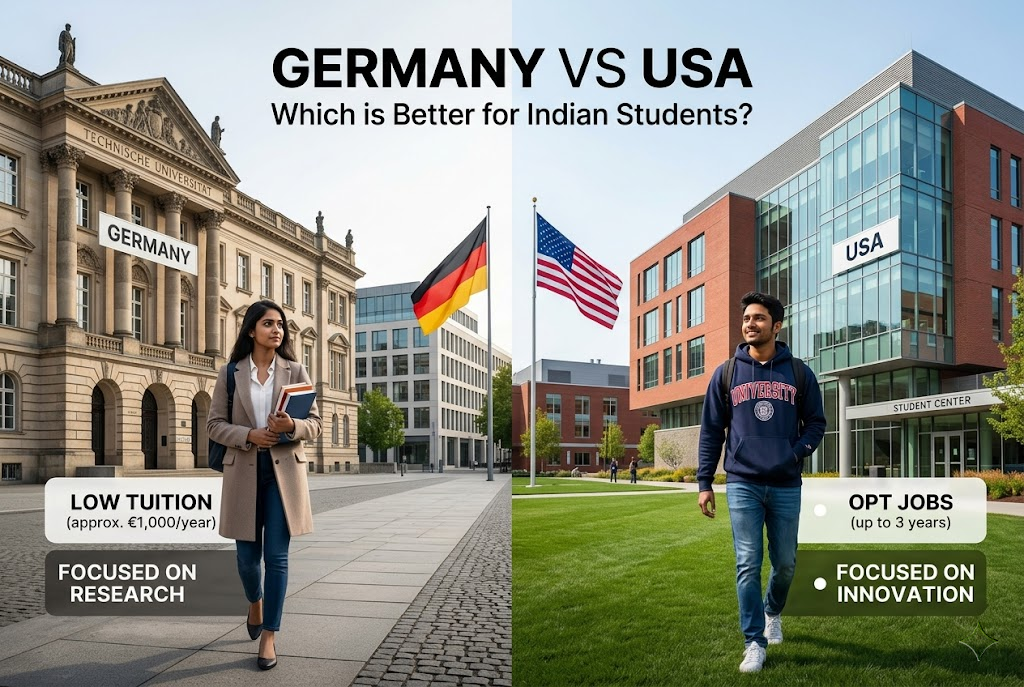
For Indian students planning international education in 2026, Germany and the United States remain two of the most powerful study destinations in the world. Both countries offer globally respected universities, cutting-edge research opportunities, and strong career prospects. However, when students begin comparing tuition fees, visa systems, job opportunities, and long-term return on investment, the differences become dramatic.
The Germany USA study comparison is especially relevant today because studying abroad has become one of the biggest financial decisions for middle-class Indian families. Students are no longer choosing countries based only on university rankings. Instead, they are analyzing affordability, employability, immigration opportunities, salaries, and lifestyle factors before making a final decision.
Germany attracts students with low-cost education and Europe’s industrial economy. Meanwhile, the USA dominates global education because of its innovation ecosystem, elite universities, and high-paying job market.
According to the Institute of International Education (IIE), the United States continues to host one of the largest international student populations globally. At the same time, DAAD Germany Official Website reports rapid growth in Indian student enrollment across German universities, particularly in engineering and technology programs.
So, which destination actually offers better value for Indian students? Let’s break it down realistically.
One of Germany’s biggest advantages is its low-cost public education system.
Most German public universities charge either no tuition fees or only a small semester contribution ranging between €150 and €350. This makes Germany one of the most affordable high-quality education destinations globally.
The USA operates very differently.
International students in American universities often pay:
USD 20,000–60,000 annually for tuition
Additional living expenses depending on the state and city
Private universities in the US can cost significantly more.
Here’s a direct comparison:
Expense Category
Germany
USA
Public University Tuition
Very Low
Expensive
Living Costs
Moderate
High
Health Insurance
Affordable
Expensive
Student Loan Pressure
Lower
Higher
Overall Education Cost
Budget-Friendly
Premium
For students from middle-income families, Germany offers significantly lower financial risk.
However, the USA often provides access to higher salaries after graduation, especially in technology and business sectors.
Germany USA Study Comparison for Job Opportunities
Career opportunities vary heavily based on industry.
Germany performs exceptionally well in:
Mechanical engineering
Automotive technology
Manufacturing
Robotics
Renewable energy
Industrial automation
The USA dominates in:
Software engineering
Artificial intelligence
Finance
Biotechnology
Entrepreneurship
Entertainment and media
The American job market is deeply connected to innovation and startups. Companies like Google, Microsoft, Amazon, and Tesla continue attracting international talent.
Germany, meanwhile, is known for industrial stability and engineering excellence.
For STEM students, both countries offer strong opportunities — but in different ecosystems.
Cost of Living: USA Is Significantly More Expensive
Many students underestimate daily living costs in the United States.
In Germany:
Average monthly expenses: €850–€1,400
Public transportation is highly affordable
Student discounts reduce overall spending
In the USA:
Average monthly expenses: USD 1,500–4,000
Rent varies heavily by city
Healthcare expenses can become very expensive
Cities like New York, San Francisco, and Boston are among the world’s most expensive student destinations.
Germany generally provides better affordability and financial stability for students trying to minimize debt.
However, American students often benefit from higher internship salaries and broader campus employment opportunities.
Student Visa Process and Approval Differences
Germany’s visa process is documentation-heavy and slower.
Students usually require:
APS certification
Blocked account proof
Health insurance
Admission letter
Academic verification
Visa timelines may stretch during peak intake seasons.
The US student visa process is interview-focused.
Applicants usually need:
I-20 form
SEVIS payment
Financial proof
F1 visa interview
Unlike Germany, the US visa decision often depends heavily on interview performance and proof of temporary study intent.
Here’s a comparison:
Factor
Germany
USA
Visa Complexity
High
High
Processing Speed
Moderate
Faster
Interview Importance
Moderate
Very High
Financial Proof
Strict
Very Strict
Documentation Volume
Extensive
Moderate
Students confident in communication skills may find the US interview system manageable. Others may prefer Germany’s more document-based approach.
PR and Long-Term Settlement Opportunities
This is where Germany and the USA differ significantly.
Germany offers:
18-month job-seeking residence permit
EU Blue Card pathway
Long-term settlement opportunities
The USA does not provide a direct PR route for international students.
Most graduates rely on:
OPT (Optional Practical Training)
H-1B visa sponsorship
Employer-sponsored immigration pathways
The challenge is that US work visas involve lottery systems and immigration uncertainty.
Germany’s settlement process is generally more structured and stable for long-term planning.
For Indian students focused heavily on immigration predictability, Germany often feels less stressful than the American visa system.
Language and Lifestyle Differences
The USA offers immediate comfort because of its English-speaking environment.
Students usually adapt faster due to:
Easier communication
Familiar media culture
Diverse international communities
Germany offers many English-taught master’s programs, especially in technical fields. However, long-term employability improves significantly with German language skills.
Daily life activities such as:
Renting apartments
Networking locally
Handling bureaucracy
often become easier with German proficiency.
Lifestyle differences are also important.
USA offers:
Dynamic campus culture
Startup ecosystem
Fast-paced professional environment
Strong networking opportunities
Germany offers:
Better work-life balance
Affordable public services
Efficient infrastructure
Lower consumer expenses
Expert Insight: Prestige Alone Should Not Decide Your Future
Many students choose the USA purely because of brand reputation.
However, the smartest students evaluate:
Total cost of education
Long-term debt burden
Immigration predictability
Career flexibility
Return on investment
Mental stress factors
The USA offers unmatched opportunities for ambitious students targeting high-growth industries and global corporate careers.
Germany offers outstanding value for technically skilled students seeking affordable education and long-term European career opportunities.
In practical terms:
The USA is often higher risk, higher reward
Germany is often lower risk, stable ROI
Your choice should depend on your personality, career goals, and financial comfort level.
Latest Trends and Updates
Germany is rapidly expanding English-taught programs and skilled migration reforms to attract more international students in engineering, AI, renewable energy, and manufacturing sectors.

Meanwhile, the USA continues strengthening its dominance in AI, software engineering, and startup ecosystems, making it highly attractive for technology-focused students.

American universities are increasingly investing in industry partnerships, internship pipelines, and entrepreneurship support to improve graduate employability.

Germany is also simplifying certain skilled worker residence pathways to address long-term labor shortages in industrial and technical sectors.

AI-driven recruitment systems are becoming common across both countries, meaning practical skills, internships, and project portfolios are now more important than academic grades alone.
Real-Life Example: Two Students, Two Different Strategies
Arjun selected Germany for a master’s in automotive engineering because tuition fees were minimal and Germany’s manufacturing ecosystem aligned with his career goals. During his studies, he learned German and later secured a role with an automotive supplier in Munich.
Meanwhile, Kavya chose the USA for a master’s in data science. Although her educational costs were much higher, she gained access to high-paying internships and eventually secured a software engineering role with a US technology company.
Both students succeeded.
However:
Arjun optimized for affordability and industrial specialization
Kavya optimized for high-income career growth and innovation exposure
Quick Checklist Before Finalizing Your Destination
Define your long-term career goals
Compare tuition and living expenses
Understand visa systems carefully
Research internship opportunities
Evaluate salary potential realistically
Check PR and settlement pathways
Build a financial safety plan
Conclusion
The Germany vs USA decision is not about choosing the “best” country universally. It is about choosing the destination that aligns with your financial situation, career ambitions, immigration priorities, and personal adaptability.
Germany offers exceptional affordability, strong engineering opportunities, and stable long-term career pathways within Europe. The USA, meanwhile, remains unmatched in innovation, technology leadership, and high-income professional opportunities.
The most successful students are not simply chasing prestige. They are strategically choosing the ecosystem that best supports their future goals.
A study abroad decision should not only help you earn a degree — it should help you build the life and career you truly want.
FAQs
Yes. Germany is significantly cheaper because most public universities charge little or no tuition fees.
The USA generally offers higher salaries, especially in technology and finance sectors.
Not always for studies, but German skills improve employability and long-term integration significantly.
Germany generally offers more stable and structured long-term settlement pathways than the USA.
For students targeting high-growth industries and strong salary potential, the USA can still offer excellent ROI despite higher costs.

 May 19, 2026
 8 Min
 No Comment