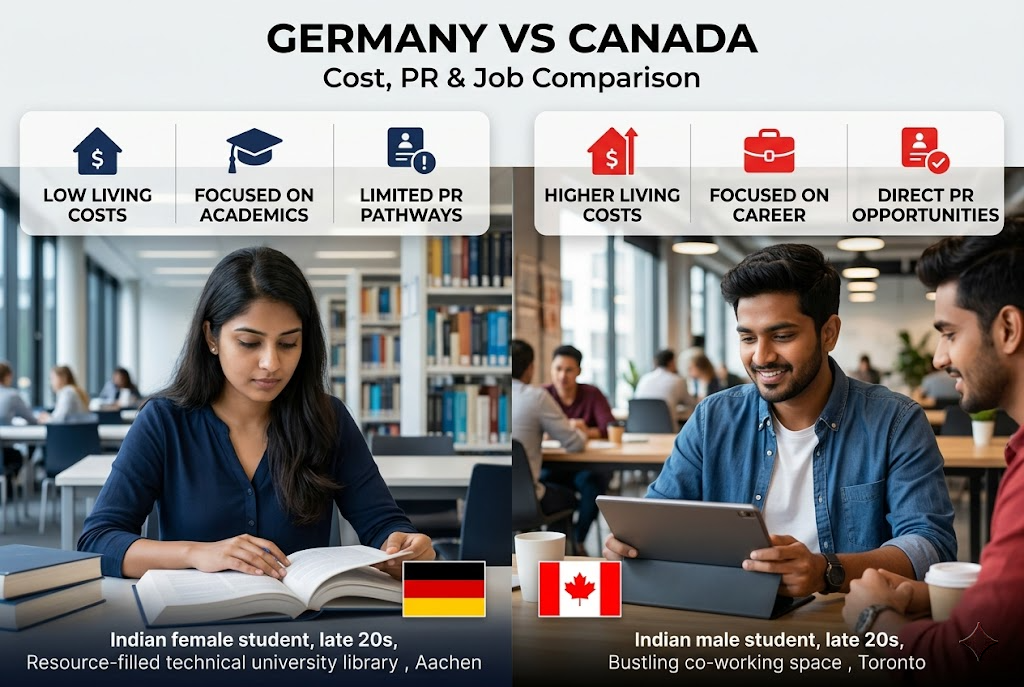
For Indian students planning international education in 2026, Germany and Canada continue to dominate the study abroad conversation. Both countries offer globally respected degrees, strong economies, and promising career opportunities. However, the real decision goes far beyond university rankings. Students today are carefully comparing tuition fees, job opportunities, visa systems, permanent residency pathways, and long-term return on investment before making a final choice.
The Germany Canada study comparison has become especially important because global education costs are rising rapidly. Families are no longer willing to spend massive amounts without understanding career outcomes and settlement opportunities.
Germany attracts students with affordable education and Europe’s industrial economy. Canada, meanwhile, remains highly attractive because of its immigration-friendly system, multicultural society, and English-speaking environment.
According to the Government of Canada Immigration Portal, international graduates continue to play a major role in Canada’s workforce strategy. Meanwhile, DAAD Germany Official Website reports growing international demand for German universities, particularly in engineering and technology programs.
If you are confused between these two destinations, this detailed comparison will help you make a smarter and more realistic decision.
Germany has become globally famous for low-cost education.
Most public universities charge either zero tuition fees or only a small semester contribution ranging from €150 to €350. This makes Germany extremely attractive for students from middle-class families seeking high-quality education without massive debt.
Canada follows a completely different model.
International students generally pay:
CAD 15,000–45,000 annually for undergraduate programs
However, Canada often provides faster financial recovery through better earning opportunities during and after studies.
Germany Canada Study Comparison for Job Opportunities
Career opportunities depend heavily on your academic field and long-term goals.
Germany is particularly strong in:
Mechanical engineering
Automotive technology
Robotics
Manufacturing
Renewable energy
Industrial automation
Canada performs exceptionally well in:
Information technology
Healthcare
Business analytics
Artificial intelligence
Finance
Construction management
Germany’s economy revolves around advanced industrial production and engineering excellence. Therefore, technically skilled graduates often find excellent opportunities there.
Meanwhile, Canada’s labor market is broader and more immigration-oriented. International graduates frequently benefit from employer-friendly hiring systems and easier workplace integration.
According to Statista Global Employment Data, Canada consistently ranks among the leading destinations for international graduate retention due to labor shortages and immigration demand.
Cost of Living: Which Country Is More Budget-Friendly?
Many students underestimate daily expenses while comparing tuition fees.
In Germany:
Average monthly expenses: €850–€1,400
Public transport discounts reduce commuting costs
Student housing is affordable but competitive
In Canada:
Average monthly expenses: CAD 1,500–3,000
Rent is significantly higher in major cities
Winter expenses increase overall budgets
Cities like Toronto and Vancouver are among the most expensive student destinations globally.
Germany generally remains more affordable, especially in smaller cities like Leipzig, Dresden, or Aachen.
However, Canadian students often offset living expenses through higher-paying part-time jobs.
PR Opportunities: Canada Has a Strong Advantage
Permanent residency is one of the biggest deciding factors for Indian students.
Canada offers one of the world’s clearest immigration systems for international graduates.
Students can access:
Post-Graduation Work Permit (PGWP)
Express Entry system
Provincial Nominee Programs (PNPs)
Canadian Experience Class pathways
These systems are specifically designed to help international students transition into permanent residency.
Germany also provides strong long-term opportunities through:
18-month job-seeking visa
EU Blue Card
Long-term residence permits
However, Germany’s PR process usually requires:
Stable employment
Longer settlement periods
Stronger German language integration
For students focused mainly on immigration and settlement, Canada often becomes the more straightforward option.
Student Visa Process and Approval Difficulty
Germany’s visa process is more documentation-intensive.
Students usually require:
APS certificate
Blocked account proof
University admission letter
Health insurance
Academic verification documents
Processing times can stretch for weeks during peak intake seasons.
Canada’s visa process is largely digital and more streamlined. However, financial scrutiny remains strict.
Here’s a direct comparison:
Factor
Germany
Canada
Visa Complexity
High
Moderate
Processing Speed
Slower
Faster
Financial Proof
Strict
Strict
Interview Requirement
Sometimes
Rare
Documentation Volume
Extensive
Moderate
Students looking for smoother administrative processes often prefer Canada.
Language and Student Lifestyle Differences
Canada offers a major advantage through its English-speaking environment.
International students usually adapt faster because:
Communication is easier
Social integration is smoother
Part-time jobs are easier to access
Germany offers many English-taught programs, especially at the master’s level. However, long-term employability improves significantly with German language skills.
Even basic daily tasks such as:
Renting apartments
Visiting local offices
Networking professionally
can become difficult without German proficiency.
Lifestyle differences also matter.
Canada offers:
Multicultural communities
Familiar Western culture
Easier networking
Friendly immigration ecosystem
Germany offers:
Strong public infrastructure
Affordable transportation
High-quality healthcare
Excellent work-life balance
Expert Insight: ROI Matters More Than Rankings
Many students choose countries emotionally rather than strategically.
The smartest international students focus on:
Total cost of education
Long-term salary potential
PR accessibility
Industry demand
Economic stability
Future career flexibility
Germany offers exceptional ROI for technically skilled students who are willing to adapt linguistically and culturally.
Canada offers smoother transition pathways and stronger immigration predictability.
However, rising housing costs and stricter immigration competition are becoming growing concerns in Canada. Meanwhile, Germany’s slower bureaucracy can frustrate newcomers unfamiliar with European administrative systems.
Choosing wisely requires understanding your own priorities first.
Latest Trends and Updates
Canada has recently tightened several student visa and institutional compliance rules to manage rising international student numbers and housing pressure in major cities.

Meanwhile, Germany is aggressively expanding skilled migration pathways to attract international talent in engineering, AI, renewable energy, and manufacturing sectors.

AI-driven recruitment systems are increasingly influencing graduate hiring decisions in both countries, especially for technology and analytics roles.

Canadian employers continue prioritizing local internship and co-op experience, making practical exposure more important than academic grades alone.

Germany is also increasing English-taught programs to remain globally competitive while addressing long-term labor shortages across technical industries.
Real-Life Example: Two Students, Two Different Priorities
Rahul chose Germany for a master’s in automotive engineering because tuition costs were minimal. During his studies, he learned German and eventually secured a role with an industrial manufacturer in Stuttgart.
Meanwhile, Neha selected Canada for a data analytics program in Toronto. Although her educational costs were significantly higher, she benefited from co-op opportunities and later transitioned into permanent residency through Canada’s immigration pathways.
Both students achieved successful outcomes.
However, Rahul optimized for affordability and technical specialization, while Neha optimized for easier integration and immigration flexibility.
Pros and Cons of Studying in Germany vs Canada
Country
Pros
Cons
Germany
Low tuition fees, strong engineering sector, affordable living
Language barrier, slower bureaucracy
Canada
Easier PR pathways, English-speaking environment, strong graduate support
High tuition and housing costs
Beginner vs Expert Approach to Study Abroad Planning
Quick Checklist Before Finalizing Your Destination
Define your long-term career goals
Compare tuition and living expenses
Research graduate salaries
Understand visa requirements
Review PR opportunities
Evaluate language comfort level
Explore part-time work options
Conclusion
The Germany vs Canada decision is not about finding a universally “better” country. It is about choosing the destination that aligns best with your financial situation, career goals, immigration priorities, and lifestyle preferences.
Germany offers exceptional value for technically skilled students seeking affordable education and strong industrial career opportunities. Canada, meanwhile, provides smoother integration, English-speaking comfort, and one of the world’s strongest immigration systems for international graduates.
The students who make the smartest decisions are not the ones who follow trends blindly. They are the ones who carefully evaluate long-term return on investment, employability, and future opportunities before committing to a destination.
Your study abroad journey should not only help you earn a degree — it should help you build a sustainable and successful future.
FAQs
Yes. Germany is generally much more affordable because many public universities charge very low or no tuition fees.
Canada usually offers more structured and accessible PR pathways for international graduates.
Not always for studies, but German skills significantly improve employment and long-term settlement opportunities.
Both countries offer excellent opportunities, but Germany excels in engineering while Canada performs strongly in IT, healthcare, and business sectors.
Yes. Both Germany and Canada allow international students to work part-time during their studies.

 May 19, 2026
 8 Min
 No Comment