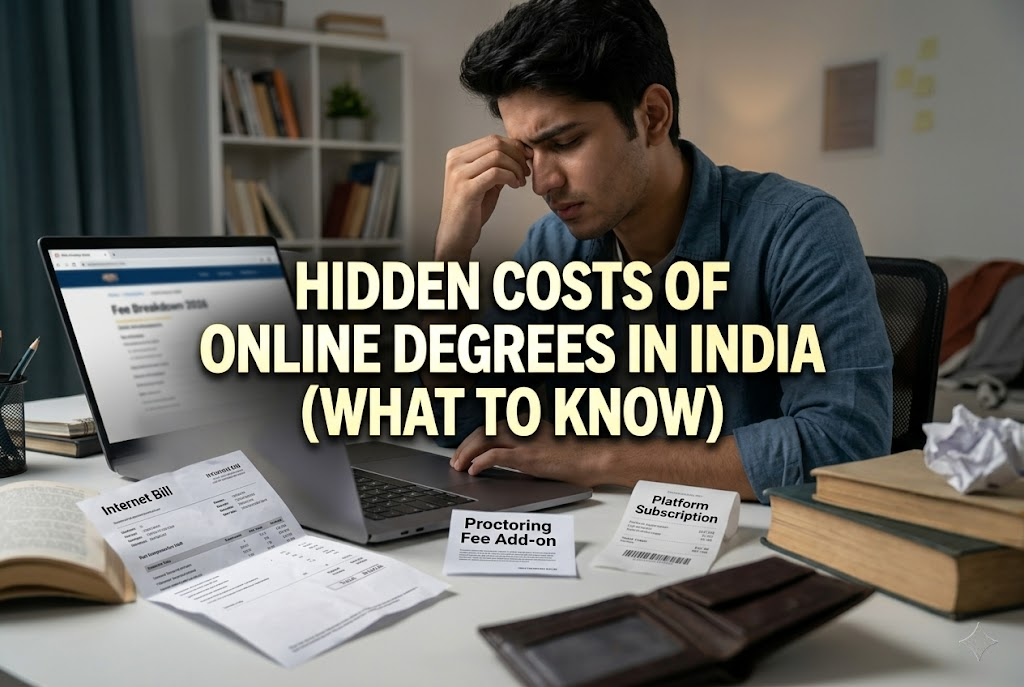
Online degrees in India are often marketed as “affordable,” “flexible,” and “budget-friendly.” On the surface, the pricing looks attractive compared to traditional college education. However, many students later discover that the advertised fee is not the actual amount they end up paying. Understanding the hidden costs online degrees frequently involve can save students from major financial surprises.
This issue has become increasingly important as India’s online education market grows rapidly. From online MBAs and BBA programs to MCA and data science courses, universities are aggressively promoting digital education. Yet many students only realize the real expenses after enrollment.
According to recent education industry reports, online degree fees in India can range from ₹20,000 to more than ₹10 lakh depending on the university, specialization, and additional services included. (College King)
Students researching affordable education planning and career-focused learning paths can also explore insights through OneGrasp Education Resources.
Most online universities advertise only the base tuition fee.
For example:
“Online MBA starting at ₹50,000”
“UGC-approved online BBA for ₹30,000”
“Affordable online MCA”
While technically true, these advertisements often exclude multiple secondary expenses.
Many students assume online learning eliminates most educational costs. In reality, digital education shifts expenses into different categories rather than removing them entirely.
The Most Common Hidden Costs in Online Degrees
Examination and Proctoring Fees
One of the biggest hidden charges is examination-related costs.
Several universities charge separately for:
Semester exams
Re-attempt exams
Supplementary exams
Online proctoring systems
Revaluation requests
Some online MBA and MCA programs charge ₹2,000–₹8,000 annually just for examination processing. (OnlineCU)
Many students discover these costs only after admission confirmation.
Technology and Device Expenses
Online learning requires reliable digital infrastructure.
This includes:
Requirement
Estimated Cost
Laptop/Desktop
₹30,000–₹80,000
High-speed Internet
₹700–₹1,500/month
Webcam & Headset
₹2,000–₹6,000
Backup Power Solutions
₹3,000–₹15,000
Students from rural or low-connectivity areas often spend even more to maintain stable access to live classes and exams.
According to online education guidance resources, technology requirements are among the most overlooked expenses in digital learning. (OnlineCU)
Software Subscription Charges Add Up Quickly
Many online programs require paid software tools.
Examples include:
Microsoft Office subscriptions
Coding software
Cloud computing tools
Data analytics platforms
Design software licenses
Specialized programs like online MCA, data science, or digital marketing degrees may require additional paid tools not included in tuition.
For instance, cloud lab access or premium analytics software can significantly increase the total learning cost.
Placement and Career Service Charges
Some private online universities promote “placement assistance” aggressively.
However, students often later discover separate charges for:
Placement training
Resume workshops
Mock interviews
Industry certifications
Internship programs
In some institutions, these career-related services are optional add-ons rather than part of the core degree fee.
Discussions on Reddit and student communities frequently mention unexpected “skill development” and placement-related charges not clearly explained during admission. (Reddit)
Printed Study Material and Certification Fees
Although online learning is digital-first, many universities still charge extra for:
Printed books
Physical study materials
Degree certificates
Transcript copies
Verification documents
Administrative charges may seem small individually but can accumulate over a multi-year program.
According to online education fee analyses, many students underestimate these post-completion administrative expenses. (OnlineCU)
Hidden EMI and Loan Costs
Many private online universities promote “easy EMI” options.
However, students sometimes ignore:
Interest rates
Processing charges
Late payment penalties
Loan documentation fees
An online MBA advertised at ₹1.5 lakh may eventually cost far more when financed through long-term EMI plans.
Therefore, students should calculate the complete repayment amount instead of focusing only on monthly installments.
Government vs Private Online Degrees: Hidden Cost Difference
Government universities are usually more transparent with fee structures.
Private universities, meanwhile, often provide:
Better learning platforms
Placement services
Live mentoring
Industry certifications
But these benefits frequently increase total cost.
Expense Type
Government Online Degree
Private Online Degree
Base Tuition
Low
High
Placement Services
Minimal
Often Charged Extra
Software Access
Limited
Sometimes Included
Exam Fees
Moderate
Higher
Marketing Transparency
Usually Better
Sometimes Aggressive
IGNOU and other government institutions remain among the cheapest recognized online degree providers in India. (edifyedu.in)
Expert Insight / Analysis
The biggest mistake students make is comparing online degree fees only by brochure price.
Experienced education advisors instead calculate:
Total program cost
Technology expenses
Certification fees
Placement costs
Opportunity cost
Skill ROI
Interestingly, the cheapest online degree is not always the smartest choice.
For example, a low-cost degree with poor career support may provide weaker outcomes than a slightly more expensive program with strong networking and placement assistance.
However, expensive branding alone does not guarantee career success either.
Experts increasingly recommend prioritizing:
UGC-DEB recognition
Curriculum relevance
Skill development
Alumni outcomes
Industry exposure
over pure marketing claims.
Common Mistakes Students Should Avoid
Many online learners make avoidable financial mistakes.
Common issues include:
Ignoring fine-print fee structures
Choosing universities based only on ads
Not verifying UGC approval
Underestimating technology costs
Assuming placement guarantees are real
Ignoring certification expenses
Another major mistake is assuming online learning automatically means “cheap.”
While online degrees can save hostel and commuting expenses, hidden academic and technology costs still matter.
Latest Trends / Updates
Online universities in India are increasingly introducing AI-powered learning systems and advanced LMS platforms.

Private universities now bundle career coaching, certifications, and internships into premium online degree packages.

Government institutions are gradually improving digital infrastructure to compete with private online education providers.

Hybrid learning models combining online classes with optional campus immersion programs are becoming more popular.

Students are increasingly comparing total ROI instead of only tuition fees before choosing online programs.

UGC and education authorities continue tightening regulations against fake and unapproved online universities across India.
Real-Life Example / Mini Case Study
Consider the example of Karthik, a working professional from Bengaluru who enrolled in an online MBA program advertised at ₹1.2 lakh.
Initially, he believed the degree would cost only the advertised amount. However, over two years, he additionally spent on:
Exam fees
Software subscriptions
Placement workshops
Internet upgrades
Laptop replacement
Certification add-ons
His actual total investment crossed ₹1.8 lakh.
Fortunately, the degree helped him secure a promotion later. But the experience taught him the importance of evaluating total educational cost instead of brochure pricing alone.
Pros and Cons of Online Degrees in India
Pros
Cons
Flexible learning schedules
Hidden additional fees
Lower cost than regular colleges
Technology expenses
Suitable for working professionals
Variable placement quality
Accessible from anywhere
Self-discipline required
Growing employer acceptance
Risk of fake universities
Beginner vs Expert Decision Approach
Beginner Thinking
Expert Thinking
Focuses only on tuition fee
Calculates total program cost
Trusts advertisements blindly
Verifies fee structure carefully
Ignores hidden expenses
Budgets for technology and exams
Chooses based on brand hype
Evaluates ROI realistically
Assumes placement guarantee
Researches alumni outcomes
How to Identify Hidden Costs Before Admission
Before enrolling in any online degree program:
Ask for a complete fee breakdown.
Verify exam charges separately.
Confirm software and LMS access costs.
Check whether placement services are included.
Research alumni experiences online.
Verify UGC-DEB recognition carefully.
Estimate total technology expenses realistically.
Students can also stay updated on education trends and career planning through OneGrasp Career Insights.
Quick Checklist
Verify UGC-DEB approval
Ask for all hidden charges
Budget technology expenses
Check placement transparency
Compare total ROI
Read student reviews carefully
Avoid fake universities
Conclusion
Online degrees in India can provide excellent flexibility and affordability, but students must look beyond the advertised tuition fee. Hidden expenses related to exams, technology, certifications, software, and placement support can significantly increase the real cost of education.
The smartest approach is not choosing the cheapest option blindly. Instead, students should evaluate total ROI, career relevance, and long-term value before enrolling.
Careful research, transparent fee analysis, and realistic budgeting can prevent financial surprises later. Platforms like OneGrasp can also help students stay informed about education trends, career planning, and future-ready opportunities in India.
FAQs
Usually yes, but many programs include hidden costs like exam fees, software subscriptions, and certification charges. (OnlineCU)
Common hidden charges include exam fees, proctoring fees, LMS access charges, certification fees, and placement training costs. (OnlineCU)
Yes. Government online universities are generally far more affordable than private online institutions. (College King)
Students should verify UGC-DEB approval and avoid institutions listed in UGC fake university warnings. (FindMyCollege)
Many employers now accept UGC-approved online degrees, especially when candidates also demonstrate practical skills and work experience. (College King)

 May 23, 2026
 7 Min
 No Comment