November 20, 2026
 8 Min
 No Comment
Meta Title: Voyager 1 Reaches One Light-Day from Earth | NASA’s Historic Mission
Meta Description: Discover how NASA’s Voyager 1 reached one light-day from Earth, its groundbreaking discoveries at Jupiter and Saturn, and its remarkable journey into interstellar space.
Focus Keyword: Voyager 1 one light-day from Earth
Suggested URL Slug: voyager-1-one-light-day-from-earth
Category: Space Science & Astronomy
Introduction: A Spacecraft That Continues to Rewrite History
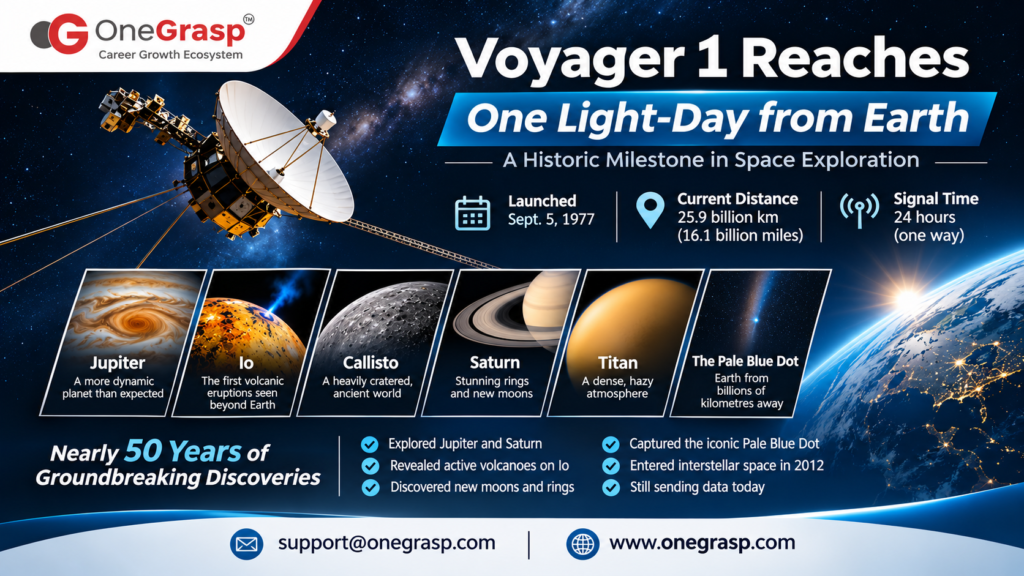
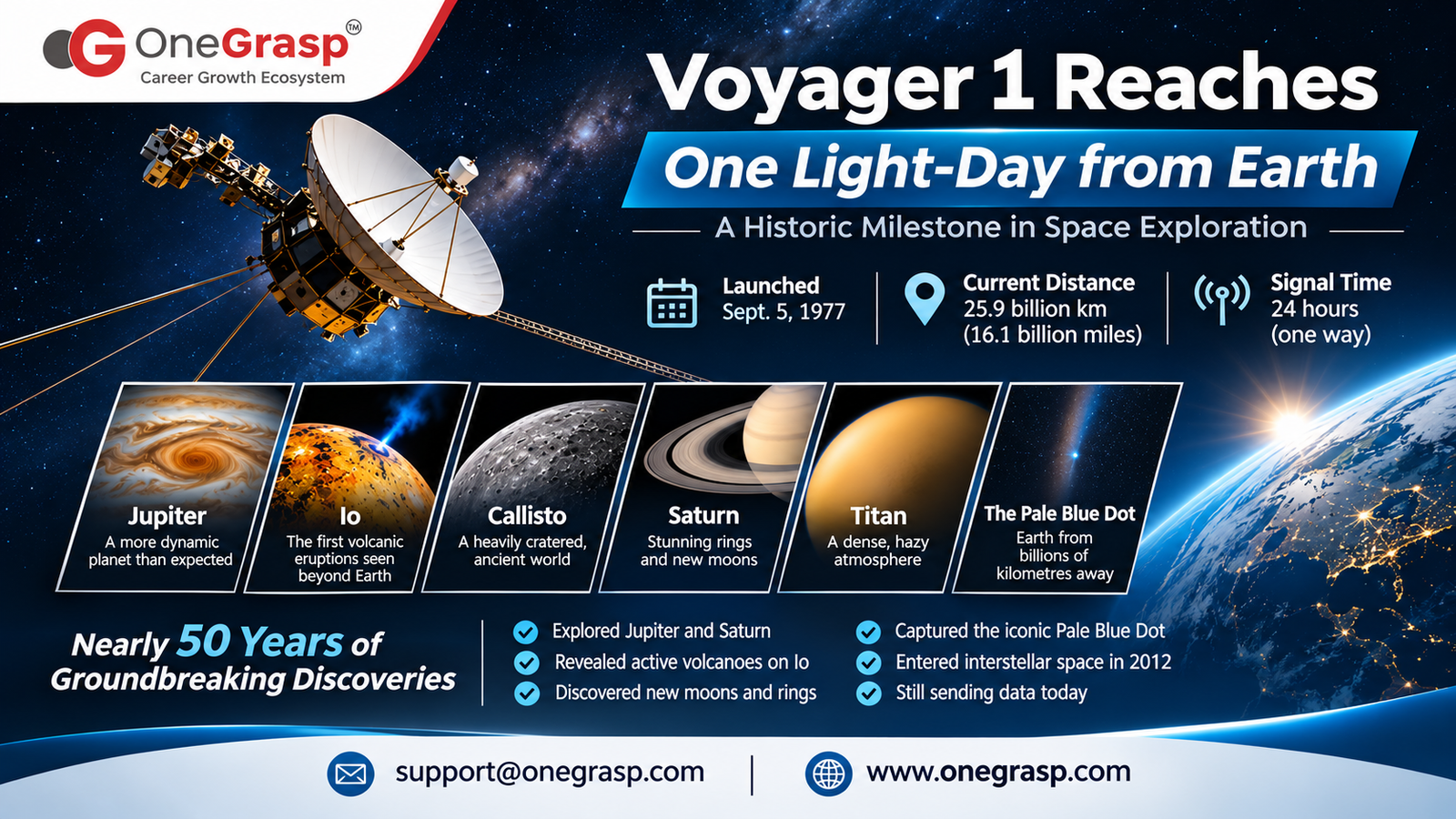
Humanity has achieved another remarkable milestone in space exploration. NASA’s Voyager 1 spacecraft, launched in September 1977, has become the first human-made object to travel a distance of one light-day from Earth.
This extraordinary achievement represents more than just a distance record. It demonstrates how far human curiosity, scientific innovation, and technological determination can take us.
Now operating approximately 25.9 billion kilometres (16.1 billion miles) from Earth, Voyager 1 has travelled so far that a radio signal moving at the speed of light takes approximately 24 hours to reach it or return to Earth.
Nearly five decades after its launch, this pioneering spacecraft continues to explore the space between stars, providing scientists with valuable information about our universe.
1. What Does One Light-Day from Earth Mean?
A light-day is the distance that light travels through space in 24 hours.
Since light travels at approximately 299,792 kilometres per second, one light-day equals approximately 25.9 billion kilometres.
For Voyager 1, reaching this milestone means communication has become increasingly challenging. When scientists send a command to the spacecraft, they must wait approximately 24 hours for the signal to arrive, followed by another 24 hours for a response.
This creates a communication delay of nearly two days for a complete round trip.
Despite these challenges, Voyager 1 continues to operate with some of its scientific instruments, making it one of humanity’s most extraordinary engineering achievements.
2. The Beginning of an Extraordinary Journey: Voyager 1’s Launch
NASA launched Voyager 1 on September 5, 1977, from Cape Canaveral, Florida, as part of its ambitious Voyager mission.
Its primary objective was to study the outer planets of our solar system, particularly Jupiter and Saturn, and investigate their moons, atmospheres, magnetic fields, and surrounding environments.
Voyager 2 was launched earlier, on August 20, 1977. However, Voyager 1 followed a faster trajectory and eventually became the first of the two spacecraft to enter interstellar space.
What began as a planetary exploration mission gradually became one of the longest-running scientific journeys in human history.
3. Jupiter: Discovering a More Dynamic Planet
One of Voyager 1’s most important encounters occurred when it approached Jupiter in March 1979.
The spacecraft captured detailed photographs of Jupiter’s atmosphere, revealing powerful storms, complex cloud formations, and atmospheric movements that had never been observed in such detail.
However, Jupiter itself was not the only discovery.
The Discovery of Active Volcanoes on Io
Perhaps the most surprising discovery was the observation of active volcanic eruptions on Io, one of Jupiter’s largest moons.
Before this discovery, scientists generally expected the moons of Jupiter to resemble Earth’s Moon: ancient worlds with relatively inactive surfaces.
Voyager 1 changed that understanding completely.
Its observations revealed active volcanoes, demonstrating that geological activity was not exclusive to Earth.
Exploring Callisto and Jupiter’s Ring System
Voyager 1 also captured detailed images of Callisto, revealing extensive impact craters that provided evidence of its ancient geological history.
Another unexpected finding was Jupiter’s faint ring system. Scientists discovered that Jupiter, like Saturn, possesses rings, although they are much thinner and fainter.
These discoveries significantly expanded scientific understanding of giant planets and their satellite systems.
4. Saturn: Revealing the Beauty of Its Rings and Moons
In November 1980, Voyager 1 reached Saturn, providing scientists with an unprecedented opportunity to study the ringed planet.
Its photographs revealed spectacular details of Saturn’s rings, including their structure, brightness, and interaction with the planet’s atmosphere.
One particularly remarkable photograph captured Saturn’s night side, showing the planet’s shadow extending across its magnificent rings.
Discovering More About Saturn’s Moons
Voyager 1 also identified five previously unknown moons around Saturn and photographed several known satellites.
Its observations of Titan, Saturn’s largest moon, were especially significant.
The spacecraft discovered that Titan possesses an exceptionally dense and hazy atmosphere that prevents visible-light cameras from directly observing its surface.
This discovery opened new possibilities for future research into planetary atmospheres and the potential environments of distant worlds.
5. The Pale Blue Dot: A Powerful Reminder of Earth’s Place in the Universe
In February 1990, Voyager 1 turned its cameras back toward the solar system and captured one of the most iconic photographs in the history of astronomy.
Known as the Pale Blue Dot, the photograph shows Earth as an extremely small point of light suspended within a beam of sunlight.
The image was captured from approximately 6 billion kilometres away.
The photograph provides a remarkable perspective on our planet. Everything humanity has ever known, including civilizations, discoveries, achievements, and generations of people, exists on this tiny distant world.
The Pale Blue Dot became a powerful symbol of human existence, scientific curiosity, and the importance of protecting our planet.
6. Voyager 1 Enters Interstellar Space
In August 2012, Voyager 1 crossed the heliopause, the boundary where the Sun’s solar wind gives way to the surrounding interstellar medium.
This achievement made it the first spacecraft to enter interstellar space.
Its scientific instruments began providing direct measurements of the environment beyond the Sun’s protective influence.
Voyager 2 followed in November 2018, becoming the second spacecraft to enter interstellar space.
Even today, Voyager 1 continues to transmit scientific information, helping researchers understand the environment between stars.
7. Why Is Voyager 1 Still Important After Nearly 50 Years?
Voyager 1 is more than a spacecraft. It represents the remarkable possibilities of long-term scientific research and engineering.
Its continuing mission helps scientists investigate:
- Interstellar Space: Understanding the physical environment beyond our solar system.
- Solar Influence: Studying how the Sun’s influence extends into surrounding interstellar space.
- Cosmic Radiation: Measuring energetic particles and radiation in distant regions.
- Magnetic Fields: Investigating magnetic conditions beyond the heliosphere.
- Spacecraft Engineering: Understanding how spacecraft systems can survive for decades in extreme environments.
NASA engineers have also had to overcome numerous technical challenges to keep the spacecraft operational, including managing declining electrical power and maintaining communication across extraordinary distances.
8. What Lies Ahead for Voyager 1?
Voyager 1’s journey is far from an ordinary scientific expedition. It is a continuing experiment in human exploration.
The spacecraft’s available electrical power is gradually decreasing, and NASA engineers are carefully managing its remaining energy to extend its scientific operations.
Some scientific instruments are expected to remain operational into the 2030s, although their actual operating lifetimes depend on available power and spacecraft conditions.
Scientists are particularly interested in understanding how far the Sun’s influence extends and when Voyager 1 may begin measuring an environment less affected by solar activity.
Its journey may eventually continue silently through the Milky Way long after its communication systems stop functioning.
Conclusion: Humanity’s Curiosity Has No Boundaries
Voyager 1 reaching one light-day from Earth is a historic reminder of what humanity can achieve through scientific innovation, persistence, and curiosity.
From discovering active volcanoes on Jupiter’s moon Io to revealing Saturn’s extraordinary rings, capturing the iconic Pale Blue Dot, and entering interstellar space, Voyager 1 has transformed our understanding of the solar system.
Its journey demonstrates that scientific discoveries are not always limited by immediate results. Some of humanity’s greatest achievements continue to provide knowledge decades after they begin.
As Voyager 1 travels farther into the unknown, it carries a message about humanity’s desire to explore, understand, and discover what lies beyond our world.
The universe is vast, but human curiosity is even greater.
Frequently Asked Questions (FAQs)
1. What is Voyager 1’s one light-day milestone?
It refers to Voyager 1 reaching a distance at which light takes approximately 24 hours to travel between the spacecraft and Earth.
2. When was Voyager 1 launched?
NASA launched Voyager 1 on September 5, 1977.
3. What were Voyager 1’s most important discoveries?
Its major discoveries include active volcanoes on Jupiter’s moon Io, Jupiter’s faint ring system, Saturn’s moons and atmospheric characteristics of Titan, and the famous Pale Blue Dot photograph.
4. Is Voyager 1 in interstellar space?
Yes. Voyager 1 crossed the heliopause in August 2012 and became the first human-made spacecraft to enter interstellar space.
5. Can Voyager 1 still communicate with Earth?
Yes. Voyager 1 continues to communicate with NASA through radio signals, although the extreme distance creates significant communication delays.
6. How long will Voyager 1 continue operating?
Some of its scientific instruments are expected to remain operational into the 2030s, depending on available electrical power and spacecraft conditions.
7. What is the Pale Blue Dot?
It is an iconic photograph of Earth captured by Voyager 1 in 1990, showing our planet as a tiny point of light from billions of kilometres away.
Stay Curious. Stay Informed. Explore Beyond Boundaries with OneGrasp.