Discover 500+ International Scientific Conferences
Browse events

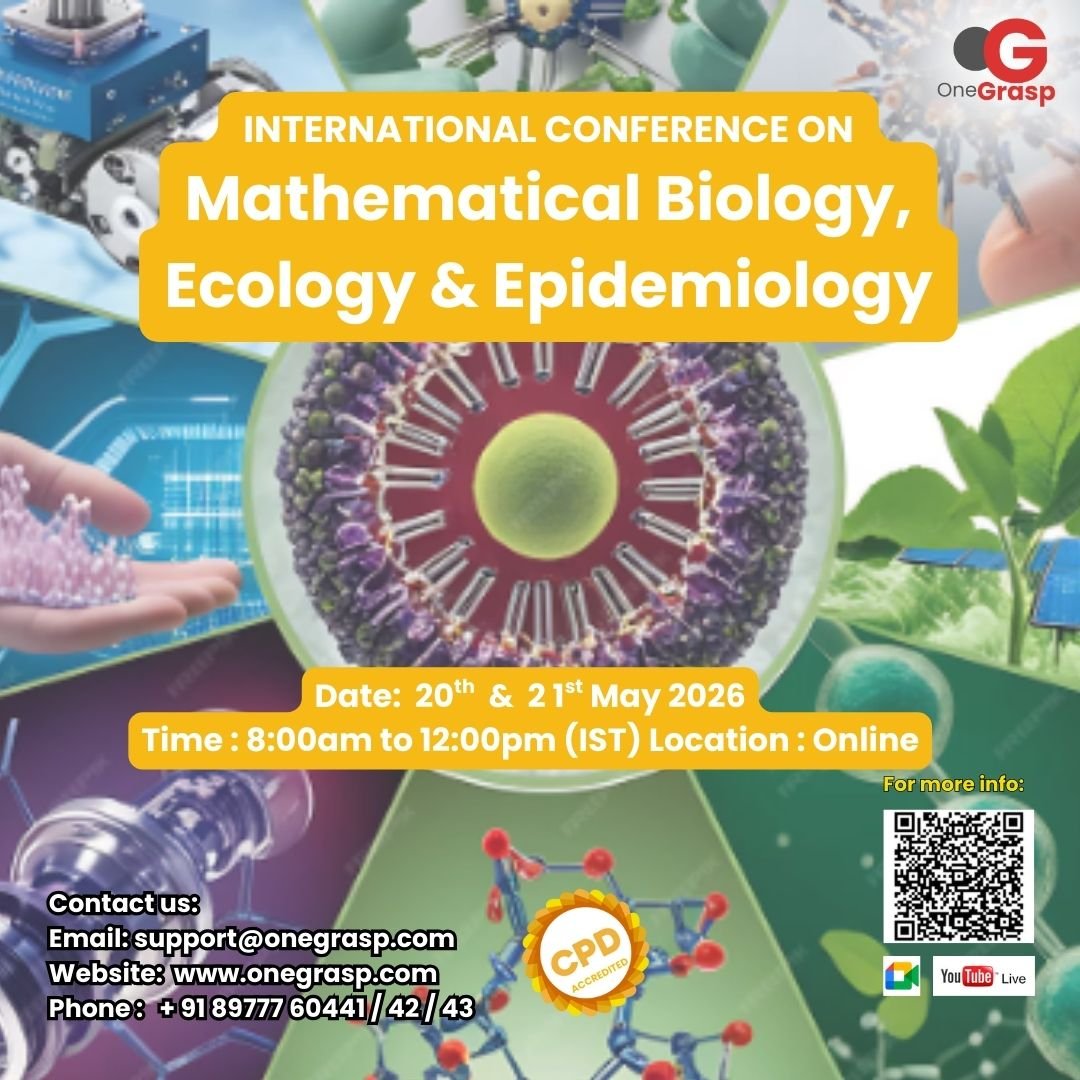
Date: 20th & 21st May 2026 | Time: 8.00 am – 12:00 pm (IST) | Location: Online
Overview
The International Conference on Mathematical Biology, Ecology & Epidemiology brings together mathematicians, biologists, and data scientists to discuss quantitative approaches for understanding biological phenomena, ecological interactions, and the dynamics of infectious diseases. The conference emphasizes mathematical modeling, computational simulation, and statistical tools that help decode complex biological and environmental systems. It aims to foster interdisciplinary collaboration to create sustainable solutions for global health, environmental management, and ecosystem stability.
Structure and Sessions (Who Does What)
Participate and Contribute (Who Benefits)
Benefits for Attendees
Abstract Topics / Call for Papers (CFP) Tracks
Detailed Program Grid
| Time (IST) | Day 1 | Day 2 |
| 08:00 – 08:15 | Opening Ceremony & Welcome | Recap and Opening Remarks |
| 08:15 – 09:00 | Keynote: Modeling Complexity in Biological Systems | Keynote: Epidemiology and Ecology within Mathematical Frameworks |
| 09:00 – 10:15 | Technical Session I – Mathematical Biology & Population Modeling | Technical Session IV – Disease Modeling & Epidemiological Studies |
| 10:15 – 10:30 | Break | Break |
| 10:30 – 11:15 | Technical Session II – Ecological Systems & Environmental Dynamics | Technical Session V – Computational Biology & Bioinformatics |
| 11:15 – 11:45 | Panel Discussion: Integration of Mathematics with Life Sciences | Student & Research Forum: Emerging Models and Applications |
| 11:45 – 12:00 | Day Summary & Announcements | Awards & Closing Ceremony |
Submit Abstract & Registration
| Conference Dates | Conference Title | Timing (IST) | Abstract Submission Deadline | Registration Deadline |
| 20th, 21st May 2026 | International Conference on Mathematical Biology, Ecology & Epidemiology | 8:00 AM – 12:00 PM | 11th May 2026 | 13th May 2026 |
Abstract Guidelines
Conclusion
This international conference celebrates the growing synergy between mathematics, biology, and environmental sciences. It provides a forum for discussing advanced modeling and data-driven frameworks that improve understanding of complex biological processes, population systems, and disease spread while advancing sustainable research and policy outcomes.