June 11, 2026
 8 Min
 No Comment
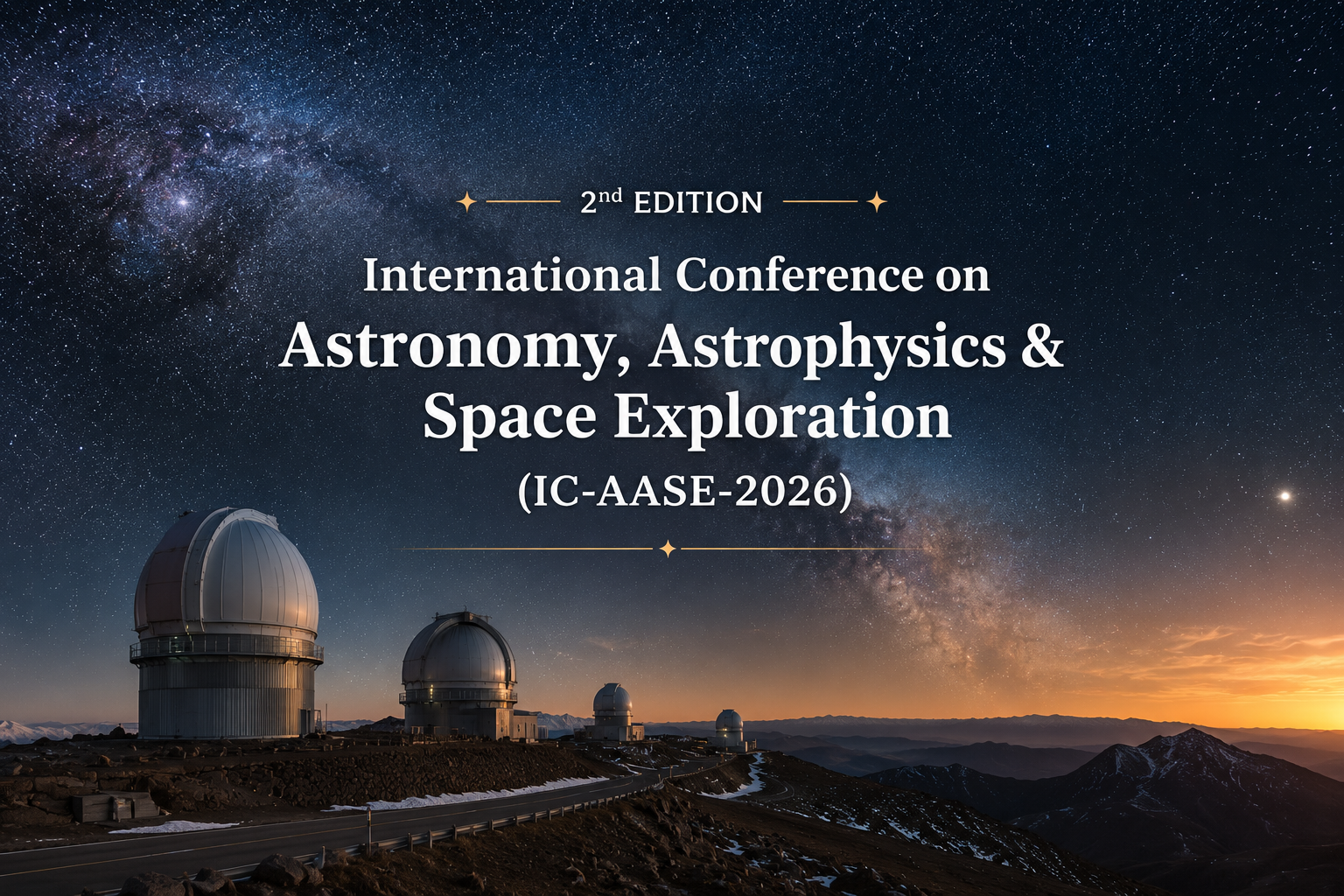
Humanity has always looked toward the stars with curiosity, seeking answers to some of the most profound questions about our existence and the nature of the universe. Today, advances in observational astronomy, astrophysics, artificial intelligence, space technology, and deep-space exploration are transforming our understanding of the cosmos at an unprecedented pace. The Astronomy Astrophysics Space Exploration community plays a vital role in driving discoveries that reshape our knowledge of planets, galaxies, black holes, dark matter, and the origins of the universe.
The 2nd Edition International Conference on Astronomy, Astrophysics & Space Exploration (IC-AASE-2026) provides a global platform for astronomers, astrophysicists, space scientists, engineers, researchers, educators, and students to share groundbreaking discoveries and discuss the future of space exploration. As governments and private organizations invest billions of dollars into space research and technology, the importance of international collaboration has never been greater.
Researchers, scientists, and enthusiasts interested in participating can Register Here: https://onegrasp.com/events/physical-life-sciences/2nd-edition-international-conference-on-astronomy-astrophysics-space-exploration-ic-aase-2026/
What the Conference Is About
Direct Answer: IC-AASE-2026 is an international conference dedicated to astronomy, astrophysics, cosmology, planetary science, space technology, and future space exploration initiatives.
The conference brings together experts from academia, research institutions, observatories, space agencies, and industry to discuss emerging discoveries and technological advancements shaping the future of space science.
Modern astronomy conferences increasingly focus on interdisciplinary research that combines physics, data science, artificial intelligence, engineering, and computational modeling to address complex cosmic questions.
Why Astronomy Astrophysics Space Exploration Matters Today
Direct Answer: Astronomy and space exploration drive scientific innovation, technological advancement, and our understanding of the universe.
Space research has historically generated technologies that impact everyday life, including satellite communications, GPS systems, weather forecasting, imaging technologies, and advanced materials.
According to organizations such as the National Aeronautics and Space Administration (NASA) and the European Space Agency (ESA), investments in space exploration continue to produce significant scientific, technological, and economic benefits.
Recent discoveries involving exoplanets, gravitational waves, black holes, and cosmic structures demonstrate how rapidly the field is advancing.
Learn more about global space exploration initiatives at:
Astronomy Astrophysics Space Exploration Research Areas
Direct Answer: The conference covers a broad range of topics related to observational astronomy, theoretical astrophysics, cosmology, planetary science, and space technology.
Major themes include:
- Observational Astronomy
- Astrophysics
- Cosmology
- Dark Matter and Dark Energy
- Black Hole Physics
- Exoplanet Discovery
- Planetary Science
- Space Missions
- Astrobiology
- Radio Astronomy
- Computational Astrophysics
- Space Instrumentation
- Satellite Technologies
- Space Exploration Strategies
- Artificial Intelligence in Astronomy
These research areas continue expanding as new telescopes, satellites, and computational tools generate unprecedented amounts of scientific data.
The New Era of Space Exploration
Direct Answer: Space exploration is entering a transformative period driven by international collaboration and private-sector innovation.
Governments and commercial organizations are pursuing ambitious missions involving:
- Lunar exploration
- Mars missions
- Deep-space telescopes
- Space habitats
- Asteroid exploration
- Planetary defense initiatives
According to industry analyses and reports from the World Economic Forum, the global space economy is expected to continue significant growth over the coming decades as space technologies become increasingly integrated into economic development.
This expansion creates new opportunities for researchers, engineers, and entrepreneurs worldwide.
Astronomy, Artificial Intelligence, and Big Data
Direct Answer: Artificial intelligence is revolutionizing astronomy by helping scientists analyze massive datasets and identify previously undetectable patterns.
Modern observatories generate enormous volumes of data daily. AI-powered systems assist researchers in:
- Detecting exoplanets
- Classifying galaxies
- Identifying transient events
- Processing telescope imagery
- Modeling cosmic structures
As observational capabilities improve, AI will play an increasingly important role in accelerating scientific discovery.
The integration of machine learning with astrophysical research is becoming a major focus area at leading research institutions worldwide.
Space Exploration and Sustainable Development
Direct Answer: Space technologies contribute significantly to sustainable development and global problem-solving.
Satellite systems support:
- Climate monitoring
- Disaster management
- Agricultural planning
- Environmental conservation
- Telecommunications
- Navigation systems
The United Nations recognizes the importance of space science and technology in supporting sustainable development goals and improving global resilience.
More information is available at:
As a result, space exploration is increasingly viewed not only as scientific discovery but also as a tool for addressing Earth-based challenges.
Opportunities for Researchers, Students, and Space Professionals
Direct Answer: IC-AASE-2026 provides opportunities for collaboration, networking, publication, and professional growth.
Participants can:
- Present original research
- Learn from international experts
- Explore emerging technologies
- Build research collaborations
- Discover funding opportunities
- Gain exposure to cutting-edge discoveries
For students and early-career researchers, the conference provides valuable access to leading scientists and institutions working at the forefront of space science.
Interested participants can Join IC-AASE-2026 Here: https://onegrasp.com/events/physical-life-sciences/2nd-edition-international-conference-on-astronomy-astrophysics-space-exploration-ic-aase-2026/
Career Benefits of Participating
Participation offers numerous professional advantages.
Benefits include:
- Increased research visibility
- Academic networking opportunities
- Exposure to emerging discoveries
- Access to interdisciplinary collaborations
- Professional development
- Enhanced publication prospects
As investment in space science grows globally, expertise in astronomy and astrophysics continues becoming increasingly valuable across academia, government agencies, and industry.
Expert Insight / Analysis
From an expert perspective, astronomy is entering one of the most exciting periods in its history.
The launch of advanced observatories, next-generation telescopes, and AI-powered research tools is enabling discoveries that were unimaginable just a decade ago. Questions about dark matter, dark energy, exoplanet habitability, and the origins of the universe are becoming increasingly accessible through improved observational capabilities.
The long-term significance of IC-AASE-2026 lies in its ability to foster collaboration among researchers from diverse disciplines. Many of the next major breakthroughs in space science are likely to emerge from interdisciplinary efforts combining astrophysics, engineering, data science, and artificial intelligence.
Latest Trends & Updates
Artificial intelligence is increasingly being used to process astronomical datasets, accelerating the discovery of exoplanets, cosmic events, and previously unknown celestial phenomena.

Private space companies are expanding the scope of commercial space exploration, contributing to innovation in launch systems, satellite technologies, and lunar mission planning.

New-generation space telescopes are providing unprecedented observations of distant galaxies, black holes, and planetary systems, enhancing our understanding of cosmic evolution.

International collaborations between research institutions and space agencies are driving ambitious projects involving lunar exploration, Mars missions, and deep-space observation programs.

Astrobiology research continues to advance as scientists investigate the conditions necessary for life beyond Earth and analyze potentially habitable exoplanets.

Space sustainability initiatives are gaining attention as organizations address concerns related to orbital debris, satellite congestion, and responsible space operations.

Quantum technologies and advanced computational models are emerging as powerful tools for solving complex astrophysical problems and improving observational accuracy.
Real-Life Example / Mini Case Study
Consider a graduate student researching exoplanet detection methods.
Initially, the student focused on traditional statistical approaches. After attending an international astronomy conference, they learned about machine learning techniques being applied to telescope data analysis.
By collaborating with astrophysicists and AI researchers, the student developed a more efficient detection model capable of identifying potential exoplanets with improved accuracy. The project later resulted in a publication and research partnership with an international observatory.
This example highlights how conferences can accelerate innovation and interdisciplinary collaboration.
Traditional Astronomy vs Modern Astronomy
| Traditional Astronomy | Modern Astronomy |
|---|---|
| Manual observations | AI-assisted analysis |
| Limited datasets | Massive astronomical databases |
| Isolated research teams | Global collaborations |
| Slower discovery cycles | Accelerated scientific discovery |
| Basic computational tools | Advanced simulations and modeling |
Beginner vs Expert Comparison
| Beginners | Experts |
|---|---|
| Learn astronomical concepts | Conduct original research |
| Focus on observations | Analyze complex datasets |
| Study known phenomena | Explore unanswered questions |
| Use standard tools | Develop innovative methodologies |
| Understand theories | Contribute to scientific advancement |
Pros and Cons
| Pros | Cons |
|---|---|
| Access to cutting-edge research | Requires technical expertise |
| Global networking opportunities | Competitive research environment |
| Collaboration potential | Extensive preparation |
| Professional development | Time commitment |
| Publication opportunities | Rapidly evolving field |
Common Mistakes to Avoid
Many participants miss valuable opportunities due to avoidable mistakes.
A common error is focusing only on a narrow specialization while ignoring interdisciplinary developments.
Another mistake is failing to prepare networking strategies before attending the conference.
Some researchers overlook emerging technologies such as AI and advanced simulations that are reshaping astronomical research.
Others underestimate the importance of communicating complex findings effectively to broader audiences.
What to Do Next (Actionable Steps)
- Review conference themes carefully.
- Identify relevant research topics.
- Prepare an abstract or presentation.
- Follow current astronomy discoveries.
- Study emerging space technologies.
- Register early for participation.
- Engage with researchers and experts.
- Explore interdisciplinary opportunities.
- Participate in networking sessions.
- Continue collaborations after the conference.
Official Registration: https://onegrasp.com/events/physical-life-sciences/2nd-edition-international-conference-on-astronomy-astrophysics-space-exploration-ic-aase-2026/
Quick Checklist
✔ Review conference topics
✔ Prepare research abstract
✔ Complete registration
✔ Follow recent space discoveries
✔ Study AI applications in astronomy
✔ Prepare presentation materials
✔ Network with experts
✔ Explore collaboration opportunities
✔ Stay updated on space missions
Conclusion
The 2nd Edition International Conference on Astronomy, Astrophysics & Space Exploration (IC-AASE-2026) offers a unique platform for advancing scientific discovery and fostering global collaboration in space science.
As humanity continues pushing the boundaries of exploration and understanding, the role of astronomy and astrophysics becomes increasingly significant. From uncovering the mysteries of distant galaxies to developing technologies that benefit life on Earth, space science remains one of the most inspiring and impactful fields of research.
For researchers, students, educators, and professionals seeking to contribute to the future of space exploration, IC-AASE-2026 provides an exceptional opportunity to learn, collaborate, and participate in shaping humanity’s next chapter among the stars.
FAQ
Astronomers, astrophysicists, space scientists, engineers, researchers, educators, students, and industry professionals interested in space exploration.
Yes. Students are encouraged to attend, present research, and engage with experts in the field.
Topics include astronomy, astrophysics, cosmology, planetary science, space technology, astrobiology, and future exploration missions.
No. Both students and experienced professionals can benefit from participating.
The conference provides networking opportunities, research exposure, collaboration possibilities, and professional development.