June 10, 2026
 9 Min
 No Comment
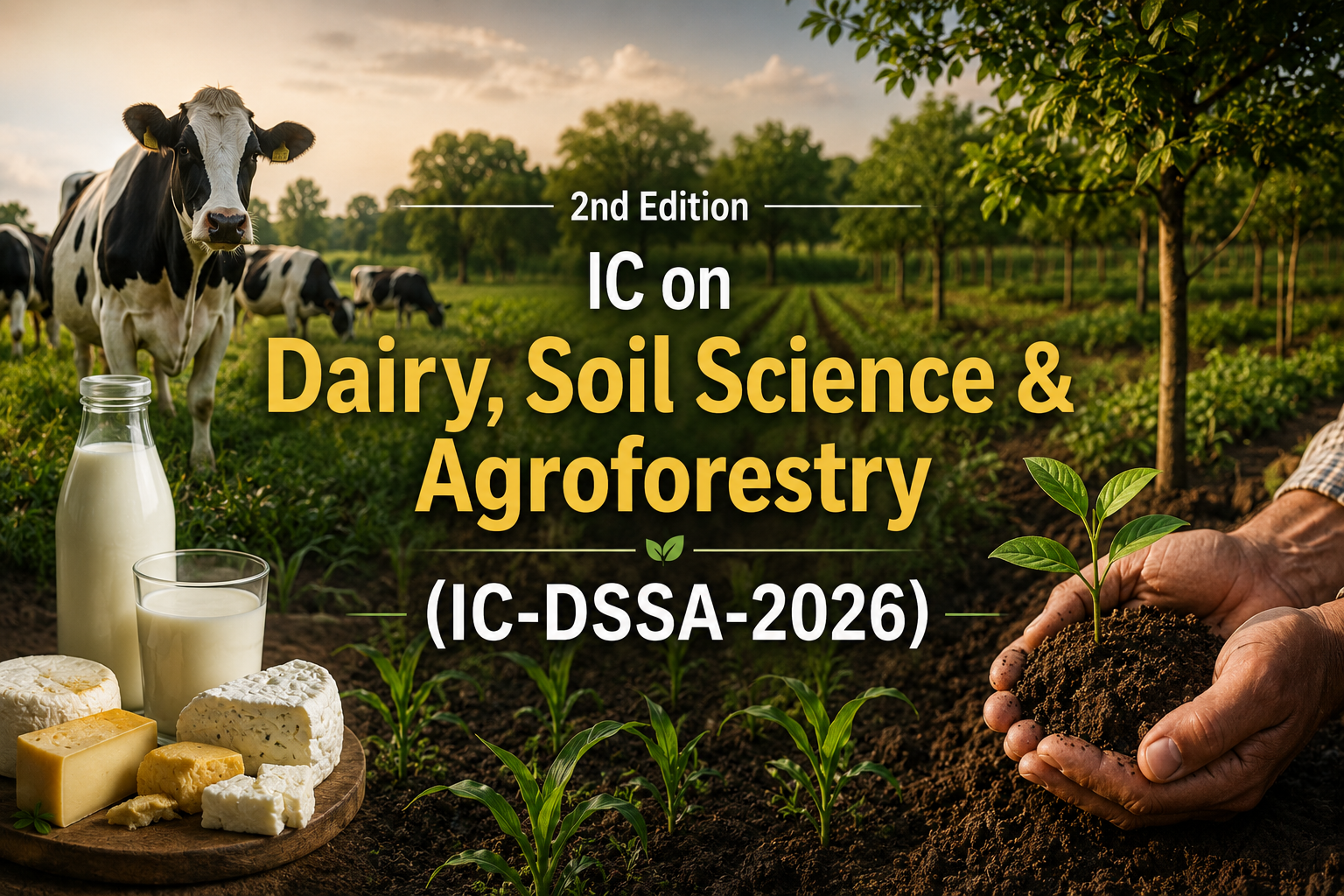
Agriculture is entering a new era where productivity, sustainability, and climate resilience must coexist. Farmers, researchers, policymakers, and agricultural innovators are increasingly recognizing that food security depends not only on crop yields but also on healthy soils, resilient farming systems, efficient dairy production, and integrated land management strategies. The IC DSSA 2026 Conference arrives at a crucial moment when agricultural systems worldwide face challenges related to climate change, soil degradation, biodiversity loss, and resource scarcity.
The 2nd Edition International Conference on Dairy, Soil Science & Agroforestry (IC-DSSA-2026) provides a global platform for researchers, agricultural scientists, dairy experts, environmental specialists, policymakers, industry professionals, and students to explore innovative solutions for sustainable agricultural development.
The conference encourages interdisciplinary collaboration across dairy science, soil management, agroforestry systems, climate-smart agriculture, livestock productivity, and environmental sustainability, helping shape the future of resilient food systems.
Participants can register here:
What the Conference Is About
Featured Snippet Answer
The International Conference on Dairy, Soil Science & Agroforestry (IC-DSSA-2026) is an international academic and professional forum focused on dairy science, soil health, agroforestry systems, sustainable agriculture, and climate-resilient farming practices.
The conference brings together experts from multiple agricultural disciplines to discuss research findings, technological innovations, policy frameworks, and practical solutions that improve agricultural productivity while protecting natural resources.
As global food demand continues increasing, integrated approaches involving livestock management, soil conservation, and agroforestry have become essential components of sustainable agricultural development.
Why Dairy, Soil Science and Agroforestry Matter Today
Featured Snippet Answer
Dairy production, soil health, and agroforestry play critical roles in food security, climate resilience, rural livelihoods, and sustainable agricultural growth.
Healthy soils support crop productivity, water retention, nutrient cycling, and ecosystem resilience. At the same time, dairy systems contribute significantly to nutrition, rural employment, and agricultural economies.
Agroforestry, which integrates trees, crops, and livestock within the same land-use system, has emerged as a powerful strategy for improving biodiversity, enhancing soil fertility, increasing carbon sequestration, and strengthening farmer incomes. Research indicates that agroforestry systems contribute to climate resilience while supporting sustainable development goals.
Consequently, conferences such as IC-DSSA-2026 are increasingly important for advancing knowledge and fostering collaboration across agricultural sectors.
IC DSSA 2026 Conference Themes and Research Areas
Featured Snippet Answer
The conference explores dairy science, soil fertility, agroforestry innovation, climate-smart agriculture, livestock management, and sustainable land-use systems.
Key research areas include:
- Dairy science and technology
- Dairy microbiology and food safety
- Soil fertility management
- Soil conservation and restoration
- Agroforestry systems
- Climate-smart agriculture
- Sustainable livestock production
- Carbon sequestration
- Precision agriculture
- Agricultural biotechnology
- Integrated farming systems
- Water and nutrient management
- Agricultural sustainability
- Food security research
These themes reflect the growing need for multidisciplinary approaches to agricultural challenges.
IC DSSA 2026 Conference and Soil Health Innovation
Featured Snippet Answer
Soil health innovation focuses on improving soil fertility, biodiversity, nutrient cycling, and long-term agricultural productivity.
Soil degradation remains one of the most pressing challenges facing agriculture worldwide. Declining organic matter, salinity, erosion, and nutrient depletion can significantly reduce crop productivity and environmental resilience.
Modern soil science research increasingly emphasizes:
- Soil restoration techniques
- Carbon management
- Microbial ecosystem enhancement
- Precision nutrient management
- Sustainable land-use planning
Recent studies demonstrate that integrated soil management practices can improve productivity while strengthening environmental sustainability.
Therefore, soil science remains a foundational element of sustainable agriculture.
Dairy Science and Sustainable Livestock Systems
Featured Snippet Answer
Dairy science focuses on improving milk production, animal health, food quality, processing efficiency, and sustainability throughout the dairy value chain.
The global dairy sector continues evolving through advances in biotechnology, animal nutrition, automation, and quality assurance systems.
Important research areas include:
- Dairy microbiology
- Milk quality and safety
- Animal nutrition
- Precision livestock management
- Dairy processing innovation
- Sustainable dairy production
Educational and research institutions increasingly emphasize integrating technology with sustainable dairy practices to improve productivity while minimizing environmental impact.
As a result, dairy science remains a key driver of agricultural innovation and food security.
Agroforestry and Climate-Smart Agriculture
Featured Snippet Answer
Agroforestry combines trees, crops, and livestock to create more resilient, productive, and environmentally sustainable farming systems.
Agroforestry offers numerous benefits:
- Improved soil health
- Enhanced biodiversity
- Carbon sequestration
- Water conservation
- Increased farm income diversification
- Climate adaptation support
Research from agroforestry experts highlights its significant role in strengthening livelihoods while promoting sustainable land management. In India, agroforestry contributes substantially to timber supply and rural economic development.
Consequently, agroforestry is increasingly recognized as an essential component of climate-smart agriculture strategies.
Technology and Digital Transformation in Agriculture
Featured Snippet Answer
Digital technologies are transforming agriculture through precision farming, remote sensing, data analytics, and smart farm management systems.
Emerging technologies include:
- Geographic information systems (GIS)
- Remote sensing
- Artificial intelligence
- Precision agriculture tools
- IoT-enabled monitoring systems
- Data-driven farm management
Modern agricultural research increasingly integrates digital technologies to improve decision-making, resource efficiency, and sustainability outcomes. Technological innovations also support agroforestry planning, species mapping, and land-use optimization.
Therefore, digital transformation is becoming a central theme in agricultural development discussions.
Opportunities for Researchers, Students and Agricultural Professionals
Featured Snippet Answer
IC-DSSA-2026 offers research exposure, professional development, networking opportunities, and interdisciplinary collaboration.
Researchers can:
- Present findings
- Receive expert feedback
- Build international collaborations
- Explore publication opportunities
Agricultural professionals benefit through:
- Exposure to emerging technologies
- Best-practice sharing
- Policy and industry insights
- Knowledge exchange
Students gain:
- Academic mentorship
- Career development opportunities
- Research experience
- Professional networking
These benefits often create long-term partnerships and innovation opportunities.
Comparison Table: Conventional Agriculture vs Integrated Agroforestry Systems
| Conventional Agriculture | Integrated Agroforestry Systems |
|---|---|
| Single-crop focus | Diverse production systems |
| Limited biodiversity | Enhanced biodiversity |
| Higher environmental vulnerability | Greater climate resilience |
| Short-term productivity focus | Long-term sustainability |
| Lower carbon sequestration | Higher carbon storage potential |
Beginner vs Expert Perspective
| Beginners | Experts |
|---|---|
| Focus on productivity | Focus on system resilience |
| Individual farm practices | Integrated landscape management |
| Basic soil management | Advanced soil ecosystem strategies |
| Livestock operations | Sustainable value-chain optimization |
| Technology adoption | Data-driven agricultural innovation |
Pros and Cons of Conference Participation
| Pros | Cons |
|---|---|
| Global networking | Time commitment |
| Research exposure | Competitive submissions |
| Knowledge sharing | Preparation requirements |
| Career advancement | Registration costs |
| Professional visibility | Travel considerations |
Expert Insight: Long-Term Implications for Sustainable Agriculture
The future of agriculture will depend increasingly on integrated approaches that balance productivity with environmental stewardship.
Climate change, soil degradation, water scarcity, and population growth require innovative solutions that strengthen agricultural resilience while protecting ecosystems.
Agroforestry, regenerative agriculture, sustainable dairy systems, and precision farming technologies offer promising pathways for achieving these objectives. Researchers are increasingly exploring how integrated farming systems can improve resource efficiency, enhance biodiversity, and support rural livelihoods.
The knowledge shared at IC-DSSA-2026 may contribute significantly to future agricultural policies, research priorities, and sustainability initiatives.
Latest Trends & Updates
Artificial intelligence is increasingly being applied to agricultural decision-making. AI-powered systems help farmers optimize irrigation schedules, monitor crop health, predict disease outbreaks, and improve livestock management.
Soil carbon sequestration has become a major focus area in agricultural sustainability research. Scientists are studying how regenerative farming practices and agroforestry systems can enhance carbon storage while improving soil productivity.
Digital agriculture continues advancing through remote sensing, satellite monitoring, geographic information systems, and precision farming technologies. These innovations enable more efficient resource management and improved agricultural planning.
Climate-smart agriculture is gaining momentum as governments and research institutions prioritize resilience-building strategies. Integrated farming systems, drought adaptation measures, and sustainable livestock management are receiving increased attention.
Responsible agricultural innovation is becoming increasingly important. Researchers and policymakers are focusing on balancing productivity gains with environmental protection, biodiversity conservation, and long-term food security.
Emerging research directions include microbial soil health enhancement, carbon farming, digital agroforestry, precision livestock systems, sustainable dairy technologies, and ecosystem-based land management approaches.
Real-Life Example: A Sustainable Agroforestry Research Project
Consider a doctoral researcher named Ravi.
Ravi was studying soil degradation in semi-arid farming regions where declining fertility and water scarcity were reducing agricultural productivity. Although his research identified potential solutions, he lacked access to interdisciplinary expertise.
After participating in an agricultural sustainability conference, Ravi connected with soil scientists, agroforestry researchers, and dairy systems experts.
Through these collaborations, he developed an integrated farming model combining agroforestry practices, improved soil management, and livestock integration.
The resulting pilot project improved soil quality, increased farm productivity, and enhanced resilience to drought conditions.
This example demonstrates how conference participation can accelerate practical agricultural innovation and sustainability outcomes.
Common Mistakes to Avoid
Submitting Weak Research Abstracts
Clearly define objectives, methodology, and expected contributions.
Ignoring Interdisciplinary Perspectives
Combine insights from soil science, livestock management, forestry, and agricultural economics.
Focusing Only on Productivity
Consider sustainability, resilience, and environmental impacts.
Overlooking Climate Considerations
Integrate climate adaptation and mitigation strategies into research designs.
Poor Networking Preparation
Identify researchers and institutions aligned with your interests before attending.
What To Do Next
- Review conference themes carefully.
- Select a relevant research topic.
- Conduct a comprehensive literature review.
- Prepare a strong abstract.
- Register early.
- Develop presentation materials.
- Explore current agricultural innovations.
- Participate actively in networking sessions.
- Follow sustainability research trends.
- Build long-term research collaborations.
Quick Checklist
✔ Identify your research topic
✔ Draft your abstract
✔ Review submission guidelines
✔ Complete registration
✔ Prepare presentation materials
✔ Explore conference themes
✔ Network with experts
✔ Follow agricultural innovation trends
Conclusion
The IC DSSA 2026 Conference provides a valuable platform for advancing sustainable agriculture through innovation in dairy science, soil health, and agroforestry. As global agriculture faces increasing environmental and economic challenges, interdisciplinary collaboration and evidence-based research have become more important than ever.
By bringing together researchers, practitioners, policymakers, and students, IC-DSSA-2026 encourages the exchange of ideas that can improve agricultural productivity, strengthen climate resilience, and support long-term sustainability.
Whether you are a soil scientist, dairy researcher, agroforestry specialist, agricultural professional, or student, participation offers opportunities to learn from leading experts, build meaningful collaborations, and contribute to the future of sustainable food systems.
Register here:
Frequently Asked Questions
Researchers, agricultural scientists, dairy experts, soil scientists, agroforestry specialists, policymakers, students, and industry professionals.
Yes. Students are encouraged to attend, present research, and engage with experts.
No. Participants may attend as presenters or listeners depending on conference guidelines.
Dairy science, soil health, agroforestry, climate-smart agriculture, sustainability, precision farming, and integrated agricultural systems.
It enhances expertise, expands professional networks, increases research visibility, and supports career development.