Healthcare is entering a transformative era where intelligent technologies, connected devices, artificial intelligence, and advanced diagnostics are reshaping patient care at an unprecedented pace. From wearable health monitors and robotic surgical systems to AI-powered diagnostic platforms, the future of medicine increasingly depends on innovation within the medical device ecosystem. As this transformation accelerates, Medical Devices Innovation Regulation has become one of the most important areas of discussion for researchers, clinicians, manufacturers, and policymakers.
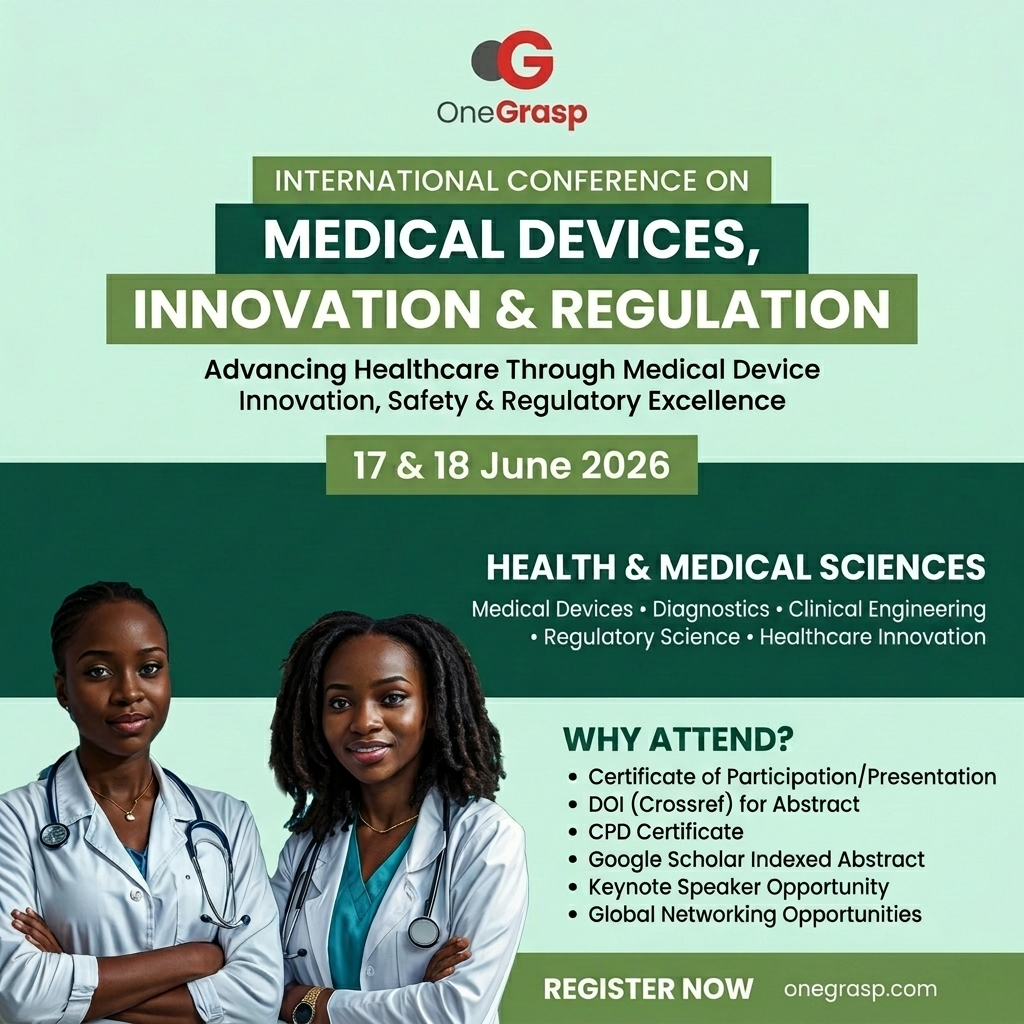
The International Conference on Medical Devices, Innovation & Regulation (ICMDI-2026) provides a global platform for professionals and academics to explore emerging technologies, regulatory science, patient safety frameworks, and next-generation healthcare solutions. The conference brings together experts from engineering, healthcare, life sciences, regulatory affairs, clinical research, and medical technology industries to examine how innovation can be balanced with compliance, safety, and ethical responsibility.
Participants interested in attending or presenting research can explore the official conference page here:
As healthcare systems become increasingly technology-driven, understanding both innovation and regulation is essential for ensuring that medical devices improve outcomes while maintaining the highest standards of patient safety.
ICMDI-2026 is an international conference dedicated to medical device innovation, regulatory science, healthcare technology development, and patient safety.
The conference serves as a multidisciplinary forum where researchers, medical professionals, biomedical engineers, regulatory specialists, quality assurance experts, and technology developers can share knowledge and discuss emerging trends in medical technology.
The event focuses on how medical devices are designed, tested, regulated, validated, and deployed across healthcare environments. It addresses critical challenges related to safety, efficacy, quality assurance, cybersecurity, artificial intelligence integration, and global regulatory harmonization.
According to conference information, major themes include medical device technologies, clinical validation, digital health integration, software-based medical systems, quality management, regulatory frameworks, and post-market surveillance.
Why Medical Device Innovation Matters Today
Medical devices play a crucial role in diagnosis, treatment, monitoring, rehabilitation, and preventive healthcare.
The global medical device industry has experienced rapid growth due to increasing healthcare demands, aging populations, and advancements in biomedical engineering. According to industry analyses from organizations such as McKinsey and the World Economic Forum, digital health technologies are becoming central to healthcare modernization efforts.
Modern healthcare depends heavily on devices such as:
Diagnostic imaging systems
Wearable health monitors
Smart implants
Surgical robotics
Telemedicine platforms
AI-assisted diagnostic systems
Connected patient monitoring solutions
These innovations improve healthcare accessibility, accuracy, and efficiency. However, rapid technological progress also introduces new regulatory and ethical challenges.
As a result, healthcare innovation today requires a balanced approach that encourages advancement while protecting patient safety.
Conference Themes and Research Areas
ICMDI-2026 explores both technological innovation and regulatory frameworks shaping the future of healthcare devices.
Key conference tracks include:
Medical Device Innovation & Emerging Technologies
Research focused on breakthrough technologies transforming healthcare delivery and patient outcomes.
Clinical Trial Design and Device Validation
Discussions on evaluating device safety, efficacy, clinical performance, and regulatory approval pathways.
Regulatory Science and Compliance
Exploration of international regulations, quality systems, compliance strategies, and evolving policy frameworks.
Digital Health and Connected Devices
Analysis of IoT-enabled healthcare systems, remote patient monitoring, and connected medical ecosystems.
Artificial Intelligence in Medical Devices
Research involving machine learning diagnostics, predictive healthcare systems, and AI-powered clinical tools.
Human Factors and Usability Engineering
Studies examining device usability, accessibility, and patient-centered design principles.
Post-Market Surveillance and Real-World Evidence
Methods for monitoring safety, effectiveness, and device performance after commercialization.
Global Regulatory Harmonization
Discussions on improving international consistency across medical device approval and compliance frameworks.
These themes reflect the growing complexity of healthcare innovation and the need for interdisciplinary collaboration.
Medical Devices Innovation Regulation and Patient Safety
Patient safety remains the foundation of all medical device innovation and regulatory processes.
While innovation drives healthcare advancement, regulatory systems ensure devices meet safety and performance standards before reaching patients.
Research in regulatory science increasingly focuses on:
Risk assessment
Clinical evidence generation
Lifecycle management
Quality assurance
Cybersecurity protection
Ethical AI implementation
Recent studies on Software as a Medical Device (SaMD) emphasize that risk management frameworks are becoming essential for AI-enabled healthcare technologies. Regulatory experts argue that future healthcare systems require adaptive oversight mechanisms capable of responding to rapidly evolving technologies.
The challenge is not merely approving new technologies but ensuring they remain safe, effective, and equitable throughout their lifecycle.
Emerging Technologies Transforming Medical Devices
Several technologies are reshaping the future of medical device development.
Artificial Intelligence and Machine Learning
AI-powered systems can assist clinicians by identifying disease patterns, supporting diagnoses, and improving workflow efficiency.
Wearable Healthcare Devices
Smart health trackers and biosensors enable continuous monitoring of vital health indicators outside traditional clinical environments.
Connected healthcare devices facilitate real-time data exchange between patients, providers, and healthcare systems.
3D Printing in Healthcare
Customized implants, prosthetics, and surgical planning tools are increasingly produced using advanced additive manufacturing technologies.
Digital Therapeutics
Software-driven treatment solutions are emerging as innovative tools for managing chronic conditions and improving patient engagement.
Together, these technologies are redefining how healthcare is delivered worldwide.
Why Regulation Is Becoming More Important
As healthcare technologies become more sophisticated, regulatory frameworks must evolve alongside innovation.
Medical devices increasingly integrate software, AI algorithms, cloud infrastructure, and real-time connectivity. These capabilities create opportunities but also introduce new risks involving:
Data privacy
Cybersecurity
Algorithmic bias
Clinical accountability
Device interoperability
The European medical technology sector, for example, has seen significant regulatory developments focused on strengthening patient protection while supporting innovation. Industry organizations continue emphasizing the need for balanced regulatory approaches that encourage technological advancement without creating unnecessary barriers.
This evolving regulatory landscape creates substantial opportunities for research and policy development.
Opportunities for Researchers, Engineers, and Healthcare Professionals
ICMDI-2026 provides valuable opportunities for learning, collaboration, and professional growth.
Researchers can:
Present original findings
Receive peer-reviewed feedback
Build international collaborations
Publish innovative work
Biomedical engineers can:
Explore emerging technologies
Understand regulatory expectations
Learn about clinical validation requirements
Healthcare professionals can:
Gain insights into new device technologies
Understand implementation challenges
Improve patient-care strategies
Regulatory specialists can:
Stay updated on compliance developments
Exchange best practices
Analyze emerging policy frameworks
Students and early-career researchers benefit significantly from exposure to real-world industry perspectives and academic discussions.
Expert Insight: The Future of Medical Device Innovation
Healthcare is moving toward highly integrated ecosystems where diagnostics, monitoring, treatment, and decision support operate through interconnected digital platforms.
The next decade will likely witness:
AI-assisted diagnostics becoming mainstream
Expansion of remote patient monitoring
Personalized medical devices
Advanced digital therapeutics
Increased use of predictive healthcare systems
However, innovation alone is not sufficient.
Future success will depend on collaboration between regulators, researchers, manufacturers, clinicians, and policymakers. Effective governance frameworks will be essential for ensuring technological advancement aligns with patient needs and societal expectations.
Research presented at conferences such as ICMDI-2026 contributes directly to these important conversations.
Latest Trends & Updates
Artificial intelligence is increasingly being incorporated into medical imaging, diagnostics, clinical decision support systems, and predictive healthcare platforms. Regulatory agencies worldwide are actively developing frameworks for AI-based medical technologies.
Software as a Medical Device (SaMD) continues to grow rapidly. Healthcare organizations are adopting software-driven solutions capable of supporting diagnosis, treatment planning, and remote patient management.
Digital health ecosystems are expanding through wearable devices, remote monitoring systems, telemedicine platforms, and connected healthcare infrastructures. These technologies are improving healthcare accessibility while reducing pressure on traditional facilities.
Global regulatory harmonization has become a major focus area. International organizations are working toward greater consistency in medical device standards, approval processes, and compliance requirements to facilitate innovation and patient safety.
Cybersecurity is emerging as one of the most critical priorities within healthcare technology. As medical devices become increasingly connected, protecting patient data and device integrity has become essential.
Researchers are also exploring ethical considerations involving AI bias, transparency, explainability, and healthcare equity. These discussions are expected to shape future medical device regulations worldwide.
Real-Life Example: How Conference Participation Accelerated Medical Innovation
A biomedical engineering graduate student developed a prototype wearable device capable of monitoring early indicators of cardiovascular complications.
While the technology demonstrated promising results in laboratory testing, the student lacked knowledge regarding regulatory pathways, clinical validation requirements, and commercialization strategies.
By participating in an international medical devices conference, the researcher connected with regulatory professionals, healthcare practitioners, and medical technology entrepreneurs. Through discussions and expert feedback, the project team improved validation protocols and strengthened regulatory documentation.
Within two years, the project secured collaborative funding opportunities and progressed toward clinical evaluation.
This example demonstrates how conferences can bridge the gap between innovation and real-world healthcare implementation.
Traditional Medical Devices vs Smart Medical Devices
Traditional Devices
Smart Medical Devices
Limited connectivity
Real-time connectivity
Manual monitoring
Continuous monitoring
Reactive healthcare
Predictive healthcare
Isolated data systems
Integrated ecosystems
Limited personalization
Personalized insights
Facility-dependent usage
Remote monitoring capability
Beginner vs Expert Approach in Medical Device Research
Beginners
Experts
Focus on device functionality
Focus on clinical outcomes
Technology-centered perspective
Patient-centered perspective
Limited regulatory understanding
Deep regulatory knowledge
Basic validation methods
Comprehensive lifecycle evaluation
Individual innovation focus
Ecosystem-level thinking
Pros and Cons of Participating in ICMDI-2026
Pros
Cons
Exposure to global expertise
Requires preparation time
Academic recognition
Competitive submissions
Research visibility
Learning curve for newcomers
Networking opportunities
Need for active participation
Professional development
Continuous knowledge updates required
Common Mistakes to Avoid
Submitting Weak Research Abstracts
Ensure objectives, methodology, and significance are clearly explained.
Ignoring Regulatory Perspectives
Innovation without compliance understanding often limits practical implementation.
Focusing Only on Technical Performance
Clinical outcomes, usability, and patient impact are equally important.
Overlooking Patient-Centered Design
Successful devices prioritize safety, accessibility, and real-world usability.
Poor Networking Strategy
Meaningful professional relationships often create long-term research opportunities.
What to Do Next
If you plan to participate in ICMDI-2026:
Review conference tracks carefully.
Select a relevant research topic.
Conduct an updated literature review.
Prepare a strong abstract submission.
Understand regulatory implications related to your research.
Register early.
Prepare questions for experts and panel discussions.
Build networking opportunities before and during the event.
Healthcare innovation is advancing rapidly, creating remarkable opportunities to improve diagnosis, treatment, monitoring, and patient outcomes. Technologies such as artificial intelligence, connected medical devices, digital therapeutics, and advanced diagnostics are reshaping healthcare delivery worldwide.
The International Conference on Medical Devices, Innovation & Regulation (ICMDI-2026) provides an important platform for researchers, engineers, healthcare professionals, and policymakers to examine these developments while addressing the regulatory and ethical challenges accompanying innovation.
As medical technology continues evolving, interdisciplinary collaboration will become increasingly important. Conferences like ICMDI-2026 help bridge gaps between innovation, regulation, clinical practice, and patient safety, ensuring healthcare technologies deliver meaningful and sustainable benefits.
For researchers, students, professionals, and organizations seeking to stay ahead of emerging trends in medical technology, ICMDI-2026 offers valuable opportunities to learn, collaborate, and contribute to the future of healthcare innovation.
Learn more and register through the official conference page:
Researchers, biomedical engineers, clinicians, healthcare professionals, regulatory specialists, students, and medical technology innovators can benefit from attending.
Yes. The conference welcomes students and early-career professionals interested in medical device innovation and healthcare technology.
No. Participants may attend as listeners without presenting research.
Medical devices, AI healthcare systems, regulatory science, digital health technologies, device validation, quality assurance, and patient safety.
It helps participants understand emerging healthcare technologies while addressing critical regulatory and patient-safety considerations.

 June 1, 2026
 10 Min
 No Comment