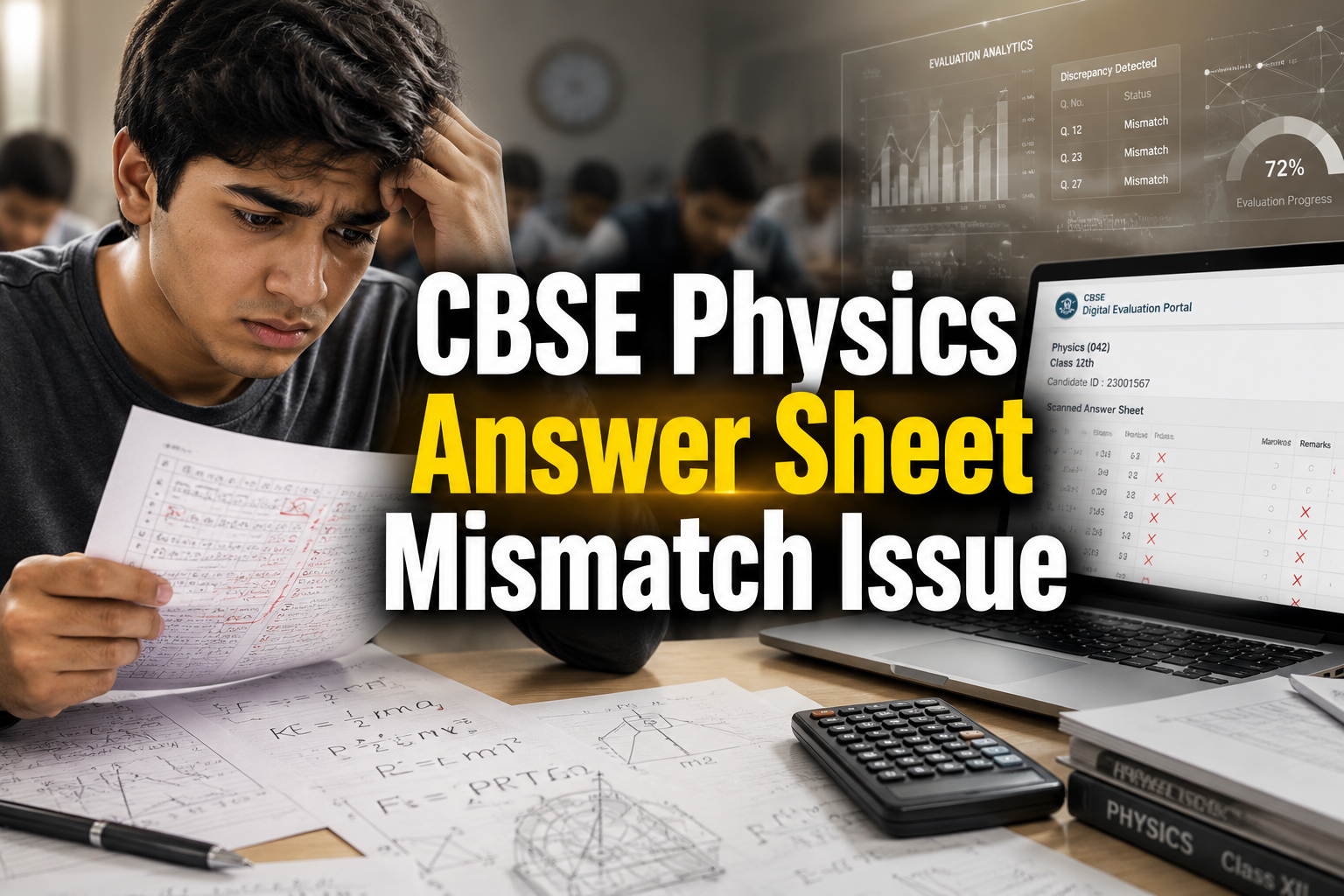
The CBSE Physics Mismatch Issue has recently become a major concern among Class 12 students across India. As thousands of students compare their response sheets with official evaluations, many are reporting inconsistencies between their marked answers and the board’s displayed responses. This has sparked confusion, anxiety, and widespread discussion on social media platforms and coaching forums.
For students who have spent an entire academic year preparing for one of the most critical subjects, even a small discrepancy in evaluation can significantly impact overall percentage, college admissions, and career pathways.
The issue is now being widely discussed in relation to the evaluation process of the Central Board of Secondary Education, which conducts Class 10 and Class 12 board examinations across the country.
The CBSE Physics Mismatch Issue refers to reported differences between students’ recorded answers and the officially evaluated response sheets released by the board.
Students claim that:
Some correct answers are marked incorrect
Numerical steps are partially ignored
Alternate correct solutions are not credited
Marking scheme interpretation varies across evaluators
While minor evaluation variations are not new in board exams, the scale of complaints this year has made the issue more visible.
According to early academic analysis shared by education platforms like HBR Education Insights, large-scale standardized exams often face challenges in subjective interpretation, especially in science-based subjects like Physics.
Why Physics is More Prone to Evaluation Disputes
Physics is not purely theoretical—it includes numerical problem-solving, derivations, and multi-step reasoning. This makes it more complex to evaluate consistently.
Key reasons include:
Multiple correct methods for solving the same problem
Step-wise marking dependency
Human evaluator interpretation differences
Space limitations in answer sheets
Variation in expected presentation format
For example, a student may reach the correct final answer using an alternative formula, but partial marking may differ depending on how strictly the marking scheme is interpreted.
Student Reactions to the CBSE Physics Mismatch Issue
Across India, students have expressed frustration and concern. Many feel that even small marking errors could affect their admission chances in competitive universities.
Common reactions include:
Fear of losing 5–10 crucial marks
Confusion over answer evaluation criteria
Demand for transparency in marking
Requests for re-evaluation or rechecking
This reaction is especially strong because Class 12 results play a direct role in engineering, medical, and undergraduate admissions.
Official Evaluation Process Explained
The CBSE follows a structured evaluation system designed to maintain fairness and consistency. The process includes:
Centralized marking guidelines
Training for examiners
Sample answer scripts for reference
Moderation of marks in borderline cases
However, despite these systems, minor inconsistencies can still occur due to human evaluation factors.
For official policies on evaluation and rechecking, students can refer to: CBSE Official Website
Additionally, broader educational assessment frameworks and fairness principles are discussed by global institutions such as UNESCO Education Standards, which emphasize transparency and reliability in national examinations.
CBSE Physics Mismatch Issue: Impact on Students
Even small discrepancies in Physics marks can significantly affect:
Overall percentage
Eligibility for college cutoffs
Scholarship qualifications
Entrance exam normalization advantage
For competitive courses like engineering and sciences, even a 1–2% change in marks can alter admission outcomes.
This is why the issue has gained so much attention among students and parents.
Expert Insight on Evaluation Errors
Education experts suggest that the CBSE Physics Mismatch Issue is not necessarily a system failure, but rather a reflection of the complexity of large-scale manual evaluation.
Key expert observations include:
Physics requires interpretation-based marking
Large examiner pools increase variation risk
Moderation helps reduce extreme discrepancies
Technology integration is still evolving in board exams
Experts also highlight that many perceived errors are later corrected during rechecking or moderation stages.
Common Mistakes Students Should Avoid
Many students panic immediately after noticing mismatches. However, this often leads to unnecessary stress or incorrect assumptions.
Avoid these mistakes:
Assuming all mismatches are errors
Ignoring official re-evaluation procedures
Relying on social media interpretations
Not applying for rechecking within deadlines
Comparing marks with unofficial answer keys
Instead, students should carefully verify each question with the official marking scheme before raising objections.
What Students Should Do Next
If you believe there is a mismatch in your Physics answer sheet, follow these steps:
Carefully review the official response sheet
Compare with marking scheme guidelines
Identify specific question numbers
Apply for re-evaluation if needed
Keep proof or supporting references ready
Follow official deadlines strictly
Most importantly, students should stay calm and avoid impulsive conclusions until the final verification process is complete.
Latest Trends / Updates
Many schools are now encouraging digital rechecking systems to reduce manual errors.

AI-based evaluation tools are being tested in pilot programs to improve accuracy in science subjects.

Students increasingly prefer transparency dashboards showing step-by-step marking logic.

Education boards are exploring hybrid evaluation models combining human + AI review systems.

Awareness about re-evaluation rights has increased significantly among Class 12 students in 2026.
Real-Life Example / Mini Case Study
A Class 12 student from Hyderabad reported a 6-mark discrepancy in Physics after comparing her response sheet with the official marking scheme. Initially, she believed it was an error in evaluation.
However, after applying for rechecking, two of the answers were re-evaluated, and 4 marks were restored. This adjustment improved her percentage enough to qualify for her preferred engineering college.
This case highlights the importance of not assuming errors prematurely and following the official correction process step-by-step.
Pros and Cons of CBSE Evaluation System
Pros
Cons
Standardized marking scheme
Human interpretation differences
Nationwide uniformity
Delays in re-evaluation
Moderation system in place
Limited transparency in step marking
Experienced examiners
Large-scale evaluation workload
Beginner vs Expert Approach to Result Analysis
Beginner Approach
Expert Approach
Panic after mismatch
Calm verification
Social media reliance
Official document analysis
Immediate conclusions
Structured rechecking process
Emotional reaction
Data-driven evaluation
Quick Checklist
Download official answer sheet
Match every response carefully
Identify discrepancies logically
Apply for re-evaluation if required
Keep deadline reminders
Avoid misinformation sources
Conclusion
The CBSE Physics Mismatch Issue highlights the challenges of large-scale academic evaluation in a high-stakes education system. While concerns raised by students are valid, most discrepancies are addressed through structured rechecking and moderation processes.
Instead of panic, students should focus on systematic verification, official procedures, and timely action. With careful analysis and proper follow-up, many issues can be resolved effectively, ensuring fairness in final results.
Ultimately, board exams are just one step in a long academic journey, and clarity in response handling is key to reducing unnecessary stress and confusion.
FAQs
It refers to reported differences between student answers and officially evaluated marks in Physics board exams.
Yes, students can apply for rechecking or re-evaluation through official CBSE procedures.
Yes, marks may increase or decrease after re-evaluation depending on corrections.
Due to step-wise marking, human evaluation differences, and multiple solving methods.
Students should visit the official CBSE website for accurate information.

 May 25, 2026
 6 Min
 No Comment