May 22, 2026
 8 Min
 No Comment
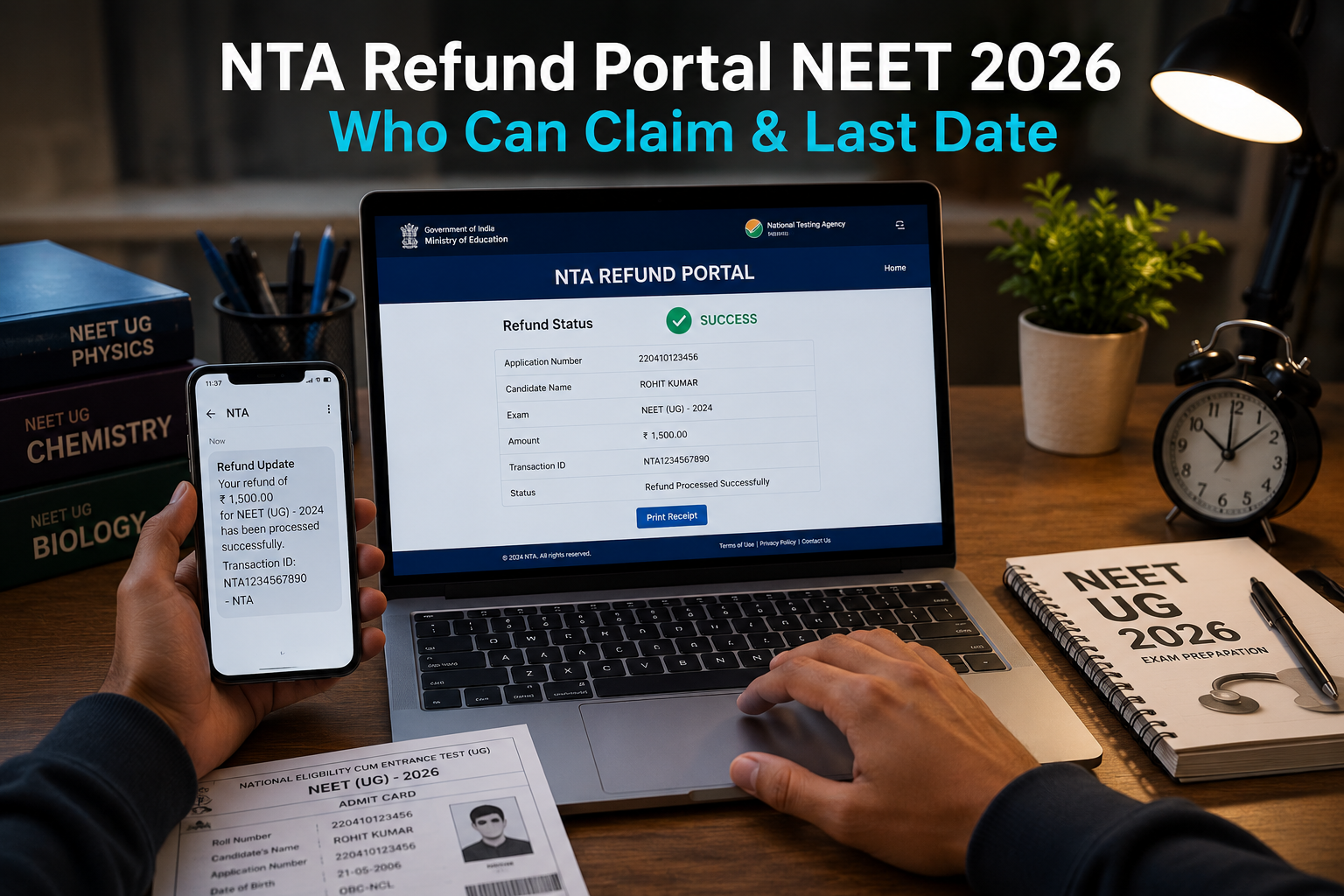
For thousands of medical aspirants across India, even a small payment issue during NEET registration can become a stressful experience. From duplicate transactions to failed submissions, refund-related concerns continue to rise every year. That is exactly why the NTA Refund Portal NEET has become one of the most searched topics among students preparing for NEET 2026.
The National Testing Agency (NTA) is expected to streamline its refund handling system further in 2026, especially after growing complaints about delayed refunds and payment gateway errors in previous admission cycles. Students who accidentally paid twice, faced technical glitches, or canceled eligible transactions may have a chance to recover their money — but only if they act within the official timeline.
Understanding who qualifies, how the claim process works, and the expected last date can save candidates from unnecessary panic later. Moreover, many students lose refunds simply because they ignore documentation rules or miss official notices.
What Is the NTA Refund Portal for NEET 2026?
The NTA refund system is an online mechanism designed to process eligible refund requests related to NEET application fees and payment discrepancies.
In simple terms, the portal helps students track and claim money that may have been deducted incorrectly during the NEET registration process.
According to the official National Testing Agency, refunds are usually processed in cases involving:
- Double fee payment
- Failed transaction with money deducted
- Technical payment gateway issues
- Duplicate application errors
- Server timeout during payment confirmation
However, not every cancellation qualifies for a refund. That is where many students misunderstand the process.
Who Can Claim Through the NTA Refund Portal NEET?
The NTA Refund Portal NEET is mainly intended for candidates facing verified payment-related issues.
Students who may qualify include:
| Eligible Candidates | Reason |
|---|---|
| Students charged twice | Duplicate payment deduction |
| Failed registration cases | Payment deducted but application incomplete |
| Technical transaction errors | Server or gateway malfunction |
| Duplicate application submission | Extra fee paid unintentionally |
| Bank processing failures | Transaction stuck without confirmation |
Meanwhile, candidates who voluntarily withdraw from NEET after successful registration generally do not receive refunds unless specifically announced by NTA.
This distinction is extremely important because many aspirants assume every canceled application becomes refundable automatically.
Expected Last Date for NEET 2026 Refund Claims
As of now, the official NEET 2026 refund notification is still awaited. However, based on previous NTA timelines, refund windows usually remain active for a limited period after the correction or application cycle ends.
Historically, most refund-related processes close within 30–60 days after registration completion.
Students should regularly monitor:
- Official NTA announcements
- Payment confirmation emails
- NEET information bulletin
- Candidate login dashboard
The safest approach is to avoid waiting for the final deadline. Payment disputes become harder to resolve after the banking reconciliation period expires.
For official updates, candidates should rely only on the NEET official website instead of social media rumors or unofficial YouTube claims.
How to Apply for a Refund Successfully
The refund process is usually straightforward if candidates maintain proper documentation.
Here’s the standard process most students follow:
- Visit the official NTA or NEET portal
- Log into the candidate dashboard
- Check payment transaction history
- Identify duplicate or failed payment entries
- Submit grievance or refund request
- Upload transaction proof if required
- Wait for verification from NTA and the payment gateway
Most refunds are credited back to the original bank account or payment method used during registration.
According to payment processing trends observed across Indian entrance exams, UPI refunds often process faster than traditional net banking reversals.
In addition, RBI digital transaction guidelines have improved dispute resolution timelines significantly in recent years. The Reserve Bank of India’s digital payment safety framework can be checked at Reserve Bank of India.
Why Refund Delays Happen Frequently
One of the biggest frustrations students face is delayed refund processing.
In reality, delays happen for several reasons:
- Incorrect bank details
- Payment gateway settlement delays
- Mismatched transaction IDs
- High application traffic
- Incomplete documentation
- Bank verification backlog
During peak NEET registration weeks, payment servers experience enormous traffic spikes. Industry reports from platforms like Statista show that India’s online education and examination ecosystem has witnessed massive growth in digital payment volumes since 2020.
As a result, even minor payment mismatches can temporarily freeze transaction verification systems.
NTA Refund Portal NEET: Important Documents You Need
Many refund requests get rejected because students fail to upload valid proof.
Candidates should keep the following ready:
| Required Document | Why It Matters |
|---|---|
| Bank transaction screenshot | Confirms deduction |
| UPI reference ID | Helps payment tracing |
| Application number | Candidate verification |
| Registered email ID | Communication tracking |
| Payment receipt | Official proof of payment |
It is also wise to save SMS alerts and email confirmations immediately after payment.
A surprising number of students delete transaction messages accidentally and later struggle to prove duplicate deductions.
Expert Insight: Why NTA Is Tightening Refund Verification
The NEET ecosystem has become far more digitized than before. With over 24 lakh candidates appearing for NEET in recent cycles, even a small percentage of payment disputes can affect lakhs of rupees collectively.
Education analysts believe NTA is now focusing heavily on automated transaction reconciliation to reduce fraud claims and fake refund requests.
Moreover, AI-assisted payment verification systems are increasingly being used by examination authorities and payment gateways to identify suspicious or duplicate transactions faster.
This shift means genuine candidates may receive quicker resolutions in 2026 compared to older cycles — provided they submit accurate information promptly.
At the same time, incomplete or manipulated claims are likely to face stricter scrutiny.
Common Mistakes to Avoid
Students often make avoidable errors during the refund process.
Here are the biggest ones:
- Waiting too long before reporting failed payments
- Entering wrong bank account details
- Ignoring official emails from NTA
- Filing multiple duplicate complaints
- Using unofficial portals or fake agents
- Forgetting to save transaction IDs
Another major mistake is assuming payment failure automatically means registration failure. Sometimes the application is actually successful despite delayed confirmation messages.
Therefore, always verify your dashboard status before making another payment.
Latest Trends & Updates
The NEET refund ecosystem is evolving rapidly with better digital infrastructure and automated payment tracking systems.

In 2026, experts expect stronger integration between payment gateways, banks, and examination authorities to reduce manual verification delays.

UPI-based transactions are becoming increasingly dominant among NEET applicants because of faster settlement and easier refund tracking.

AI-powered fraud detection systems are also being adopted to identify duplicate claims and suspicious payment activity more efficiently.

Meanwhile, students are relying more on real-time grievance dashboards instead of traditional email-only support systems, improving transparency significantly.
Real-Life Example: How One Student Recovered a Duplicate NEET Payment
In the previous NEET cycle, a student from Hyderabad accidentally paid the application fee twice after the first payment page froze during processing.
Initially, the candidate panicked and assumed both payments were mandatory. However, after checking the dashboard carefully, only one application was active.
The student then submitted:
- Bank transaction proof
- UPI reference numbers
- Registered mobile details
Within approximately three weeks, the duplicate amount was automatically reversed to the original bank account.
The key reason the refund succeeded quickly was proper documentation and early complaint submission.
Pros and Cons of the NTA Refund System
| Pros | Cons |
|---|---|
| Online tracking convenience | Refunds may take weeks |
| Digital documentation process | Technical glitches still occur |
| Reduced manual paperwork | Limited support during peak traffic |
| Faster UPI reversals | Confusing eligibility rules |
| Transparent payment logs | Students often misunderstand timelines |
Beginner vs Expert Approach to Refund Claims
| Beginner Approach | Expert Approach |
|---|---|
| Panics after payment failure | Verifies dashboard first |
| Makes repeated payments instantly | Waits for bank confirmation |
| Ignores transaction proof | Saves every payment receipt |
| Depends on social media rumors | Follows official NTA notices |
| Files incomplete complaints | Submits detailed evidence |
What to Do Next (Actionable Steps)
If you believe you may qualify for a refund, follow these steps immediately:
- Save every payment-related screenshot
- Check your NEET dashboard status daily
- Track bank deduction messages carefully
- Avoid duplicate fee submissions
- Monitor official NTA notifications regularly
- Keep transaction IDs stored safely
Most importantly, never rely on unofficial refund “agents” claiming guaranteed approval.
Quick Checklist
- Verify application submission status
- Save payment confirmation receipt
- Note transaction reference number
- Check refund eligibility carefully
- Follow official NTA announcements
- Submit complaint before deadline
- Track refund processing updates
Conclusion
The NTA Refund Portal NEET process may seem confusing initially, but students who stay informed and organized usually avoid major problems. With NEET registrations becoming increasingly digital, payment-related disputes are expected to remain common in 2026 as well.
However, candidates who maintain proper transaction records, monitor official announcements, and act quickly after payment issues stand the best chance of receiving successful refunds.
Instead of panicking during technical glitches, focus on verification, documentation, and timely action. In a competitive exam ecosystem where every detail matters, staying alert can save both money and unnecessary stress.
Frequently Asked Questions
No. Refunds are generally allowed only for verified payment-related issues like duplicate transactions or failed payments.
Most refunds may take anywhere between 7 and 30 working days depending on bank processing and verification.
NTA usually handles refund-related requests through the official NEET or NTA candidate portal.
Candidates should first check their application dashboard. If the application remains incomplete, they can raise a refund grievance with proof.
In many cases, yes. UPI reversals are often processed more quickly due to faster settlement systems.