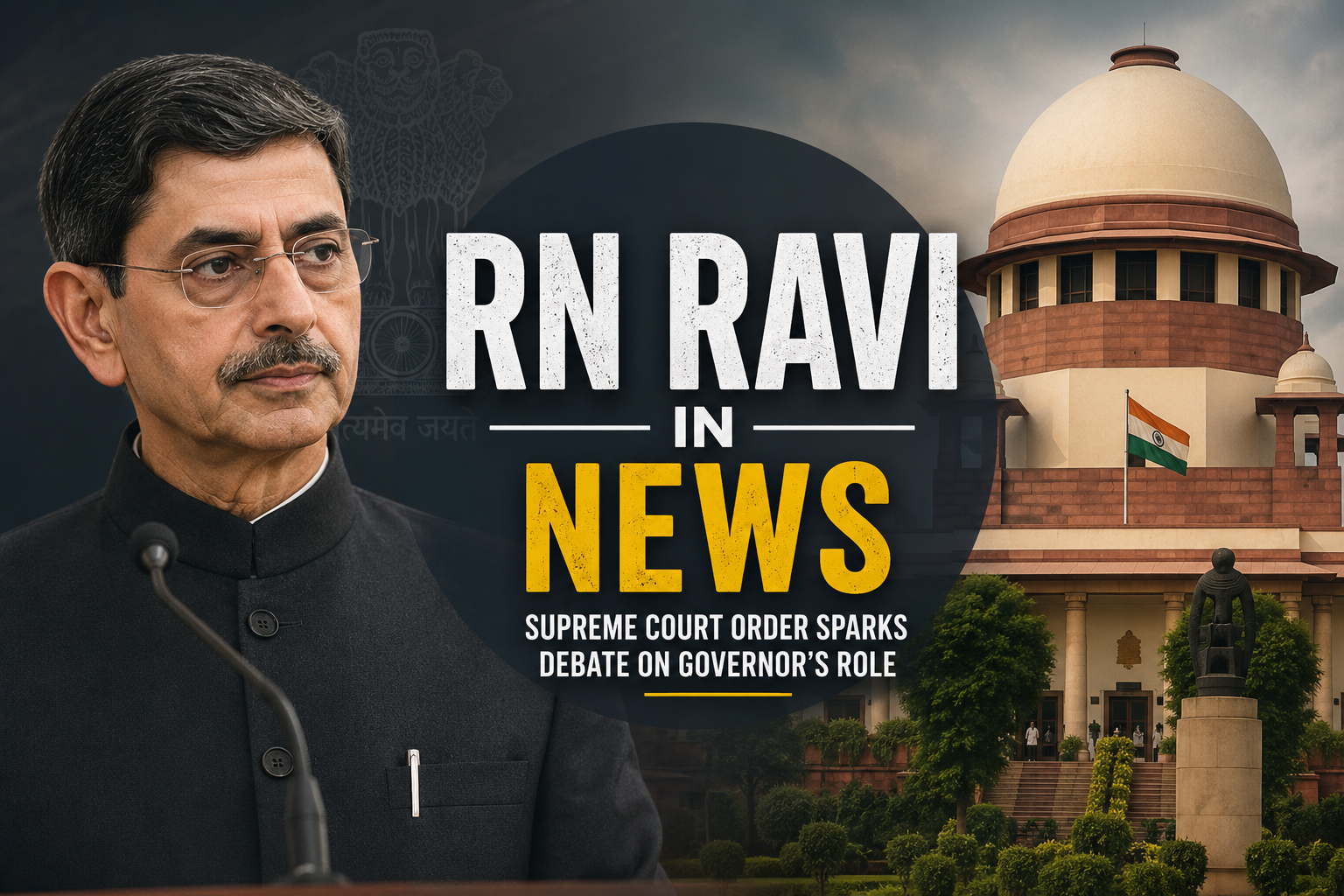
RN Ravi in News once again after the Supreme Court made important observations regarding the role of Governors in university appointments. The discussion gained momentum after the apex court asked the West Bengal Governor to appoint Vice-Chancellors in three state-aided universities. The development has revived debates over constitutional powers, Centre-State relations, and the Governor’s role in higher education administration.
According to a recent report by The Hindu, the Supreme Court emphasized the importance of ensuring universities function smoothly without prolonged administrative delays.
This issue has become highly relevant for UPSC, MPPSC, and other competitive exam aspirants because questions related to Governors, constitutional provisions, and federalism are frequently asked in examinations.
R. N. Ravi has been involved in several constitutional and political discussions over the past few years. Many of these issues revolve around:
Delays in approving Bills
State government disagreements
University Vice-Chancellor appointments
Constitutional powers of Governors
Moreover, the recent Supreme Court observations have increased public attention on how Governors exercise their authority in state universities.
In addition, similar debates have emerged in states like Tamil Nadu, Kerala, and West Bengal. Therefore, the issue is now viewed as a larger constitutional matter rather than an isolated political disagreement.
Supreme Court’s Observation on University Appointments
The Supreme Court recently directed the Governor of West Bengal to appoint Vice-Chancellors in three state-aided universities. The court highlighted that educational institutions should not suffer because of administrative conflicts.
According to education reports, India has more than 1,100 universities, and delays in leadership appointments can directly affect lakhs of students. Therefore, courts increasingly stress timely administrative decisions.
The court’s remarks are significant because Governors often act as Chancellors of state universities. This gives them an important role in appointing Vice-Chancellors and approving university decisions.
For students preparing for civil services exams, this case is a practical example of constitutional governance and federal structure in action.
RN Ravi in News and the Constitutional Role of Governors
The topic “RN Ravi in News” is directly connected with Articles 153 to 162 of the Indian Constitution.
Key constitutional points include:
Article 153: Provides for the Governor of a state
Article 154: Executive power of the state
Article 163: Governor acts on aid and advice of the Council of Ministers
Article 200: Governor’s power regarding Bills passed by state legislatures
However, controversies usually arise when Governors delay decisions or take actions viewed as politically sensitive.
Experts believe the Constitution intended the Governor to act as a neutral constitutional authority. Moreover, many commissions like the Sarkaria Commission and Punchhi Commission recommended limiting unnecessary political conflicts between Governors and state governments.
One of the biggest concerns in these controversies is the effect on students.
When Vice-Chancellor appointments are delayed:
Academic decisions slow down
Examination schedules may suffer
Research approvals get delayed
Administrative functioning becomes weak
According to higher education surveys, administrative vacancies in universities have increased in several states during the last few years. Therefore, courts are increasingly pushing for faster governance decisions.
In addition, uncertainty in university administration can impact placements, academic planning, and institutional rankings.
Expert Insight and Analysis
Constitutional experts believe this issue highlights the growing tension between elected state governments and appointed constitutional authorities.
From an exam perspective, this topic is extremely important because it connects multiple areas:
Indian Polity
Federalism
Constitutional Bodies
Education Governance
Judiciary vs Executive Balance
Moreover, students preparing for UPSC or MPPSC should understand that such current affairs are often linked with static syllabus topics.
For example, a prelims question may ask about Articles related to Governors, while a mains question may discuss whether Governors should have discretionary powers in university administration.
Therefore, aspirants should study both the current controversy and the constitutional background together.
Common Mistakes Students Should Avoid
Ignoring the Constitutional Context
Many students only read headlines. However, competitive exams require understanding constitutional provisions behind the news.
Memorizing Without Analysis
Simply remembering the names of Governors or states is not enough. Students must understand why the issue matters.
Skipping Editorial Discussions
Editorial analysis helps improve answer-writing skills for mains examinations.
Not Linking Current Affairs With Static Subjects
This topic should be connected with:
Federalism
Separation of powers
Constitutional morality
Centre-State relations
Latest Trends and Updates
Recently, Governor-related controversies have increased across several Indian states.
Key trends include:
Increased judicial intervention
Debates on Governor neutrality
State government demands for reforms
Discussions on limiting discretionary powers
Moreover, legal experts say the judiciary is now more actively monitoring delays in constitutional functioning.
This trend may influence future constitutional reforms and educational governance policies in India.
Make short notes from editorials and current affairs
In addition, students should prepare both factual and analytical dimensions of the topic for better exam performance.
Conclusion
The topic “RN Ravi in News” has become an important constitutional discussion in India. The recent Supreme Court observations on university appointments have once again highlighted debates surrounding Governors’ powers and Centre-State relations.
Moreover, this issue is highly relevant for competitive exam aspirants because it combines current affairs with constitutional concepts. Therefore, students should not only follow the news but also understand the legal and political background behind it.
As debates continue, the role of Governors in India’s federal structure is likely to remain a major topic in public and academic discussions.
FAQs
RN Ravi is in the news because debates around Governors’ powers and university appointments have intensified after recent Supreme Court observations.
The Supreme Court asked the West Bengal Governor to appoint Vice-Chancellors in three state-aided universities without unnecessary delays.
Articles 153, 154, 163, and 200 are especially important.
It relates to Indian Polity, federalism, constitutional governance, and current affairs.
In many states, Governors serve as Chancellors of state universities and oversee Vice-Chancellor appointments.

 May 9, 2026
 6 Min
 No Comment