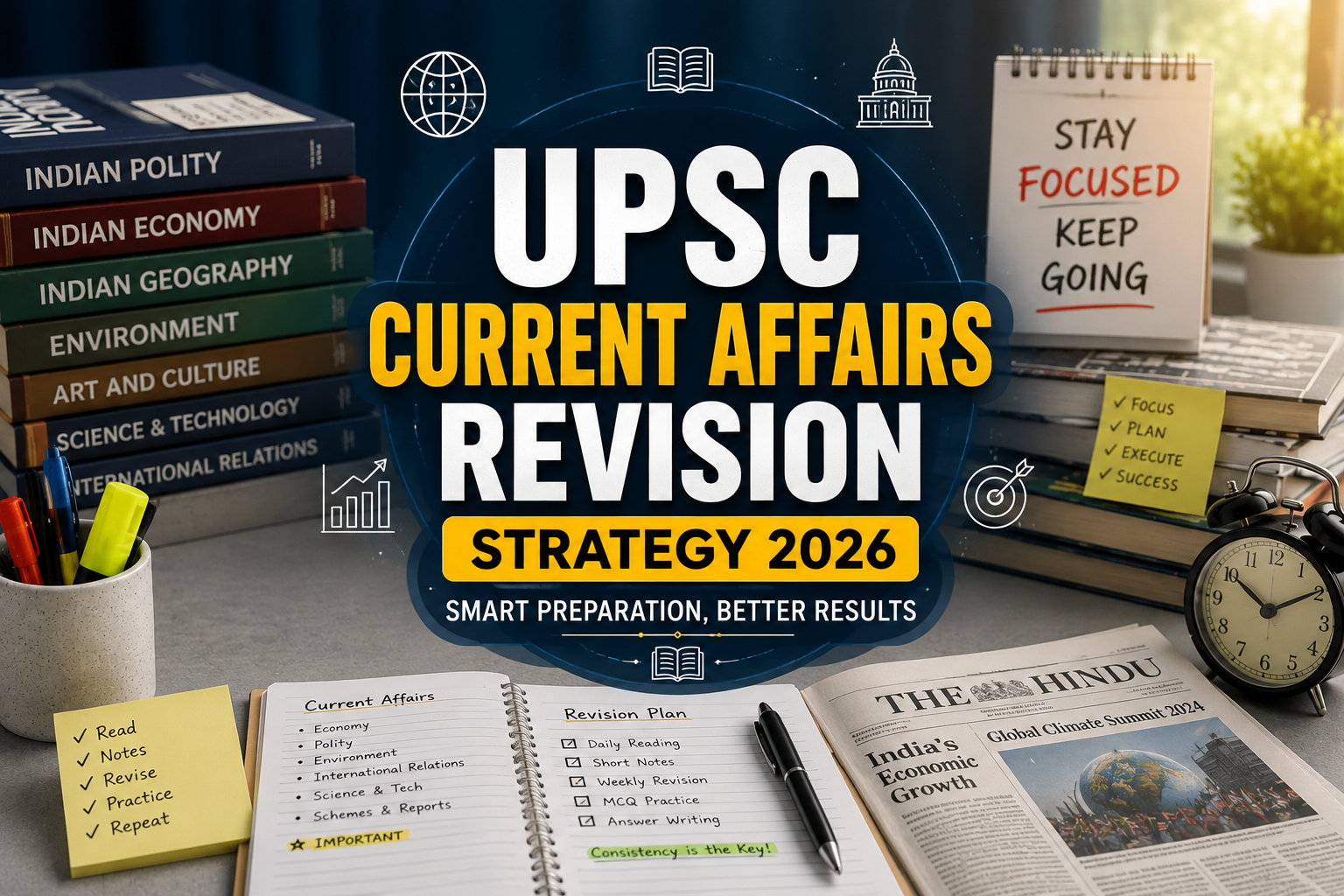
UPSC Current Affairs Revision has become one of the most important pillars of civil services preparation in recent years. Every year, UPSC asks a large number of questions that are directly or indirectly connected with current events, government policies, international relations, economy, science, and the environment. Therefore, candidates who revise effectively usually perform much better than those who only read newspapers without proper consolidation.
The nature of the UPSC examination is also changing rapidly. Earlier, factual memorization was enough to clear many sections of the exam. However, the current pattern focuses more on analytical understanding and conceptual clarity. As a result, aspirants must learn how to connect current affairs with static subjects like polity, geography, economics, and governance.
According to recent exam analysis, nearly half of the Prelims paper now contains questions linked with current affairs. Similarly, Mains examination increasingly rewards candidates who can provide balanced analysis supported by examples, data, and government initiatives. Therefore, revision is no longer optional. It has become an essential part of UPSC preparation.
Students preparing for UPSC 2026 should focus on creating a smart revision strategy from the beginning instead of waiting until the final months before the exam.
Why UPSC Current Affairs Revision Is Extremely Important
Many aspirants spend several hours every day reading newspapers, monthly magazines, and current affairs compilations. However, they often fail to revise what they study. As a result, they forget important information during the examination.
A proper UPSC Current Affairs Revision strategy helps candidates improve retention and confidence. Moreover, repeated revision strengthens conceptual understanding and makes answer writing easier.
For example, if a student revises topics like climate change, India-China relations, inflation, or women’s empowerment multiple times, they can easily use those examples in GS answers, essays, and interviews.
Revision also improves decision-making in the Prelims examination. UPSC often frames confusing options, and only candidates with strong conceptual clarity can eliminate wrong choices effectively.
According to topper interviews published on Insights IAS, most successful candidates revise their current affairs notes at least four to five times before the examination. This repeated exposure helps them remember important facts and connect issues from multiple perspectives.
In addition, revision reduces exam pressure because students become familiar with recurring topics and patterns.
Best Sources for UPSC Current Affairs Preparation
One of the biggest mistakes made by aspirants is following too many sources. Many students download excessive study material from Telegram channels and YouTube videos but fail to revise even one source properly.
Instead of collecting unlimited resources, aspirants should focus on limited and reliable sources.
The Hindu and Indian Express remain the most recommended newspapers because they provide balanced analysis and quality editorials. In addition, government sources like PIB and Yojana magazine help students understand schemes, policies, and governance issues in detail.
Monthly current affairs magazines from reputed coaching institutes can also help in revision. However, students should avoid depending completely on monthly PDFs without understanding the original issues.
Aspirants must remember that understanding is more important than simply memorizing information.
UPSC Current Affairs Revision Techniques That Actually Work
Many aspirants read current affairs daily but struggle during revision because they do not follow a structured system. Therefore, students should adopt practical revision techniques from the beginning.
One of the most effective methods is preparing short notes. Instead of writing long paragraphs, students should create concise notes containing keywords, data, constitutional articles, government schemes, committee names, and important facts. These short notes become extremely useful during the final revision phase.
Another useful strategy is monthly consolidation. Daily news should be converted into monthly topic-wise notes. This approach reduces confusion and helps students revise faster before exams.
Mind maps and flowcharts are also highly effective. They improve memory retention and help connect static and dynamic portions of the syllabus. For example, a topic like climate change can be connected with geography, environment, economy, international relations, and disaster management.
In addition, solving MCQs regularly is essential for improving accuracy and time management. Many toppers recommend solving at least 25 to 50 questions daily. However, simply attempting questions is not enough. Students must analyze mistakes carefully and understand why certain answers are wrong.
Another important technique is issue-based preparation. Instead of memorizing isolated facts, aspirants should understand:
Causes of the issue
Impact on society and economy
Government response
Challenges involved
Possible solutions
This analytical approach becomes extremely useful in Mains answer writing.
UPSC Current Affairs Revision for Prelims and Mains
The strategy for Prelims and Mains should be different because both stages test different skills.
For Prelims, students should focus more on factual clarity, government schemes, reports, environmental conventions, mapping, international organizations, and current events linked with static subjects.
Repeated revision is crucial because UPSC often asks confusing conceptual questions. Candidates who revise multiple times can identify traps and eliminate incorrect options more effectively.
On the other hand, Mains preparation requires analytical understanding. Students should learn how to structure answers using introduction, body, and conclusion formats. They should also include examples, government initiatives, committee recommendations, and recent developments in their answers.
For example, if the topic is unemployment, students should connect it with economic growth, skill development, demographic dividend, government schemes, and global challenges.
In addition, answer-writing practice is essential. Writing two or three answers daily can significantly improve presentation and analytical ability.
Expert Insight and Analysis
Experts believe that revision is now more important than studying new material continuously. Many aspirants waste time searching for “best resources” instead of revising what they already have.
According to UPSC toppers, revising one source multiple times is far more effective than reading ten different books once.
Moreover, UPSC is increasingly asking interdisciplinary questions. A question related to artificial intelligence may involve ethics, governance, economy, and technology simultaneously. Therefore, students must develop an integrated understanding of current affairs.
Experts also believe digital tools are becoming more important in UPSC preparation. Many aspirants now use digital flashcards, productivity apps, and AI-powered note-making systems to improve revision efficiency.
However, handwritten notes still remain one of the most effective methods for long-term retention.
Common Mistakes Students Should Avoid
One common mistake is following too many current affairs sources. This creates confusion and prevents effective revision.
Another major mistake is ignoring revision cycles. Without repeated revision, most information fades quickly from memory.
Many students also avoid mock tests because they fear low scores. However, mock tests are essential for improving accuracy and time management.
Reading without making notes is another serious problem. During the final months before the exam, students who lack concise notes often struggle to revise efficiently.
Finally, many aspirants ignore Previous Year Questions (PYQs). PYQs help students understand UPSC’s thinking pattern and identify important areas repeatedly asked in examinations.
Latest Trends in UPSC Preparation 2026
Several new trends are emerging in UPSC preparation. Analytical questions are increasing rapidly, especially in economy, environment, and international relations.
In addition, UPSC is focusing more on governance, technology, climate change, data protection, cybersecurity, and global geopolitics.
Another major trend is the increasing use of digital learning tools. Many aspirants now use revision apps, flashcards, and AI-based systems for note-making and scheduling.
Experts also observe that UPSC is rewarding balanced and solution-oriented answers rather than extreme opinions. Therefore, aspirants should focus on developing mature analytical thinking.
What Students Should Do Next
Students preparing for UPSC 2026 should immediately finalize limited current affairs sources and stop changing resources repeatedly.
They should create monthly revision notes, practice MCQs daily, and begin answer writing as early as possible. In addition, weekly revision sessions are essential for improving long-term retention.
Aspirants should also analyze previous year questions regularly because they reveal important trends and recurring themes.
Most importantly, students must remain consistent. UPSC preparation is a marathon, not a sprint. Smart revision and disciplined preparation matter far more than studying for extremely long hours.
Conclusion
A strong UPSC Current Affairs Revision strategy can significantly improve performance in UPSC 2026. Instead of collecting excessive material, aspirants should focus on repeated revision, concise notes, analytical understanding, and regular practice.
Moreover, the UPSC examination now rewards conceptual clarity and integrated thinking rather than rote memorization. Therefore, candidates who revise strategically and maintain consistency will have a clear advantage.
Success in UPSC is not about studying everything available online. It is about understanding important issues deeply and revising them multiple times with discipline and patience.
FAQs
Generally, 12 to 18 months of current affairs are considered important for both Prelims and Mains preparation.
The Hindu and Indian Express are the most recommended newspapers because of their balanced coverage and quality analysis.
No. Monthly magazines help in revision, but daily newspaper understanding is equally important.
Most toppers recommend at least four to five revisions before the examination.
Yes. Current affairs form a major part of GS papers, essays, and interview discussions.

 May 9, 2026
 8 Min
 No Comment