Every year, millions of students prepare for the SSC Combined Graduate Level examination hoping to secure a stable and prestigious government job. However, the competition in 2026 is expected to become even tougher. Recent discussions around SSC CGL 2026 Changes have sparked curiosity among aspirants because the Staff Selection Commission is gradually shifting toward faster evaluation systems, higher analytical standards, and smarter screening methods.
If you are preparing casually, this exam may feel overwhelming. But if you understand the latest trends early, your preparation instantly becomes more strategic. That is exactly where most toppers separate themselves from the crowd.
According to recent recruitment trends published on the official SSC portal: https://ssc.gov.in
the number of applicants for SSC CGL has consistently crossed several million registrations annually. Meanwhile, the vacancy-to-selection ratio continues to tighten, making efficient preparation more important than ever.
The good news? Candidates who adapt early to the new pattern changes often gain a major advantage.
The SSC CGL examination is no longer just about hard work. It is increasingly becoming a test of speed, accuracy, decision-making, and smart preparation.
Several factors are contributing to this shift:
Faster normalization systems
Increased focus on conceptual clarity
Tougher competition from repeat aspirants
Rise of AI-based mock test platforms
Better access to online coaching resources
Moreover, government job demand has surged significantly after economic uncertainties in the private sector. Reports from organizations like the Centre for Monitoring Indian Economy (CMIE) indicate that government employment remains one of the most preferred career choices among Indian graduates.
As a result, SSC CGL 2026 Changes are not merely cosmetic updates. They reflect a broader shift in how competitive exams are evolving in India.
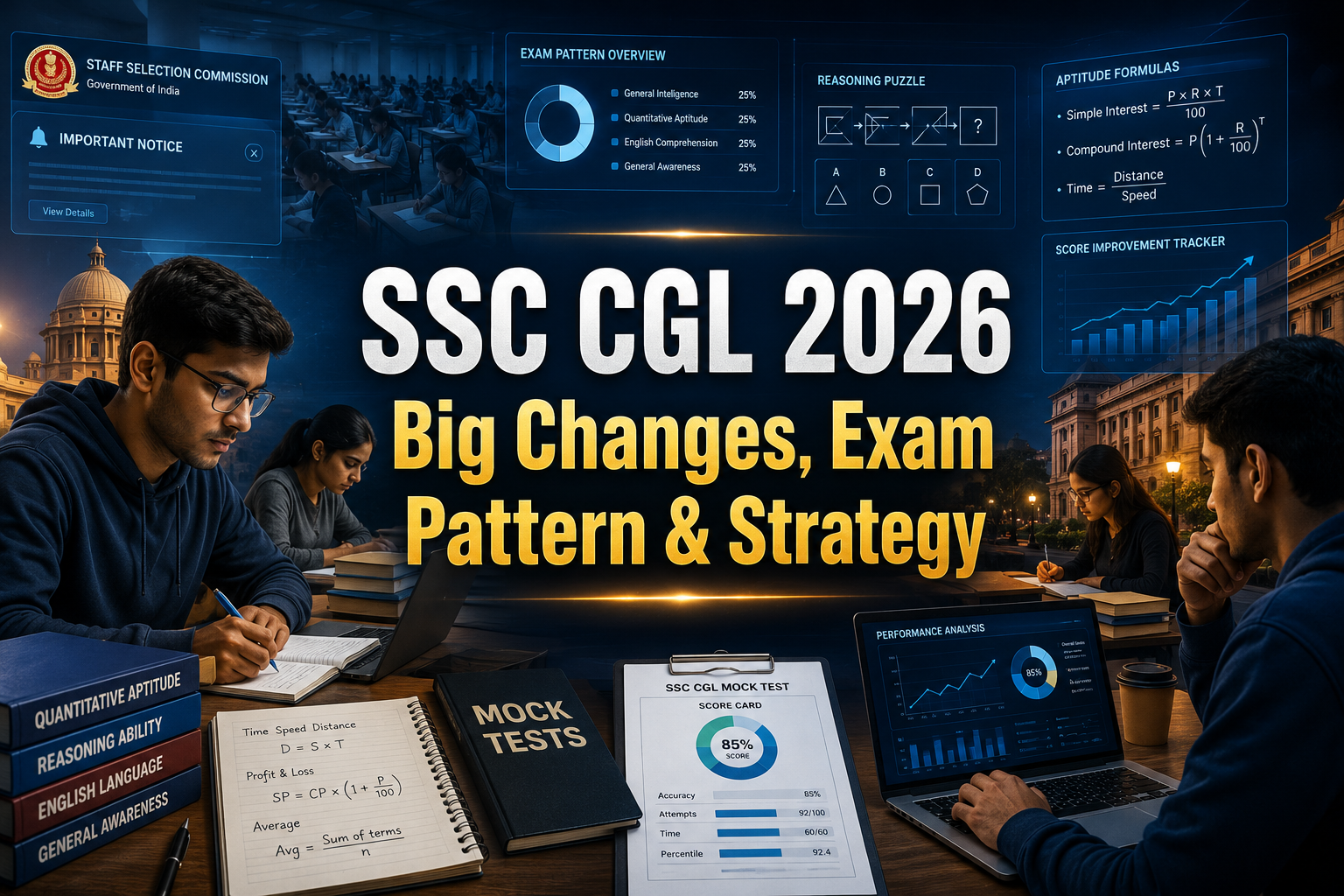
SSC CGL 2026 Changes in Exam Pattern
The biggest talking point among aspirants is the possibility of refinements in the Tier-I and Tier-II structure.
Here’s a simplified breakdown of the expected pattern:
Section
Expected Focus in 2026
Quantitative Aptitude
Higher application-based questions
General Intelligence
More logical reasoning
English Comprehension
Advanced vocabulary and comprehension
General Awareness
Current affairs + static integration
Data Entry Speed Test
Faster typing benchmarks
Experts believe SSC may continue emphasizing analytical ability over rote memorization. Therefore, students depending solely on shortcuts may struggle in higher difficulty shifts.
Another important observation is that question framing has become less predictable. Earlier, repeated PYQs alone could secure decent marks. Now, conceptual understanding matters far more.
Understanding the New Preparation Reality
One major mistake candidates make is preparing like it is still 2018 or 2019.
The preparation ecosystem has changed dramatically.
Today’s successful aspirants are:
Using AI-generated performance analysis
Tracking mock accuracy trends daily
Studying through adaptive learning platforms
Focusing on revision cycles instead of endless new material
For example, modern exam preparation platforms now use data-driven analytics similar to learning models discussed by Google’s education research: https://research.google
This means preparation is becoming more scientific.
Meanwhile, candidates who ignore mock test analysis often remain stuck despite studying for long hours.
Best Strategy for SSC CGL 2026 Changes
A smart strategy is no longer optional. It is essential.
Build Conceptual Strength First
Many students rush toward shortcuts too early. However, shortcuts only work when fundamentals are already strong.
Spend the first phase of preparation mastering:
Arithmetic basics
Grammar rules
Reading comprehension
Reasoning patterns
Static GK foundations
This creates long-term stability during difficult exam shifts.
Prioritize Mock Tests Aggressively
Toppers often attempt 50–100 full-length mocks before the actual exam.
Why?
Because mock tests improve:
Time management
Pressure handling
Accuracy control
Question selection ability
In addition, performance analysis matters more than simply attempting tests.
A detailed study by educational analytics firms highlighted by platforms like: https://www.statista.com
shows that adaptive practice improves retention and exam performance significantly compared to passive reading.
Follow the 3-Stage Revision Formula
A highly effective SSC strategy includes:
Preparation Stage
Focus
Learning Phase
Concepts + basics
Practice Phase
PYQs + sectional tests
Revision Phase
Speed + accuracy refinement
This layered approach prevents burnout and improves memory retention.
SSC CGL 2026 Changes Aspirants Must Not Ignore
Many candidates underestimate how rapidly exam behavior evolves.
Here are the most important trends emerging for 2026:
Increased emphasis on comprehension-based English
Moderate-to-difficult quant expected
Higher competition from full-time aspirants
More unpredictable reasoning patterns
Faster sectional solving required
Therefore, relying only on coaching notes may not be enough anymore.
The smartest aspirants are now building multi-source preparation systems combining:
Official notices
Mock test analytics
PYQs
Current affairs integration
Personalized revision plans
Expert Insight: What These Changes Really Mean
From an expert perspective, SSC CGL is slowly moving toward a “skill filtration model” rather than a purely academic test.
This means the commission is likely prioritizing candidates who can:
Analyze information quickly
Maintain consistency under pressure
Avoid negative marking traps
Handle mixed-difficulty question sets
In practical terms, even average students can outperform highly knowledgeable candidates if they develop better exam temperament.
Interestingly, many successful candidates today study fewer books but revise them multiple times.
That shift is extremely important.
Depth is now beating quantity.
Latest Trends & Updates
AI-powered mock test platforms are becoming mainstream among SSC aspirants in 2026.

Many coaching institutes now provide personalized performance dashboards that identify weak areas automatically.

Mobile-first learning has increased sharply, allowing candidates to study micro-topics during short breaks.

Current affairs preparation is shifting toward integrated static-GK linking rather than isolated memorization.

Meanwhile, YouTube-based free mentorship communities are influencing preparation strategies more than traditional classroom coaching in several regions.
Common Mistakes to Avoid
Ignoring Previous Year Questions
PYQs still remain one of the most powerful resources. Ignoring them creates a major disadvantage.
Studying Without Timers
SSC is fundamentally a speed-based exam. Untimed practice gives a false sense of confidence.
Overcollecting Study Material
Many aspirants keep downloading PDFs without revising them properly.
More content does not equal better preparation.
Neglecting Revision
Students often spend months learning but very little time revising. As a result, retention collapses during exams.
Real-Life Example: How Smart Strategy Beat Long Study Hours
Rohit, a graduate from Uttar Pradesh, failed SSC CGL twice despite studying nearly 10 hours daily.
In his third attempt, he completely changed his approach.
Instead of endless studying, he focused on:
Daily mock analysis
Error tracking notebooks
Timed sectional practice
Weekly revision cycles
Interestingly, his study hours reduced to around 6 focused hours daily.
The result?
His mock scores improved steadily, and he eventually secured a central government post.
His experience highlights an important lesson: productivity matters more than raw study duration.
Beginner vs Expert Preparation Approach
Beginner Approach
Expert Approach
Random studying
Structured planning
Collects many books
Revises limited resources
Avoids mocks initially
Starts mocks early
Focuses only on theory
Balances theory + testing
Panics after bad scores
Uses failures as data
This difference in mindset often determines final selection outcomes.
Pros and Cons of SSC CGL Preparation in 2026
Pros
Cons
Stable government career
Extremely high competition
Strong salary structure
Long preparation cycles
Career growth opportunities
Pressure from cutoffs
Social prestige
Mental fatigue during preparation
Pension and benefits
Unpredictable difficulty shifts
What to Do Next
If you are serious about SSC CGL 2026, take these steps immediately:
Create a realistic 6–12 month preparation plan
Attempt one diagnostic mock test this week
Identify weak sections honestly
Build a revision schedule
Follow official SSC notifications regularly
Limit study resources to trusted materials
Most importantly, remain consistent.
Consistency beats intensity in long competitive exam journeys.
Quick Checklist
Complete syllabus mapping
Start daily current affairs
Practice timed mocks weekly
Revise formulas regularly
Analyze mistakes carefully
Improve typing speed gradually
Follow official SSC updates
Maintain a healthy study routine
Conclusion
SSC CGL 2026 is shaping up to be far more strategic than many previous editions of the exam. The era of random preparation and endless memorization is fading quickly. Today, smart planning, consistent revision, mock analysis, and conceptual clarity are becoming the real differentiators.
The encouraging part is that success is still achievable for disciplined aspirants. You do not need perfect intelligence or expensive coaching. What you truly need is a focused system, patience, and the ability to adapt to changing exam trends.
Start early, stay consistent, and prepare with intention rather than panic. In a highly competitive environment, strategic preparation is no longer an advantage — it is the foundation of selection itself.
FAQs
Yes, competition is expected to increase due to higher applicant numbers and evolving question patterns.
Most successful aspirants study 5–8 focused hours consistently rather than relying on extreme schedules.
PYQs are essential, but they should be combined with mocks and concept-building for complete preparation.
It varies by candidate, but Quantitative Aptitude and English comprehension are commonly considered challenging.
Ideally, candidates should begin at least 8–12 months before the examination.

 May 21, 2026
 8 Min
 No Comment