April 28, 2026
 5 Min
 No Comment
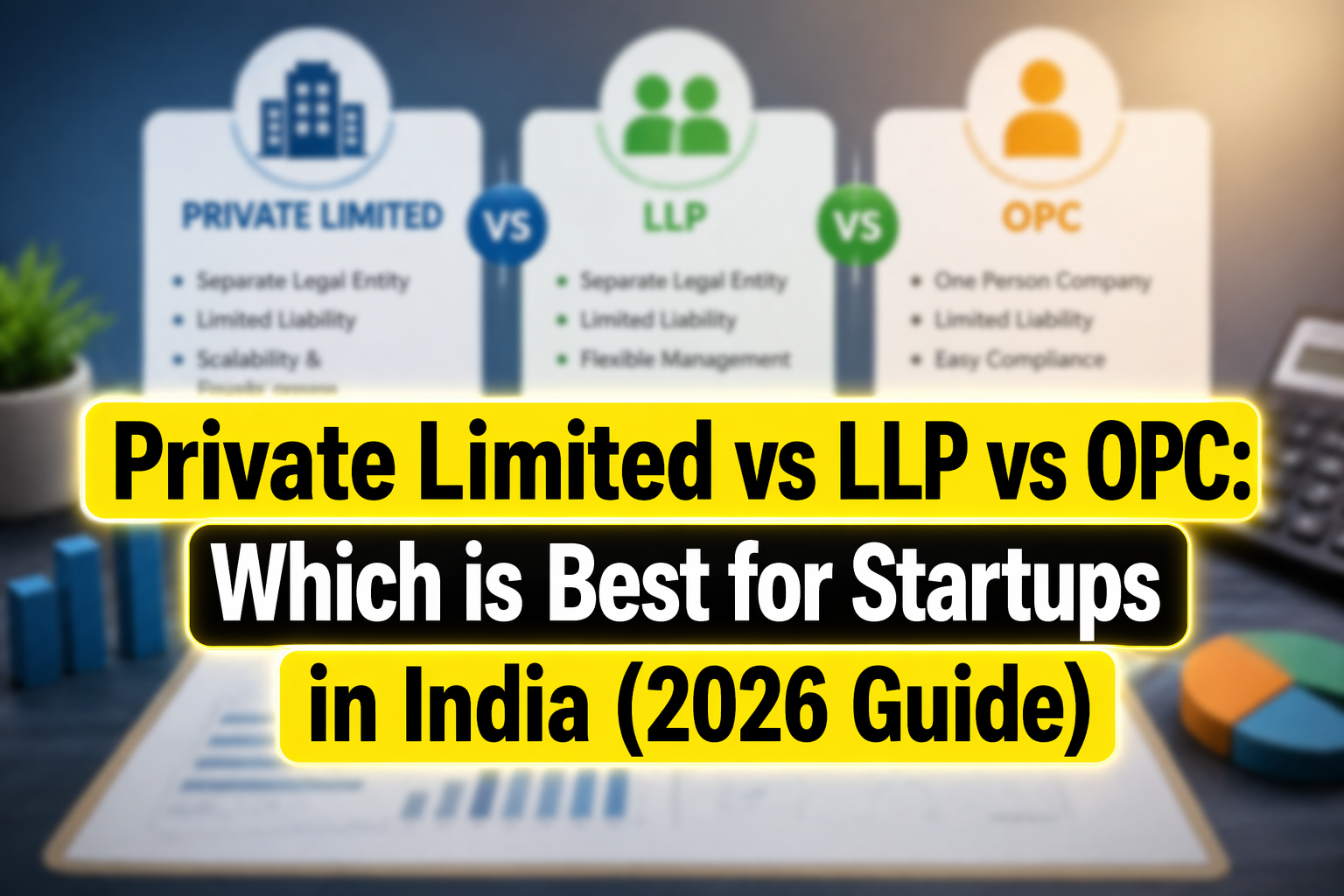
Private Limited vs LLP is the key decision for Indian founders seeking the optimal legal structure to secure funding and scale efficiently.
Private Limited vs LLP: Funding and Investor Perspective
In India, these are the three most common business structures for startups:
- Private Limited Company
- LLP (Limited Liability Partnership)
- OPC (One Person Company)
Each structure has different advantages depending on your goals — funding, scalability, or simplicity.
1. Private Limited Company
A Private Limited Company is the most preferred structure for startups.
Key Features:
- Separate legal identity
- Can raise funding from investors
- Limited liability protection
- Scalable structure
Advantages:
- Best for venture capital funding
- High credibility
- Suitable for scaling business
Disadvantages:
- Higher compliance
- More regulations
👉 Most funded startups in India are Private Limited companies, especially those registered under the Startup India Initiative.
If you’re planning to build a serious startup, it’s worth understanding the full startup journey and structure options in detail here:
👉 https://onegrasp.com/startups/
2. LLP (Limited Liability Partnership)
LLP is a hybrid between a partnership and a company.
Key Features:
- Lower compliance
- Separate legal identity
- Flexible structure
Advantages:
- Easy to manage
- Lower cost of compliance
- Good for small businesses
Disadvantages:
- Not ideal for funding
- Limited scalability compared to Private Limited
For a deeper understanding of how LLPs differ legally and structurally, you can refer to this detailed explanation:
👉 Ministry of Corporate Affairs guidelines and resources.
3. OPC (One Person Company)
OPC is designed for solo entrepreneurs.
Key Features:
- Single owner structure
- Separate legal identity
- Limited liability
Advantages:
- Easy to start alone
- Full control
Disadvantages:
- Cannot raise equity funding easily
- Must convert to Private Limited after growth
Comparison Table
| Feature | Private Limited | LLP | OPC |
| Ownership | Multiple founders | Partners | Single founder |
| Funding | Best option | Limited | Very limited |
| Compliance | High | Low | Medium |
| Scalability | High | Medium | Low |
| Best for | Startups | Small businesses | Solo founders |
Which One Should You Choose?
Choose Private Limited if:
- You want to raise funding
- You plan to scale startup
- You want investor credibility
Choose LLP if:
- You want low compliance
- You are running a small business
- You don’t need funding
Choose OPC if:
- You are starting alone
- You want full control initially
- You plan to convert later
Startup Growth Perspective
If your goal is serious startup building, Private Limited is usually the best long-term structure.
This is why most founders registering under the Startup India Initiative eventually convert or start directly as Private Limited companies.
Common Mistakes Founders Make
- Choosing LLP only for low compliance
- Starting OPC without thinking about scaling
- Delaying Private Limited conversion
- Ignoring investor requirements
These mistakes often block funding and growth later.
Strategic Insight
Your business structure is not just legal paperwork — it directly impacts:
- Funding ability
- Growth speed
- Investor trust
- Long-term scalability
Choosing correctly early saves years of restructuring later.
CTA SECTION
Before registering your startup, choosing the right structure is critical.
- Get clarity on funding and scalability
- Understand compliance requirements
- Make the right legal decision from day one
If you’re planning your startup journey, explore a complete roadmap and guidance here:
👉 https://onegrasp.com/startups/
FAQ SECTION
Which is best for startups in India?
Private Limited Company is best for funding and scaling.
Is LLP good for startups?
Yes, but mainly for small or low-growth businesses.
Can OPC raise funding?
No, OPC has limited funding options.
Can OPC be converted to Private Limited?
Yes, after crossing certain thresholds.
Which is easiest to start?
LLP and OPC are easier than Private Limited.
Beyond the basic comparison, founders should also evaluate tax implications of each structure. Private Limited Companies benefit from lower corporate tax rates after certain thresholds, while LLPs are taxed as partnership firms, which can be advantageous for low‑margin businesses. Understanding these nuances helps in forecasting cash flow and profitability.
Another critical factor is governance. Private Limited Companies require a board of directors, statutory auditors, and regular shareholder meetings, which adds a layer of oversight that investors often demand. LLPs, on the other hand, have a more flexible governance model, allowing partners to make swift decisions without extensive board approvals—a benefit for agile startups.
Finally, consider future exit strategies. Private Limited Companies are better positioned for mergers, acquisitions, and public listings due to their structured share capital and compliance framework. LLPs may face challenges in attracting strategic buyers who prefer the clarity of a corporate entity. Planning the exit early can influence the initial choice of business structure.
Frequently Asked Questions
Which business structure is best for raising venture capital in India?
A Private Limited Company is preferred for venture capital funding because it offers investor credibility and the ability to issue equity.
Can an LLP raise equity funding?
LLPs can obtain loans but are not ideal for equity funding, making them less suitable for high‑growth startups that need investor capital.
Is an OPC suitable for a solo entrepreneur who plans to grow later?
Yes, an OPC allows a single founder to start quickly, but it must be converted to a Private Limited Company when larger funding or scaling is required.
What are the main compliance differences between Private Limited and LLP?
Private Limited Companies have higher compliance obligations, including annual returns and board meetings, while LLPs enjoy lower compliance and fewer statutory filings.
How does the Startup India Initiative affect the choice of structure?
The Startup India Initiative primarily supports Private Limited Companies, offering benefits like tax exemptions and easier access to government schemes.