May 11, 2026
 6 Min
 No Comment
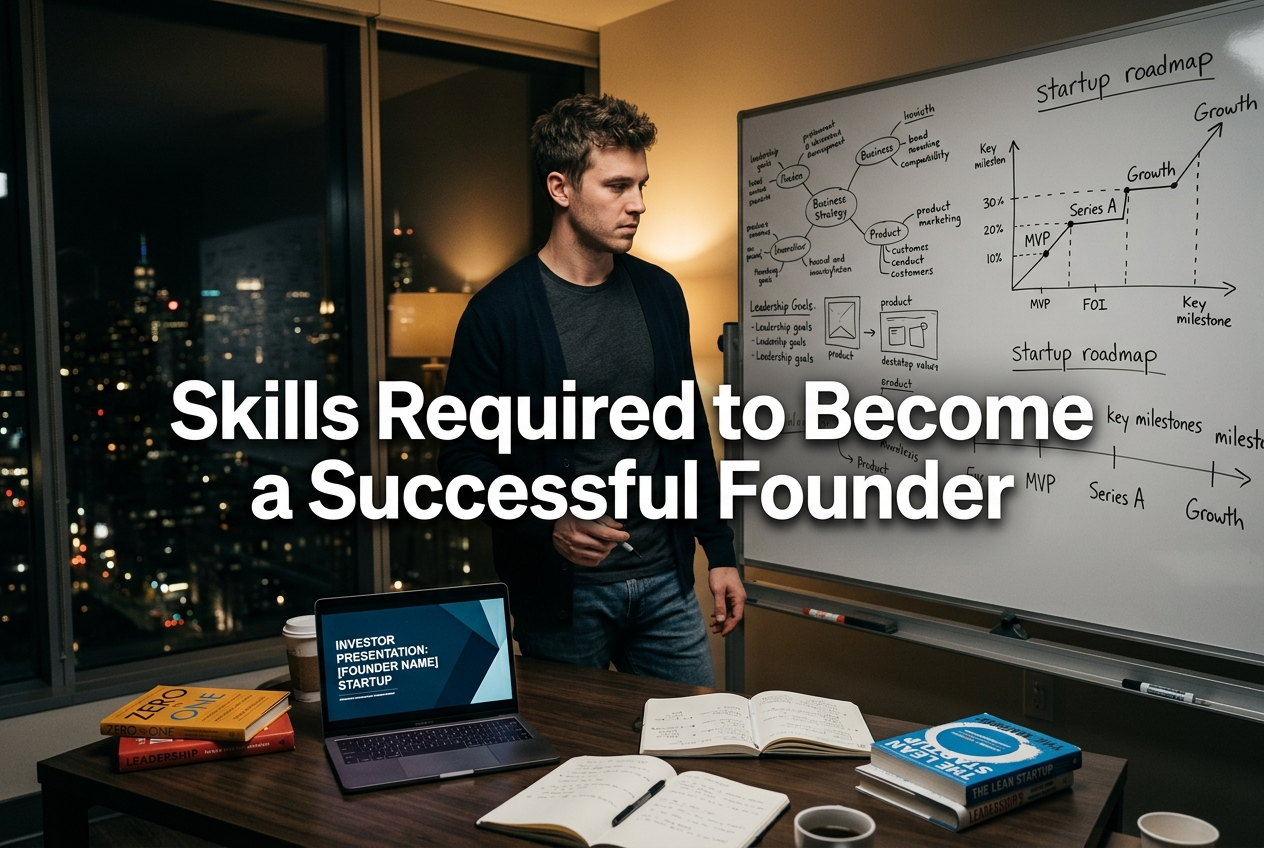
Becoming a successful startup founder is not defined by a single skill. It is a combination of mindset, execution ability, business understanding, and adaptability.
In 2026, startup ecosystems are highly competitive, fast-moving, and AI-driven. This means founders must evolve continuously to survive and scale.
Understanding Skills Required to Become a Successful Founder helps entrepreneurs avoid common mistakes and build stronger, scalable businesses.
If you want more startup growth insights and entrepreneurship guides, visit https://onegrasp.com/startups/
Founder Mindset and Vision
The foundation of every successful founder is mindset.
A strong founder mindset includes:
- Long-term thinking
- Risk tolerance
- Patience during slow growth
- Confidence in uncertainty
- Clarity of vision
Successful founders do not just react to problems—they anticipate future opportunities and build toward them.
Without vision, even good ideas fail to scale.
Execution Ability (Most Important Skill)
Ideas are common. Execution is rare.
Execution means:
- Turning ideas into real products
- Launching quickly
- Improving based on feedback
- Solving problems consistently
Many startups fail not due to weak ideas, but due to poor execution speed and consistency.
Strong execution separates successful founders from dreamers.
Product Thinking
Product thinking is understanding what users truly need.
It includes:
- Identifying real user problems
- Building simple solutions
- Prioritizing useful features
- Improving user experience continuously
Founders with strong product thinking avoid unnecessary complexity and focus on value creation.
This skill directly impacts customer satisfaction and retention.
Financial Intelligence
A successful founder must understand basic financial principles.
Key areas include:
- Revenue generation
- Burn rate management
- Profit margins
- Pricing strategy
- Cash flow control
Even non-finance founders must know how money moves in the business.
Without financial awareness, startups can grow fast but collapse due to poor cash management.
Marketing and Growth Skills
No startup survives without users.
Founders must understand how to:
- Acquire customers
- Build brand awareness
- Run digital marketing campaigns
- Use SEO and content marketing
- Improve conversion rates
Marketing is not optional—it is a core survival skill.
Even basic marketing knowledge helps founders scale faster and cheaper.
Leadership and Team Building
As startups grow, founders must become leaders.
Leadership involves:
- Hiring the right people
- Building team culture
- Delegating tasks effectively
- Resolving conflicts
- Motivating teams during pressure
A strong team is often the biggest advantage in competitive markets.
Great founders build great teams—not just great products.
Problem-Solving Ability
Startups constantly face uncertainty.
Founders must solve:
- Product failures
- Funding challenges
- Market competition
- Operational issues
Problem-solving requires:
- Logical thinking
- Creativity
- Decision-making under pressure
The faster a founder solves problems, the faster the startup grows.
Communication Skills
Clear communication is essential in every stage of a startup.
Founders communicate with:
- Investors
- Employees
- Customers
- Partners
Good communication helps in:
- Raising funding
- Building trust
- Closing deals
- Managing teams
Poor communication often leads to confusion and missed opportunities.
Adaptability in a Changing Market
Startup environments change quickly due to technology and competition.
Successful founders must:
- Learn continuously
- Adapt strategies
- Pivot when needed
- Accept feedback quickly
In 2026, AI and automation are reshaping industries rapidly, making adaptability more important than ever.
Expert Insight and Analysis
Startup experts agree that successful founders are not necessarily the smartest—they are the most consistent learners and executors.
Key insights include:
- Execution matters more than ideas
- Customer understanding drives success
- Fast iteration reduces failure risk
- Simplicity beats complexity
- Learning speed determines growth speed
Founders who improve continuously outperform those who rely only on initial knowledge.
Latest Founder Skill Trends in 2026
The skillset required to become a successful founder is evolving rapidly due to advancements in technology, automation, and changing market dynamics. In 2026, founders are no longer relying only on traditional business instincts—they are combining data, AI, and digital tools to make smarter and faster decisions.
AI-Driven Decision Making
Artificial Intelligence has become a core part of modern founder decision-making. Instead of relying purely on intuition, founders now use AI-powered tools to analyze markets, predict outcomes, and optimize business strategies.
Key applications include:
- Market trend analysis and forecasting
- Automated financial projections
- Customer behavior prediction
- Workflow and operations automation
- Competitive analysis at scale
This shift significantly reduces uncertainty and allows founders to make faster, more informed decisions backed by real-time data.
Data-Led Strategy Building
In 2026, successful founders are increasingly adopting a data-first mindset. Business strategies are no longer based only on experience or assumptions but are driven by measurable insights.
Founders now rely on:
- Real-time analytics dashboards
- Customer acquisition and retention metrics
- Conversion rate tracking
- Cohort and behavior analysis
- Performance-based decision systems
This data-driven approach helps startups identify what works, eliminate inefficiencies, and continuously optimize growth strategies.
Creator-Led Branding
Personal branding has become one of the most powerful growth assets for modern founders. Instead of building anonymous companies, founders are actively building visibility and trust through content creation.
This includes:
- Sharing insights on LinkedIn, X (Twitter), and YouTube
- Documenting startup journeys publicly
- Building authority in niche industries
- Engaging directly with audiences and communities
A strong creator-led brand helps founders attract customers, investors, and talent more easily. In many cases, the founder’s personal influence becomes a key driver of startup growth.
No-Code + Tech Hybrid Skills
Modern founders are increasingly blending no-code tools with basic technical knowledge to build and scale startups faster. This hybrid skillset allows them to move independently without relying heavily on large development teams in the early stages.
Key advantages include:
- Faster MVP development and product testing
- Reduced dependency on engineers
- Ability to automate workflows and systems
- Flexibility to experiment and iterate quickly
By combining no-code platforms with a basic understanding of technology, founders can turn ideas into functional products in record time.
Remote Leadership Skills
Managing distributed teams requires stronger digital communication and leadership clarity.
These trends show that modern founders must be both business leaders and digital operators.
Common Mistakes New Founders Make
- Overthinking ideas without execution
- Ignoring customer feedback
- Weak financial understanding
- Poor hiring decisions
- Lack of consistency
What Aspiring Founders Should Do Next
- Start building small products quickly
- Learn basic finance and marketing
- Improve communication skills
- Focus on solving real problems
- Practice consistent execution
Conclusion
Understanding Skills Required to Become a Successful Founder is essential for building and scaling startups successfully.
In 2026, founders must combine mindset, execution ability, financial intelligence, and adaptability to survive in competitive markets.
Successful founders are not defined by ideas alone but by how effectively they execute, learn, and lead.
Continuous improvement is the real secret behind long-term startup success.
FAQs
Execution, leadership, product thinking, finance, and adaptability are key skills.
Yes, with the right mindset and continuous learning, anyone can become a founder.
Not always, but understanding technology helps in decision-making.
Consistency, execution speed, and adaptability.
Yes, most founder skills are developed through experience and practice.