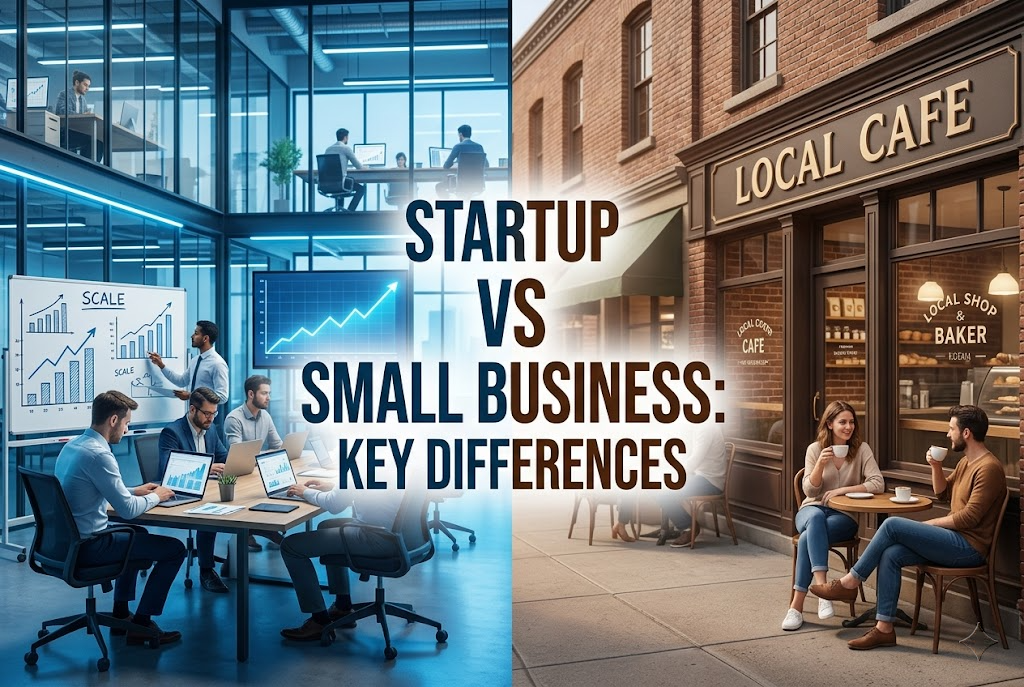
Many people use the terms startup and small business interchangeably. However, these two business models are very different in terms of growth strategy, scalability, funding, risk, and long-term vision.
Understanding these differences is important for entrepreneurs planning to launch a business in 2026. While both startups and small businesses aim to generate profit, their goals and operational approaches often differ significantly.
A startup is usually built for rapid growth and scalability, whereas a small business focuses more on steady income and long-term sustainability.
A startup is a business designed to grow rapidly by solving scalable problems using technology, innovation, or unique business models.
Startups often aim to:
Disrupt industries
Scale quickly
Acquire large user bases
Raise investor funding
Expand globally
Most startups operate in uncertain environments where experimentation and innovation are essential.
Examples of startup industries include:
SaaS platforms
AI businesses
Fintech apps
E-commerce technology
Health-tech companies
Startups usually prioritize growth before profitability during early stages.
What Is a Small Business?
A small business is generally built to generate stable income for owners and operate sustainably within a specific market.
Small businesses often include:
Restaurants
Local shops
Agencies
Freelance businesses
Service-based companies
Unlike startups, small businesses typically focus on:
Consistent revenue
Local customers
Long-term stability
Controlled expansion
Many small businesses remain profitable without seeking aggressive growth or external investment.
Startup vs Small Business Growth Strategy
One of the biggest differences between startups and small businesses is growth philosophy.
Startup Growth
Startups prioritize:
Rapid scaling
Market expansion
Technology-driven growth
User acquisition
Innovation
Founders often aim to capture large markets quickly.
Small Business Growth
Small businesses usually prefer:
Sustainable growth
Local market focus
Stable customer relationships
Gradual expansion
Growth is important, but financial stability often takes higher priority.
Funding Differences
Funding structures differ significantly between startups and small businesses.
Startup Funding
Startups often raise money from:
Angel investors
Venture capital firms
Seed funding rounds
Startup accelerators
Investors expect high growth potential and scalability.
Small Business Funding
Small businesses usually rely on:
Personal savings
Bank loans
Family funding
Business revenue
Most small business owners prefer maintaining full ownership instead of giving equity to investors.
Risk Levels in Startups and Small Businesses
Startups generally involve higher risk.
Because startups aim for rapid growth, they often face:
Market uncertainty
Competitive pressure
Financial instability
Product validation challenges
Many startups fail before becoming profitable.
Small businesses usually operate with lower risk because they focus on proven local demand and stable operations.
However, both models require strong financial management and customer understanding.
Startup vs Small Business Scalability
Scalability is another major difference.
Startups
Startups are designed to scale rapidly without proportional increases in costs.
For example:
SaaS platforms
Mobile apps
AI tools
can serve millions of users globally.
Small Businesses
Small businesses often grow linearly.
For example, a local restaurant usually requires:
More staff
Larger space
Higher operational costs
to increase revenue significantly.
Therefore, startups generally have higher long-term expansion potential.
Expert Insight and Analysis
Business experts believe entrepreneurs should choose business models based on personal goals rather than trends.
People interested in innovation, technology, and rapid growth may prefer startups.
Meanwhile, individuals seeking financial stability, independence, and predictable operations may find small businesses more suitable.
Experts also emphasize that neither model is universally better.
Success depends on:
Market demand
Execution quality
Financial discipline
Customer experience
Long-term strategy
Many profitable businesses worldwide are traditional small businesses rather than high-growth startups.
Latest Trends in Entrepreneurship
Several trends are shaping modern businesses in 2026.
AI-Powered Startups
AI tools are reducing operational costs and enabling faster startup growth.
Rise of Micro Businesses
Small digital businesses are becoming increasingly popular.
Remote-First Companies
Businesses now operate globally with distributed teams.
Subscription-Based Revenue Models
Recurring revenue systems are growing across industries.
Creator-Led Businesses
Content creators are transforming audiences into profitable businesses.
These trends show that entrepreneurship opportunities are expanding rapidly across different business models.
Startup vs Small Business: Pros and Cons
Startup Pros
High growth potential
Scalable business models
Investor funding opportunities
Global market reach
Innovation-driven environment
Startup Cons
High failure rates
Financial uncertainty
Intense competition
Operational pressure
Long working hours
Small Business Pros
Stable income potential
Lower operational risk
Full ownership control
Strong local customer relationships
Sustainable long-term operations
Small Business Cons
Slower growth
Limited scalability
Smaller market reach
Lower investor interest
Growth tied to operational expansion
Common Mistakes Entrepreneurs Make
Confusing startups with traditional businesses
Scaling too early without validation
Ignoring cash flow management
Following trends blindly
Choosing business models unsuited to personal goals
What Entrepreneurs Should Do Next
Define your long-term business vision
Research your target market carefully
Understand scalability requirements
Build realistic financial plans
Choose growth strategies aligned with your goals
Conclusion
Understanding Startup vs Small Business: Key Differences helps entrepreneurs make smarter decisions before launching businesses.
Startups focus on rapid innovation, scalability, and market disruption. Meanwhile, small businesses emphasize stability, sustainable income, and steady customer relationships.
Neither model is automatically better. The ideal choice depends on personal goals, financial readiness, risk tolerance, and long-term vision.
In today’s evolving business environment, entrepreneurs who understand their strengths and choose the right business model are more likely to succeed long-term.
FAQs
Startups focus on rapid scalable growth, while small businesses prioritize stable long-term income.
Yes, startups usually involve higher financial and operational risks.
No, but many startups seek external funding to scale faster.
Some small businesses evolve into scalable startups depending on growth strategy and technology adoption.
Both can be profitable, but startups generally offer higher growth potential along with higher risk.

 May 11, 2026
 5 Min
 No Comment