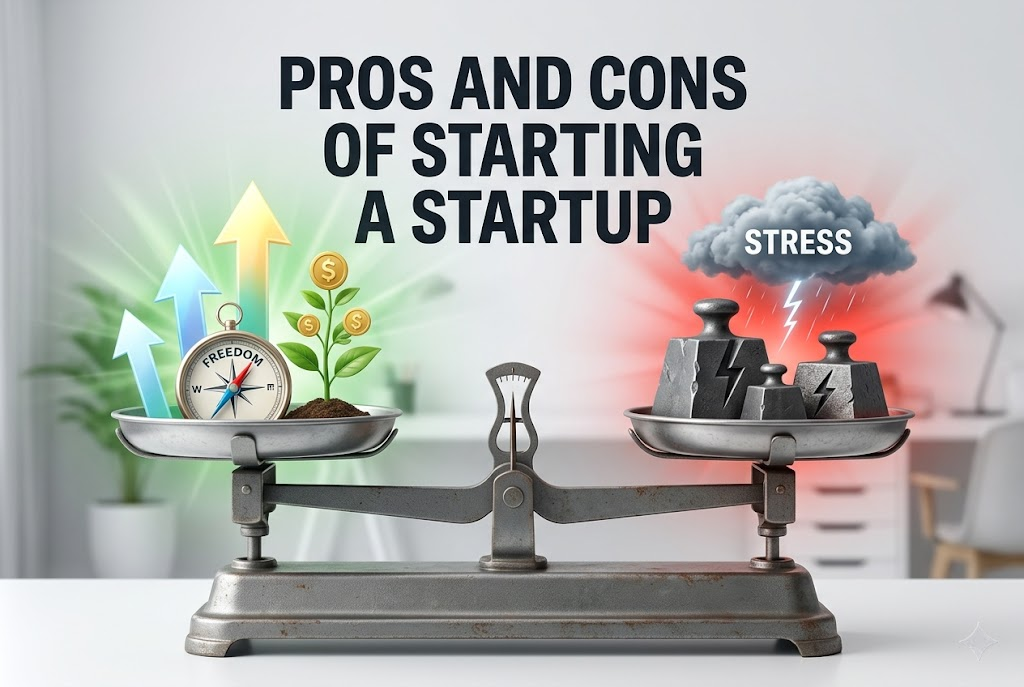
Starting a startup is one of the most exciting career paths today. The idea of building a business from scratch, creating innovative products, and becoming financially independent attracts millions of aspiring entrepreneurs worldwide. However, entrepreneurship is not always glamorous. Behind every successful startup are years of uncertainty, hard work, risk, and learning.
Understanding the startup pros and cons is important before beginning the entrepreneurial journey. Many people enter the startup world inspired by success stories, but they often underestimate the challenges involved.
In 2026, startups are growing rapidly because technology, AI tools, and digital platforms have reduced many traditional barriers. According to Statista, startup ecosystems continue expanding across industries such as AI, fintech, health tech, and eCommerce. Nevertheless, startup failure rates also remain high due to poor planning, lack of market demand, and financial problems.
If you enjoy entrepreneurship insights and startup-related guides, explore OneGrasp Startups for more business content and growth ideas.
Entrepreneurship offers opportunities that traditional jobs often cannot provide. Many founders want:
Creative freedom
Flexible work lifestyles
Higher income potential
Personal growth
The ability to solve real-world problems
Moreover, modern technology allows individuals to launch businesses faster than ever before. A laptop, internet connection, and strong idea can now become the foundation of a global startup.
However, startups also require patience, emotional resilience, and long-term commitment.
The main pros of starting a startup include freedom, growth potential, and innovation opportunities, while the cons include financial risk, stress, and uncertainty.
Pros of Starting a Startup
Entrepreneurship can create life-changing opportunities when approached strategically.
Creative Freedom
Startup founders have the ability to build products, services, and brands based on their own vision.
Unlike traditional jobs where decisions come from management, entrepreneurs can experiment with ideas and innovate freely.
This creative independence is one of the biggest reasons people pursue startups.
Unlimited Growth Potential
In regular jobs, salary growth is often limited. However, successful startups can scale rapidly and generate significant wealth.
For example, many tech startups started as small projects and later became billion-dollar companies.
Moreover, digital businesses today can reach global audiences much faster through online marketing and eCommerce platforms.
Personal and Professional Growth
Building a startup teaches practical skills quickly.
Entrepreneurs learn:
Marketing
Leadership
Communication
Financial management
Sales
Problem-solving
These experiences often create stronger long-term career opportunities even if the startup itself does not become massively successful.
Flexibility and Independence
Many entrepreneurs enjoy controlling their schedules and work environments.
Remote work and digital tools now allow startup founders to operate businesses from almost anywhere.
Platforms like Notion, Canva, and Trello help startups manage operations efficiently without large office setups.
Opportunity to Create Impact
Many startups solve important real-world problems.
The pressure can become emotionally exhausting, especially during difficult growth phases.
Long Working Hours
Many entrepreneurs work far beyond traditional office schedules.
During the early stages, founders often sacrifice:
Personal time
Social activities
Work-life balance
Therefore, entrepreneurship requires strong discipline and energy management.
Risk of Failure
Failure is common in startups.
Products may fail to attract customers. Markets can shift unexpectedly. Competitors may grow faster.
However, failure also provides valuable experience and learning opportunities for future ventures.
Unpredictable Income
Unlike salaried jobs, startup income is rarely stable initially.
Some months may generate strong profits, while others may create financial challenges.
This uncertainty can feel uncomfortable for people who prefer predictable income structures.
Startup Pros and Cons in Modern Business Culture
The startup world has changed significantly in recent years.
AI tools and automation now reduce many operational challenges. Businesses can automate:
Customer support
Email marketing
Analytics
Scheduling
Content generation
This means startups can scale faster with smaller teams.
However, competition has also increased dramatically. Because digital tools are accessible to everyone, standing out in crowded markets is becoming more difficult.
Therefore, modern startups must focus heavily on branding, customer trust, and unique value.
Modern startups benefit from technology and global reach, but they also face higher competition and customer expectations.
Real-Life Startup Example
Imagine two entrepreneurs launching online clothing brands.
The first founder spends heavily on expensive branding without understanding customer demand. Sales remain low, and financial pressure increases quickly.
The second founder starts with a small product line, studies customer feedback carefully, and improves gradually based on market demand.
Over time, the second business grows steadily while maintaining lower financial risk.
This example shows that startup success often depends more on strategy and adaptability than initial investment size.
Beginner vs Expert Entrepreneur Mindset
Beginner Founder
Experienced Founder
Focuses mainly on excitement
Focuses on long-term strategy
Expects quick success
Understands slow growth
Avoids failure
Learns from mistakes
Tries to do everything alone
Builds systems and teams
Chases trends blindly
Solves real customer problems
Experienced entrepreneurs understand that consistency and execution matter more than hype.
Pros and Cons Comparison Table
Pros
Cons
Creative freedom
Financial uncertainty
Unlimited income potential
High stress levels
Fast skill development
Long working hours
Flexible lifestyle
Risk of failure
Ability to create impact
Unpredictable growth
This balance is why entrepreneurship is rewarding but also demanding.
Common Mistakes New Founders Make
Ignoring Market Validation
Many startups launch products without confirming customer demand first.
Overspending Early
Some founders spend heavily on branding, offices, or unnecessary tools too quickly.
Trying to Scale Too Fast
Rapid growth without strong systems often creates operational problems.
Avoiding Customer Feedback
Businesses improve faster when they listen carefully to users.
Comparing Too Much
New founders sometimes compare themselves to successful startups without understanding the years of work behind those businesses.
Expert Insight and Analysis
Business experts often say entrepreneurship is not suitable for everyone — and that is completely normal.
Successful founders usually have strong adaptability, resilience, and problem-solving abilities.
Moreover, experts believe startups today must focus on building trust instead of simply attracting attention. Customers increasingly support businesses that feel authentic and customer-focused.
Another major insight is that founders should prioritize sustainable growth rather than chasing rapid expansion without stability.
The startup ecosystem rewards businesses that continuously improve and evolve.
Latest Trends in Startups
Several startup trends are shaping entrepreneurship in 2026.
AI-Powered Businesses
AI-based startups continue growing rapidly.
Remote-First Companies
Many startups now operate globally with remote teams.
Subscription Revenue Models
Recurring revenue models are becoming more popular.
Creator-Led Brands
Founders are building personal brands alongside businesses.
Sustainable Startups
Eco-friendly businesses continue attracting customer interest and investor attention.
According to Forbes, startups combining technology with authentic customer experiences are scaling fastest today.
Tools and Resources for Startup Founders
Modern startups rely on digital tools to improve efficiency.
Useful tools include:
Canva for design and branding
Notion for workflow management
HubSpot for customer management
Google Trends for market research
Trello for task organization
These tools help startups operate professionally with smaller teams.
What to Do Next Before Starting a Startup
If you are considering entrepreneurship, begin with research instead of rushing immediately.
First:
Identify a real customer problem
Study competitors carefully
Validate your idea with users
Start small and improve gradually
Build strong financial discipline
Most importantly, understand that entrepreneurship is a long-term journey.
Understanding the startup pros and cons helps entrepreneurs make smarter and more realistic decisions.
Startups offer exciting opportunities for growth, independence, creativity, and impact. However, they also require resilience, patience, financial discipline, and consistent learning.
The modern startup ecosystem provides more opportunities than ever before thanks to technology, AI, and global digital access. Nevertheless, competition is increasing, and customers expect higher quality experiences.
Entrepreneurship is not about avoiding challenges. Instead, it is about learning how to solve problems continuously while building something meaningful.
For those willing to stay adaptable and committed, startups can become one of the most rewarding journeys both financially and personally.
Frequently Asked Questions
Creative freedom, income potential, flexibility, and personal growth are major advantages.
Financial uncertainty and business failure are the biggest risks.
For people willing to learn, adapt, and solve real problems, startups can be highly rewarding.
Not always. Many digital startups begin with relatively low costs.
Common reasons include poor planning, lack of market need, and financial problems.

 May 9, 2026
 8 Min
 No Comment