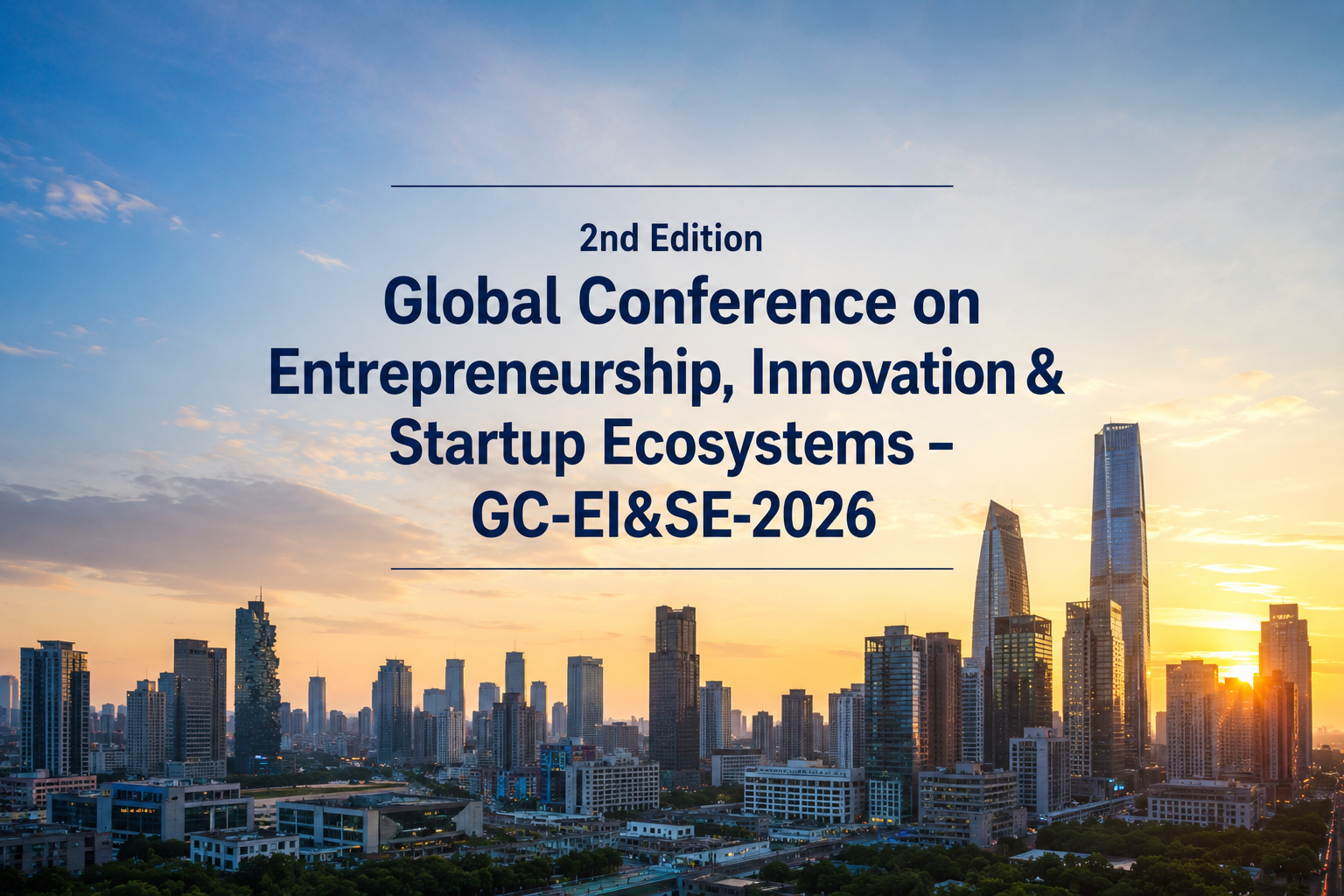
The Entrepreneurship Innovation Conference 2026 brings together scholars, investors, and startup founders to explore the future of entrepreneurship and innovation ecosystems.
Entrepreneurship Innovation Conference: Key Themes and Research Areas
Entrepreneurship is no longer confined to small business creation. It has evolved into a global force driving innovation, economic transformation, technological advancement, and social progress. The GC EISE 2026 Conference arrives at a time when startups, innovation ecosystems, venture capital networks, and entrepreneurial communities are reshaping industries worldwide.
The 2nd Edition Global Conference on Entrepreneurship, Innovation & Startup Ecosystems (GC-EI&SE-2026) provides a platform where researchers, entrepreneurs, investors, educators, policymakers, and industry leaders can exchange ideas, share research findings, and discuss the future of entrepreneurial growth. The conference focuses on understanding how innovation-driven enterprises can thrive in increasingly complex and digital economies.
For aspiring founders, academic researchers, startup mentors, and ecosystem builders, this conference offers valuable opportunities to gain insights into emerging trends, discover collaborative opportunities, and explore the evolving relationship between entrepreneurship and sustainable economic development.
The Global Conference on Entrepreneurship, Innovation & Startup Ecosystems (GC-EI&SE-2026) is an international forum dedicated to advancing entrepreneurship research, innovation management, startup development, venture funding, and ecosystem building.
The conference creates a collaborative environment where academic research meets practical business innovation. Participants can discuss startup strategies, venture capital trends, entrepreneurial resilience, innovation ecosystems, policy frameworks, and emerging technologies influencing modern business creation.
According to global entrepreneurship research, startup ecosystems significantly contribute to employment generation, economic diversification, and technological advancement. Consequently, conferences like GC-EI&SE 2026 help bridge the gap between research insights and real-world entrepreneurial practice.
Why Entrepreneurship and Startup Ecosystems Matter Today
Featured Snippet Answer
Startup ecosystems accelerate innovation, attract investment, create jobs, and foster sustainable economic growth through collaboration among entrepreneurs, investors, universities, and policymakers.
The World Economic Forum consistently highlights entrepreneurship as a critical driver of future economic resilience and innovation. As economies increasingly depend on knowledge-intensive industries, startup ecosystems have become essential infrastructure for growth.
Modern entrepreneurial ecosystems include:
Universities and research institutions
Startup incubators and accelerators
Venture capital firms
Angel investors
Corporate innovation programs
Government support initiatives
Industry mentors and advisors
Research from organizations such as the OECD demonstrates that vibrant startup ecosystems often generate stronger innovation outcomes and greater competitiveness in regional economies.
Useful resources include:
https://www.weforum.org/
https://www.oecd.org/
GC EISE 2026 Conference Themes and Research Areas
Featured Snippet Answer
GC EISE 2026 explores entrepreneurship, venture capital, startup scaling, innovation management, digital transformation, sustainability, and entrepreneurial policy development.
Major conference themes include:
Entrepreneurial ecosystems
Startup financing
Venture capital and angel investment
Innovation management
Digital entrepreneurship
Artificial intelligence and business innovation
Sustainable entrepreneurship
Social innovation
Corporate entrepreneurship
Startup scalability
Policy and regulatory frameworks
Emerging market entrepreneurship
These themes reflect the growing complexity of entrepreneurial success in today’s interconnected world. Researchers and practitioners are increasingly recognizing that innovation emerges through networks, collaborations, and ecosystem dynamics rather than isolated efforts.
The Rise of Innovation-Driven Entrepreneurship
Featured Snippet Answer
Innovation-driven entrepreneurship focuses on creating scalable solutions through technology, research, and business model innovation.
Entrepreneurship has shifted dramatically over the last decade. Traditional business creation remains important, but innovation-driven ventures now account for a substantial share of high-growth companies worldwide.
According to McKinsey research, organizations embracing innovation as a core strategic capability consistently outperform peers in long-term growth and market adaptability.
https://www.mckinsey.com/
Several factors contribute to this shift:
Artificial intelligence adoption
Digital platform economies
Cloud computing accessibility
Global connectivity
Data-driven decision making
Open innovation networks
As a result, startup founders increasingly require interdisciplinary skills combining technology, business strategy, sustainability, and leadership.
Venture Capital, Startup Funding, and Growth Opportunities
Featured Snippet Answer
Access to capital remains one of the most important factors influencing startup success and ecosystem development.
Global venture capital investment continues to support innovation across sectors including fintech, health technology, sustainability, education technology, and artificial intelligence.
Conference discussions often examine:
Seed funding strategies
Angel investment networks
Venture capital trends
Startup valuation methods
Growth financing
IPO pathways
Exit strategies
Understanding funding dynamics helps entrepreneurs make informed decisions throughout the startup lifecycle.
Moreover, investors increasingly prioritize startups demonstrating sustainable business models, measurable impact, and responsible governance practices.
Sustainable Entrepreneurship and Innovation Ecosystems
Featured Snippet Answer
Sustainable entrepreneurship creates economic value while addressing environmental and social challenges.
The relationship between entrepreneurship and sustainability has become increasingly important. Entrepreneurs are developing solutions for climate change, clean energy, circular economy systems, healthcare accessibility, and social inclusion.
The United Nations Sustainable Development Goals continue influencing startup strategies and innovation priorities worldwide.
Learn more:
https://www.un.org/sustainabledevelopment/
Sustainable entrepreneurship extends beyond environmental concerns. It also involves inclusive growth, ethical innovation, responsible governance, and long-term societal impact.
Consequently, startup ecosystems increasingly encourage founders to balance profitability with broader stakeholder value creation.
Opportunities for Researchers, Students, and Startup Founders
Featured Snippet Answer
GC EISE 2026 provides research exposure, networking opportunities, collaboration prospects, and professional development benefits.
For researchers, the conference offers:
Presentation opportunities
Peer feedback
Publication exposure
Interdisciplinary collaboration
Future research partnerships
Students benefit through:
Entrepreneurial learning
Career exploration
Industry networking
Exposure to startup ecosystems
Mentorship opportunities
Startup founders gain access to:
Ecosystem insights
Investor perspectives
Market intelligence
Strategic partnerships
Innovation frameworks
Such interactions often generate collaborations that continue long after the conference concludes.
Comparison Table: Traditional Startups vs Innovation-Driven Startups
Traditional Startups
Innovation-Driven Startups
Local market focus
Global scalability
Incremental growth
Rapid growth potential
Limited technology use
Technology-centered
Traditional financing
Venture-backed opportunities
Operational efficiency
Continuous innovation
Beginner vs Expert Entrepreneurship Perspective
Beginners
Experts
Focus on ideas
Focus on execution
Limited market validation
Data-driven validation
Product-centric thinking
Ecosystem thinking
Short-term planning
Long-term strategy
Individual efforts
Network-based collaboration
Pros and Cons of Attending Entrepreneurship Conferences
Pros
Cons
Networking opportunities
Time commitment
Startup exposure
Competitive environment
Knowledge sharing
Preparation requirements
Research visibility
Travel considerations
Career advancement
Information overload
Expert Insight: Long-Term Impact of Startup Ecosystems
The future of entrepreneurship depends increasingly on ecosystem quality rather than individual startup performance alone.
Successful ecosystems integrate research institutions, investors, mentors, policymakers, corporations, and entrepreneurs into collaborative networks. This interconnected approach accelerates innovation diffusion and improves startup survival rates.
Technology-policy challenges will remain central. Governments must balance innovation incentives with regulation, data governance, competition policy, and responsible AI frameworks.
Meanwhile, sustainability opportunities continue expanding. Climate technology, digital public infrastructure, healthcare innovation, and inclusive entrepreneurship represent major growth areas for future ventures.
Researchers participating in GC-EI&SE-2026 can contribute valuable insights into these evolving dynamics and help shape evidence-based entrepreneurship policies for future generations.
Latest Trends & Updates
Artificial intelligence continues transforming startup ecosystems worldwide. Founders increasingly leverage generative AI, automation tools, predictive analytics, and intelligent decision-support systems to improve operational efficiency and customer experiences.
AI governance has emerged as a major policy focus. Governments across Europe, North America, and Asia are developing regulatory frameworks that encourage innovation while addressing transparency, accountability, and ethical concerns.
Digital public infrastructure is becoming a cornerstone of entrepreneurial growth. Digital identity systems, payment platforms, interoperable data networks, and public digital services are enabling startups to scale more efficiently across markets.
Sustainable technology ventures continue attracting investor attention. Climate technology, renewable energy, carbon management, circular economy solutions, and green manufacturing innovations are among the fastest-growing startup sectors globally.
Responsible innovation frameworks are gaining prominence across entrepreneurial ecosystems. Investors, regulators, and consumers increasingly expect startups to demonstrate ethical governance, social responsibility, cybersecurity readiness, and environmental awareness.
Emerging research directions include entrepreneurial resilience, ecosystem intelligence, digital entrepreneurship, innovation governance, platform economies, startup internationalization, and sustainable venture creation. These themes are expected to dominate entrepreneurship scholarship throughout the coming decade.
Real-Life Example: University Startup Success
Consider a graduate student named Arjun working on an AI-powered agricultural analytics platform.
Although his technical solution showed promise, he struggled with customer discovery, business model design, and investor communication.
After participating in a startup ecosystem conference, he attended sessions focused on venture funding, entrepreneurial ecosystems, and startup scaling strategies.
Through networking opportunities, he connected with agricultural researchers, startup mentors, and angel investors. These connections helped him refine his value proposition, secure pilot projects, and improve market validation efforts.
Within a year, his startup expanded to multiple agricultural regions and attracted seed-stage funding.
This example demonstrates how conferences can transform innovative ideas into sustainable entrepreneurial ventures.
Common Mistakes to Avoid
Submitting Weak Research Abstracts
Clearly define objectives, methodology, and contributions.
Ignoring Ecosystem Perspectives
Successful entrepreneurship depends on networks, not isolated actions.
Focusing Only on Funding
Capital is important, but customer validation and execution remain critical.
Overlooking Sustainability
Investors increasingly evaluate long-term impact and responsible business practices.
Poor Networking Preparation
Research speakers and participants beforehand to maximize relationship-building opportunities.
What To Do Next
To maximize your conference experience:
Review conference themes carefully.
Identify relevant research or startup topics.
Conduct a literature review.
Prepare a compelling abstract.
Register early.
Develop presentation materials.
Research key speakers and attendees.
Participate actively in networking sessions.
Follow emerging startup ecosystem trends.
Build long-term professional connections.
Quick Checklist
Frequently Asked Questions
Researchers, entrepreneurs, startup founders, investors, educators, policymakers, and students interested in entrepreneurship and innovation.
Yes. Students are encouraged to attend, present research, and engage with entrepreneurial communities.
No. Both beginners and experienced entrepreneurs can benefit from conference participation.
Yes. Conferences provide valuable opportunities to connect with researchers, founders, investors, and ecosystem stakeholders.
Participants gain knowledge, visibility, professional connections, research exposure, and insights into emerging innovation trends.
Conclusion
The GC EISE 2026 Conference represents an important platform for understanding the future of entrepreneurship, innovation, and startup ecosystems. As global economies become increasingly dependent on innovation-driven growth, collaboration among researchers, entrepreneurs, investors, and policymakers becomes more important than ever.
Through discussions on venture capital, ecosystem development, digital transformation, sustainability, and entrepreneurial resilience, the conference provides participants with valuable knowledge and practical insights.
Whether you are a researcher seeking academic collaboration, a student exploring entrepreneurial opportunities, or a founder aiming to scale a venture, GC-EI&SE-2026 offers a unique environment for learning, networking, and growth.

 June 10, 2026
 9 Min
 No Comment