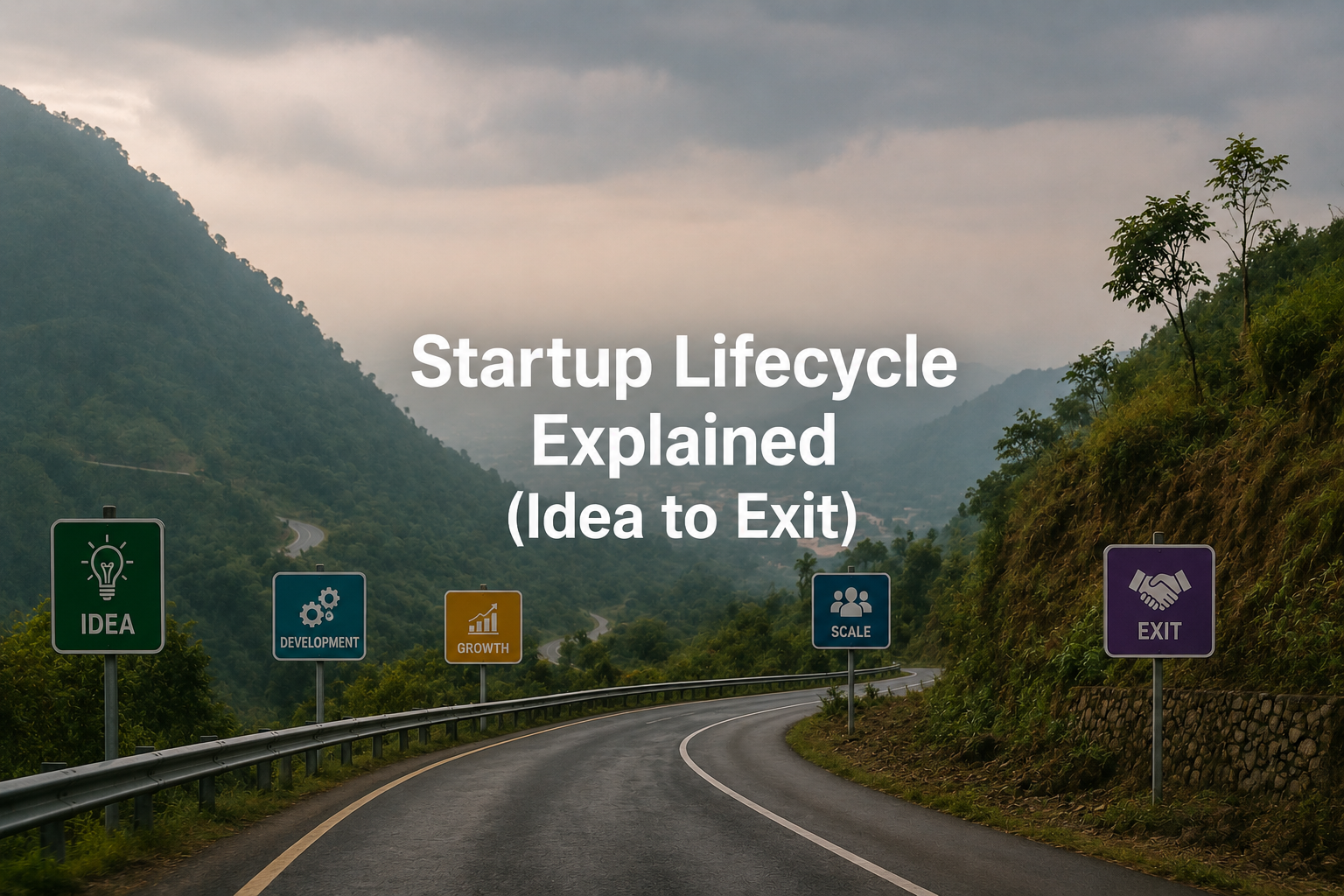
The startup lifecycle guide reveals how founders can move from idea validation to a successful exit in today's AI‑driven market.
Startup Lifecycle Guide: Stage 1 – Idea & Problem Identification
The startup lifecycle outlined in this guide shows founders how to navigate each phase from idea validation to a successful exit in 2026.
Every successful startup goes through multiple stages before becoming a profitable company or reaching a successful exit. From the initial idea to scaling operations and eventually exiting through acquisition or IPO, each phase brings unique opportunities and challenges.
Understanding Startup Lifecycle Explained Guide helps entrepreneurs make smarter decisions at every stage of growth.
In 2026, startups are evolving faster than ever because of AI, digital transformation, and changing investor expectations. Founders who understand the startup lifecycle can prepare better for growth, funding, and long-term sustainability.
If you want more startup growth insights and entrepreneurship guides, visit https://onegrasp.com/startups/
Stage 1: Idea and Problem Identification
Every startup begins with identifying a problem worth solving.
At this stage, founders focus on:
- Market research
- Customer pain points
- Industry analysis
- Idea validation
- Competitor understanding
Strong startups solve real problems rather than creating unnecessary products.
The goal during this stage is validating whether demand truly exists.
Stage 2: Validation and MVP Development
After identifying the opportunity, startups begin building a Minimum Viable Product (MVP).
An MVP is a basic version of the product with core features only.
The purpose is to:
- Test market demand
- Collect customer feedback
- Improve product direction
- Reduce development risk
Modern startups increasingly use no-code tools and AI-assisted development to build MVPs faster.
Stage 3: Early Customers and Product-Market Fit
At this stage, startups focus heavily on acquiring initial users and improving retention.
Important goals include:
- Understanding customer behavior
- Improving user experience
- Increasing retention
- Finding sustainable demand
Product-market fit occurs when customers genuinely value and repeatedly use the product.
Many startups fail before reaching this stage because they scale too early.
Stage 4: Startup Funding and Growth
Once traction improves, startups often seek external funding.
Common funding stages include:
- Bootstrapping
- Angel investment
- Seed funding
- Series A and beyond
Funding helps startups:
- Hire teams
- Improve products
- Increase marketing
- Expand operations
However, raising money also increases investor expectations and growth pressure.
Stage 5: Scaling Operations
Scaling is one of the most challenging startup phases.
At this stage, startups focus on:
- Expanding customer acquisition
- Building larger teams
- Improving operations
- Automating systems
- Entering new markets
Scaling too early can create financial and operational problems.
Successful startups scale only after establishing strong product-market fit.
Stage 6: Maturity and Sustainable Growth
Mature startups focus on stability and long-term profitability.
Key priorities include:
- Revenue optimization
- Operational efficiency
- Brand positioning
- Customer retention
- Expansion strategies
Many startups transition from aggressive growth toward sustainable business operations during this phase.
Stage 7: Exit Stage
The final stage in the startup lifecycle is exit.
Common exit options include:
Acquisition
A larger company acquires the startup.
IPO (Initial Public Offering)
The company becomes publicly traded.
Merger
Two businesses combine operations strategically.
Founder Buyout or Secondary Sale
Ownership is partially or fully transferred.
Successful exits reward founders, employees, and investors financially.
Why Understanding Startup Lifecycle Matters
Understanding the startup lifecycle helps founders:
- Prepare for challenges
- Manage finances better
- Avoid premature scaling
- Improve fundraising readiness
- Build long-term strategies
Each stage requires different leadership, operations, and financial priorities.
Expert Insight and Analysis
Startup experts believe many founders fail because they treat every stage of business growth the same way.
For example:
- Early-stage startups need experimentation
- Scaling startups need systems and processes
- Mature companies need operational discipline
Experts also emphasize that startups should adapt strategies based on current lifecycle stage instead of blindly copying larger companies.
The most successful founders understand when to:
- Experiment
- Optimize
- Scale
- Reduce burn rate
- Focus on profitability
Lifecycle awareness improves decision-making significantly.
Latest Startup Lifecycle Trends in 2026
The startup ecosystem is changing rapidly in 2026 due to AI, automation, and evolving investor expectations.
One major trend is faster MVP development. AI coding assistants, no-code platforms, and automation tools now allow founders to build and validate products much faster than before.
Bootstrapped startups are also becoming more common because founders can launch products with smaller teams and lower infrastructure costs.
Another important trend is the growing investor focus on profitability rather than aggressive user growth alone. Startups are now expected to show stronger unit economics earlier in the lifecycle.
Remote-first operations continue transforming scaling strategies. Many startups now expand globally without building expensive physical offices.
AI-native startups are shortening traditional startup lifecycles because automation allows faster product iteration, customer support, and operational scaling.
Community-led growth models are also becoming more powerful, helping startups reduce paid marketing dependency during growth stages.
Exit strategies are evolving as well. Instead of waiting for IPOs, many startups now pursue strategic acquisitions, secondary sales, or niche market consolidation opportunities earlier.
In 2026, startups that combine lean operations, AI efficiency, customer retention, and sustainable scaling are progressing through lifecycle stages more successfully.
Common Startup Lifecycle Mistakes
- Scaling before product-market fit
- Raising funding too early
- Ignoring customer feedback
- Overspending during growth
- Weak operational systems during scaling
What Founders Should Do Next
- Understand current startup stage clearly
- Focus on solving real customer problems
- Build MVPs quickly and test continuously
- Track financial metrics carefully
- Scale only after validation
Conclusion
Understanding Startup Lifecycle Explained Guide is essential for entrepreneurs building scalable businesses in 2026.
Every startup moves through different growth stages, and each phase requires unique strategies, financial planning, and operational focus.
Founders who understand the lifecycle can avoid common mistakes, improve execution quality, and build sustainable long-term businesses.
In today’s fast-changing startup ecosystem, adaptability, customer focus, and disciplined scaling remain the biggest drivers of startup success.
FAQs
It refers to the different stages a startup goes through from idea to exit.
It occurs when customers strongly value and consistently use a product.
Only after achieving strong validation and product-market fit.
No, many startups grow successfully through bootstrapping.