May 8, 2026
 8 Min
 No Comment
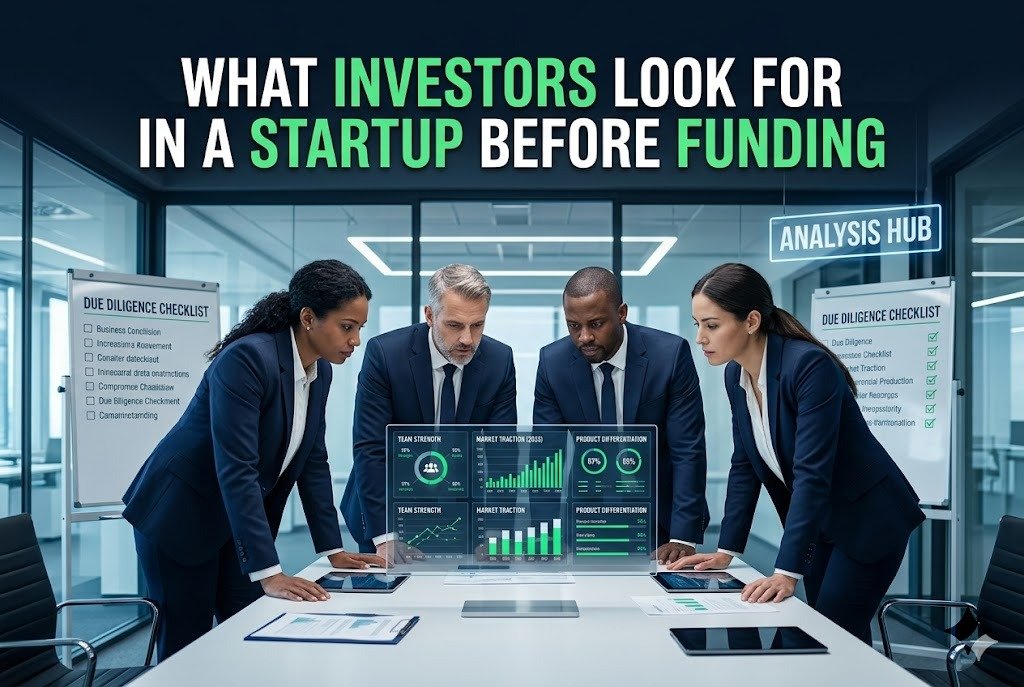
Understanding what investors look for in a startup is one of the most important things every founder should learn before raising money. Many entrepreneurs assume investors mainly care about unique ideas, but experienced investors analyze much deeper factors before deciding whether a startup deserves funding.
In 2026, startup funding has become highly competitive. Thousands of startups launch every month across industries like artificial intelligence, SaaS, fintech, e-commerce, creator economy, automation, cybersecurity, and HealthTech. Investors receive huge numbers of startup pitches regularly, which means founders must clearly demonstrate why their startup has strong long-term growth potential.
Investors are not simply looking for “interesting ideas.” They are searching for startups capable of:
- Solving meaningful problems
- Scaling rapidly
- Building sustainable revenue
- Dominating markets
- Creating long-term value
- Generating strong investment returns
This is why understanding investor psychology is critical for startup founders.
If you’re also exploring startup growth systems, fundraising strategies, and scalable business models, you can explore more startup-focused insights on https://onegrasp.com/startups/ to understand how modern startups grow successfully.
Why Startup Funding Is Extremely Competitive
Raising startup funding is difficult because investing in startups is extremely risky.
Most startups fail because of:
- Weak market demand
- Poor execution
- Founder conflicts
- Financial problems
- Weak business models
- Lack of scalability
- Poor customer retention
- Intense competition
Because of these risks, investors analyze startups very carefully before investing.
According to startup research from https://www.cbinsights.com/, lack of market need remains one of the biggest reasons startups fail globally. Investors know this, which is why they prioritize businesses with clear customer demand and strong growth potential.
Most investors ask themselves a simple question before investing:
“Can this startup become significantly more valuable in the future?”
If the answer is unclear, funding becomes difficult.
The First Thing Investors Look At: The Founding Team
One of the biggest factors in what investors look for in a startup is the founding team.
Many investors believe:
“A strong team can improve a weak product faster than a weak team can execute a strong idea.”
This is why investors spend a huge amount of time evaluating founders.
They analyze:
- Industry knowledge
- Leadership ability
- Execution speed
- Problem-solving mindset
- Adaptability
- Communication skills
- Long-term commitment
A startup idea may evolve over time, but the founders remain responsible for adapting and executing successfully.
Investors want founders who:
- Learn quickly
- Handle pressure effectively
- Stay consistent during challenges
- Make intelligent decisions
- Understand customer problems deeply
In many early-stage startups, investors are investing more in the founders than the product itself.
Why Market Size Matters So Much
Another major part of what investors look for in a startup is market opportunity.
Even excellent startups struggle if the market itself is too small.
Investors analyze:
- Total addressable market (TAM)
- Industry growth trends
- Consumer behavior changes
- Long-term expansion potential
Large markets create larger opportunities for:
- Revenue growth
- Market dominance
- Future valuation increases
High-growth industries in 2026 include:
- Artificial intelligence
- SaaS software
- Fintech
- HealthTech
- Climate technology
- Automation tools
- Cybersecurity
- Creator economy platforms
According to market analysis from https://www.mckinsey.com/, AI and automation continue driving major startup investment opportunities globally.
Investors want startups entering markets with:
- Rising demand
- Technology adoption
- Long-term relevance
- Expansion possibilities
Product-Market Fit Is Critical
One of the strongest indicators investors evaluate is product-market fit.
Product-market fit means:
- Customers genuinely want the product
- Users continue returning
- Retention remains strong
- Organic growth increases
Without product-market fit, startups often struggle with:
- Customer acquisition costs
- Revenue stability
- User retention
- Sustainable growth
Investors prefer startups where customer demand is already validated.
Signs of strong product-market fit include:
- Consistent usage growth
- Positive customer feedback
- High engagement
- Organic referrals
- Strong retention metrics
According to startup scaling research from https://hbr.org/, startups with strong product-market fit scale far more effectively than startups still searching for customer validation.
Traction Is One of the Most Important Funding Signals
Traction proves the startup is making progress.
This is why investors pay close attention to:
- Revenue growth
- User growth
- Active users
- Customer retention
- Conversion rates
- Engagement metrics
Even small traction can significantly improve investor confidence because it shows customers actually care about the product.
Investors understand that:
Ideas are common.
Execution is rare.
Traction demonstrates execution quality.
For example:
- A SaaS startup with growing subscriptions
- An AI tool with increasing daily users
- A marketplace with rising transactions
All signal potential scalability.
Startups without traction can still raise funding, especially at very early stages, but traction dramatically improves credibility.
Scalability Is Essential for Investors
Scalability is one of the biggest parts of what investors look for in a startup.
Investors prefer businesses capable of growing rapidly without proportional increases in operational costs.
Scalable business models include:
- SaaS platforms
- AI tools
- Subscription businesses
- Marketplaces
- Digital products
Scalability matters because investors seek large returns.
A startup that can scale globally becomes far more attractive than a business limited to local operations.
This is why investors often favor technology startups.
Technology enables:
- Faster expansion
- Automation
- Operational efficiency
- Global reach
Strong Business Models Matter
A startup must eventually generate sustainable revenue.
Investors analyze:
- Monetization systems
- Pricing structures
- Revenue predictability
- Profit potential
Popular monetization systems include:
- Subscriptions
- Freemium pricing
- Marketplace commissions
- Enterprise licensing
- Usage-based pricing
Weak monetization creates long-term sustainability concerns.
Investors want businesses capable of:
- Growing revenue consistently
- Improving margins over time
- Building recurring income systems
If you’re also exploring startup monetization systems and scalable business models, you can discover more startup-focused insights on https://onegrasp.com/startups/.
Competitive Advantage Is Extremely Important
Investors avoid startups that are easy to copy.
This is why they look for:
- Proprietary technology
- Strong branding
- Network effects
- Unique positioning
- Operational advantages
Competitive advantages create long-term defensibility.
For example:
- AI infrastructure systems
- Large user communities
- Strong brand recognition
- Exclusive partnerships
All improve startup defensibility.
Startups without differentiation often struggle in crowded markets.
Customer Retention Matters More Than Growth Alone
Many founders focus heavily on user acquisition.
However, investors often care more about retention.
Why?
Because retention proves:
- Customers find value
- The product solves real problems
- Users are likely to continue paying
Poor retention suggests weak product-market fit.
Strong retention signals:
- Sustainable growth
- Better monetization
- Higher lifetime customer value
Retention is often one of the clearest indicators of long-term startup health.
Financial Discipline Builds Investor Trust
Even early-stage startups need financial clarity.
Investors evaluate:
- Burn rate
- Cash management
- Revenue projections
- Unit economics
- Profitability potential
Poor financial management creates major investor concerns.
Founders should understand:
- Customer acquisition cost (CAC)
- Lifetime value (LTV)
- Gross margins
- Operational expenses
Financial discipline signals operational maturity.
Adaptability and Execution Speed
Markets evolve quickly.
Investors prefer founders capable of:
- Learning rapidly
- Adjusting strategies
- Improving products continuously
- Responding to customer feedback
Execution often matters more than the original idea.
Some of the world’s biggest startups changed direction multiple times before finding scalable business models.
Adaptability improves survival probability significantly.
Vision and Long-Term Thinking
Investors also evaluate the founder’s vision.
They want startups thinking beyond:
- Short-term profits
- Temporary trends
- Limited markets
Strong startups often demonstrate:
- Expansion potential
- Product ecosystem opportunities
- Long-term scalability
- Industry transformation potential
Investors want startups capable of becoming category leaders.
Legal and Operational Structure
Professional structure matters more than many founders realize.
Investors prefer startups with:
- Proper business registration
- Founder agreements
- Intellectual property protection
- Compliance systems
- Financial transparency
Weak operational foundations create unnecessary risks.
Professional structure improves investor confidence significantly.
How AI Is Changing Startup Funding in 2026
AI startups are attracting enormous investor attention.
However, investors are becoming more selective.
They now prioritize:
- Real-world business value
- Sustainable monetization
- Defensible technology
- Operational scalability
AI hype alone is no longer enough.
Investors want startups solving meaningful problems efficiently.
Platforms like:
Frequently analyze modern startup funding trends and investor expectations.
Common Mistakes Founders Make While Fundraising
Many founders:
- Focus only on ideas
- Ignore customer validation
- Overestimate valuations
- Present unrealistic projections
- Lack clear monetization systems
Investors prefer:
- Realistic planning
- Strong execution
- Data-supported growth
- Operational clarity
Overhyped pitches without traction often reduce credibility.
Strategic Insight
Understanding what investors look for in a startup helps founders build stronger businesses before fundraising even begins.
The most attractive startups usually combine:
- Strong founding teams
- Large market opportunities
- Product-market fit
- Scalability
- Sustainable revenue systems
- Competitive advantages
According to startup ecosystem research from https://a16z.com/, investors increasingly prioritize operational discipline and execution quality over purely visionary ideas.
In 2026, startups solving real-world problems efficiently remain the most attractive investment opportunities.
If you’re also exploring startup growth systems, fundraising frameworks, and scalable business strategies, you can discover more startup-focused resources on https://onegrasp.com/startups/.
Conclusion
Learning what investors look for in a startup is essential for fundraising success.
Investors analyze much more than ideas. They evaluate:
- Team quality
- Market opportunity
- Product-market fit
- Traction
- Scalability
- Financial systems
- Competitive advantages
- Long-term vision
The startups most likely to raise funding are usually the ones capable of solving meaningful problems while building scalable and sustainable businesses.
FAQs
Investors primarily look for strong teams, market opportunity, product-market fit, traction, and scalability.
Not always. Early-stage startups can raise funding without revenue if they show strong growth potential and execution capability.
It proves customers genuinely want the product and improves long-term growth potential.
AI, SaaS, fintech, cybersecurity, automation, and HealthTech are among the fastest-growing investment sectors.
Yes, but traction significantly improves investor confidence and fundraising success.