May 13, 2026
 8 Min
 No Comment
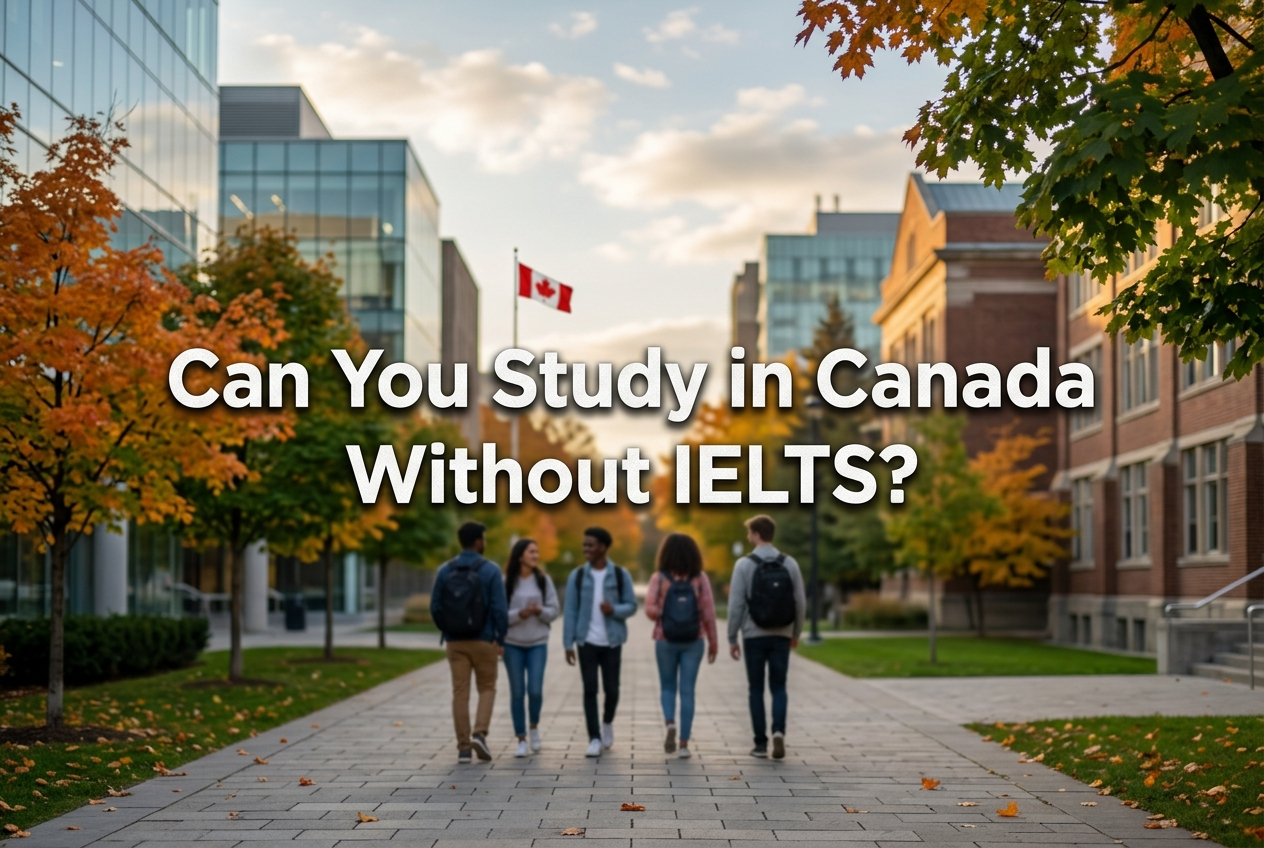
Many Indian students dream of studying in Canada because of its world-class education system, multicultural environment, career opportunities, and immigration-friendly policies. However, one major concern for many students is the IELTS exam.
The good news is that in 2026, it is absolutely possible to study Canada without IELTS under specific conditions. Many Canadian universities and colleges now accept alternative English proficiency tests, Medium of Instruction (MOI) letters, pathway programs, and other language assessment methods instead of IELTS.
According to multiple recent education reports, Canadian institutions are becoming increasingly flexible in their admission processes to attract talented international students from around the world. (meridean.org)
However, students must understand an important point: studying without IELTS does not mean studying without proving English proficiency. Canadian universities still require evidence that students can communicate effectively in English.
Therefore, students must carefully understand:
- Accepted alternatives
- University-specific requirements
- Visa implications
- PGWP eligibility
- Language waiver conditions
before applying.
Is It Really Possible to Study in Canada Without IELTS?
Yes, many Canadian institutions now allow international students to apply without IELTS if they meet alternative English language requirements.
Common alternatives include:
- Duolingo English Test
- TOEFL
- PTE Academic
- CAEL
- CELPIP
- MOI (Medium of Instruction) certificate
- English pathway programs
Some universities may also conduct online interviews to evaluate communication skills. (DekhoCampus)
This flexibility has become increasingly popular among Indian students because IELTS preparation can be time-consuming, expensive, and stressful.
Why Canadian Universities Are Becoming More Flexible
Canada continues competing globally for international students. As a result, universities are expanding admission flexibility while still maintaining academic quality standards.
Several factors are driving this trend:
- Increasing global student demand
- Digital learning expansion
- Growth of alternative English tests
- International student competition
- Remote assessment technologies
Moreover, many universities recognize that students from English-medium educational backgrounds may already possess strong communication skills.
Therefore, institutions increasingly accept:
- English-medium school education
- Alternative language tests
- Internal language assessments
- Foundation English programs
instead of relying only on IELTS.
Popular Alternatives to IELTS in Canada
Many Canadian universities now officially accept multiple English proficiency alternatives.
Duolingo English Test
The Duolingo English Test has become one of the fastest-growing IELTS alternatives because:
- It is affordable
- Can be taken online from home
- Provides quick results
- Is accepted by many institutions
Most universities require scores between 105–120 depending on the program level. (EEC)
TOEFL
TOEFL remains one of the most widely recognized English proficiency exams globally.
Many Canadian universities accept TOEFL scores instead of IELTS for:
- Undergraduate programs
- Master’s degrees
- Diploma programs
PTE Academic
PTE Academic is also increasingly accepted across Canadian colleges and universities.
Students often prefer PTE because:
- Results are faster
- AI-based evaluation reduces human bias
- Flexible scheduling is available
Medium of Instruction (MOI) Letter
Some universities waive IELTS if students completed previous education in English-medium institutions.
An MOI letter usually confirms:
- Your education was conducted fully in English
- You studied for several years in English-medium institutions
However, MOI acceptance varies significantly between institutions. (DekhoCampus)
Top Canadian Universities Accepting Students Without IELTS
Several Canadian institutions now provide flexible English proficiency options.
Popular universities and colleges include:
- University of Winnipeg
- University of Regina
- Concordia University
- Memorial University of Newfoundland
- Brock University
- Algoma University
- Seneca College
- Niagara College
Accepted alternatives vary by institution and program. (DekhoCampus)
Therefore, students should always check official university websites before applying.
Can You Get a Canadian Student Visa Without IELTS?
Yes, it is possible to obtain a Canadian study permit without IELTS if your university accepts alternative English proof.
However, visa officers still carefully evaluate:
- English communication ability
- Academic readiness
- Financial capability
- Genuine student intent
Students using alternatives like:
- PTE
- TOEFL
- CELPIP
- MOI
- Duolingo
may still receive study permits if all requirements are properly fulfilled. (EEC)
However, students should verify whether their chosen pathway affects:
- Post-Graduation Work Permit (PGWP)
- Visa processing
- Institutional eligibility
before making decisions.
Comparison Table: IELTS vs Alternative English Tests
| Test | Online Option | Fast Results | Widely Accepted | Cost |
|---|---|---|---|---|
| IELTS | No | Moderate | Very High | High |
| Duolingo | Yes | Very Fast | Growing | Low |
| TOEFL | Yes | Fast | High | Moderate |
| PTE Academic | Yes | Fast | High | Moderate |
| MOI Letter | Yes | Immediate | Limited | Free |
Expert Insight: Flexibility Does Not Mean Lower Standards
One major misconception among students is that studying without IELTS is somehow “easier.”
In reality, Canadian universities still maintain strict academic and communication standards.
Experts increasingly advise students to:
- Improve spoken English
- Build communication confidence
- Practice academic writing
- Develop presentation skills
because strong communication abilities remain essential for:
- Classroom success
- Internships
- Networking
- Part-time jobs
- Career growth
Students who focus only on bypassing IELTS without improving actual English skills often struggle later during studies and employment.
Latest Trends and Updates in 2026
Canada’s international education system is evolving rapidly in 2026. Several major trends are influencing how universities assess English proficiency and admit international students.
Alternative English Tests Are Becoming Mainstream
Universities are increasingly accepting:
- Duolingo English Test
- PTE Academic
- TOEFL
- CAEL
- CELPIP
because digital testing systems have become more reliable and globally recognized. (EEC)
This trend is reducing dependency on IELTS alone.
MOI Acceptance Is Growing — But Carefully
Many institutions now accept Medium of Instruction certificates from English-medium schools and colleges.
However, acceptance policies vary significantly. Some universities:
- Fully accept MOI
- Require interviews
- Combine MOI with additional assessments
Therefore, students must verify institution-specific rules carefully.
Pathway Programs Are Expanding
Canadian colleges increasingly offer pathway English programs allowing students to:
- Improve communication skills
- Transition into degree programs
- Avoid traditional IELTS requirements
This trend is especially helping students who need additional language preparation.
Visa Competition Is Increasing
Although IELTS alternatives are expanding, Canadian study permit competition has become more intense due to growing international demand.
Students now need:
- Strong SOPs
- Financial clarity
- Genuine academic goals
- Clear career planning
to improve visa approval chances. (EEC)
Skill-Based Education Is Becoming More Important
Employers increasingly prioritize:
- Communication skills
- Technical abilities
- Real-world experience
- Adaptability
Therefore, students should focus on developing practical abilities alongside language qualifications.
Real-Life Example: Using an MOI Letter Successfully
Priya from Hyderabad completed her schooling and bachelor’s degree entirely in English-medium institutions.
Instead of taking IELTS, she applied to a Canadian college using:
- An MOI certificate
- Academic transcripts
- A strong Statement of Purpose
The college accepted her application after a short online interview assessing her communication skills.
Today, she is studying Business Analytics in Canada while also improving her professional English through internships and networking.
Her experience shows that preparation and communication ability matter more than simply taking one specific exam.
Pros and Cons of Studying in Canada Without IELTS
| Pros | Cons |
|---|---|
| Saves IELTS preparation time | Limited university acceptance |
| Reduces testing costs | Policies vary between institutions |
| More flexible admission options | Some visa concerns may arise |
| Faster application process | Strong communication skills still required |
| Multiple test alternatives available | MOI acceptance is not universal |
Beginner vs Expert Approach
| Beginner Thinking | Expert Thinking |
|---|---|
| Wants to avoid English preparation completely | Focuses on real communication skills |
| Chooses any university blindly | Researches institutional policies carefully |
| Depends fully on consultants | Verifies official university requirements |
| Looks only for shortcuts | Builds long-term career readiness |
| Ignores visa implications | Studies PGWP and immigration rules |
Useful Tools and Resources
Helpful resources for students planning Canadian education:
- Canva — https://www.canva.com
- Notion — https://www.notion.so
- HubSpot — https://www.hubspot.com
- Trello — https://trello.com
- Google Trends — https://trends.google.com
Students interested in entrepreneurship and startup learning can also explore: https://onegrasp.com/
Common Mistakes to Avoid
Many students make avoidable mistakes while applying without IELTS.
Avoid:
- Assuming every university accepts MOI
- Ignoring communication skill development
- Applying without checking PGWP eligibility
- Using unofficial consultants blindly
- Depending only on shortcuts
- Submitting incomplete documentation
What to Do Next
Before applying, students should:
- Research university-specific requirements
- Compare accepted English alternatives
- Prepare strong SOPs
- Improve communication skills
- Verify visa requirements carefully
- Build financial documentation
- Check PGWP eligibility
Strategic planning significantly improves admission and visa success chances.
Quick Checklist
- Research accepted alternatives
- Check official university websites
- Prepare MOI if eligible
- Compare English test options
- Improve spoken English
- Build strong SOP
- Verify visa requirements
- Plan finances carefully
Conclusion
Yes, it is absolutely possible to study Canada without IELTS in 2026. Canadian universities and colleges are increasingly accepting alternative English proficiency proofs such as Duolingo, TOEFL, PTE, MOI certificates, and pathway programs.
However, students should understand that communication ability still remains extremely important for academic success, internships, employment, and long-term career growth.
Instead of focusing only on avoiding IELTS, students should prioritize building strong English communication skills, researching university policies carefully, and planning their study journey strategically.
Students who prepare properly, verify official requirements, and develop practical skills usually experience much smoother academic and career success in Canada.
FAQs
Yes, many Canadian universities and colleges now accept alternatives such as Duolingo, TOEFL, PTE, and MOI letters.
Yes, many Canadian institutions now accept the Duolingo English Test for admissions.
An MOI (Medium of Instruction) letter confirms that your previous education was conducted in English.
Yes, if your institution accepts alternative English proof and all visa requirements are properly fulfilled.
Universities like University of Winnipeg, Concordia University, University of Regina, and several colleges accept alternatives to IELTS. (DekhoCampus)