Canada remains one of the most popular destinations for Indian and international students because of its globally recognized education system, strong job market, multicultural environment, and immigration-friendly policies. However, before students can begin their academic journey, understanding the visa application process becomes extremely important.
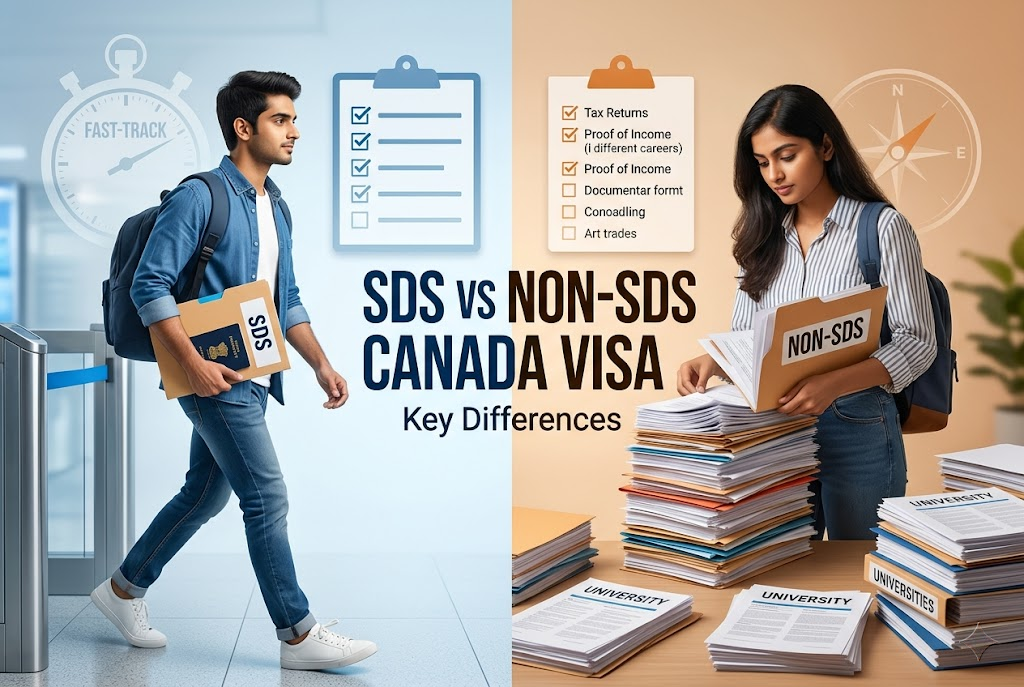
One of the most searched topics among students is the difference between SDS and Non-SDS visa pathways. Understanding the complete SDS Non-SDS Canada visa comparison is crucial because the application category directly affects documentation requirements, financial proof expectations, processing speed, and overall visa approval strategy.
Many students mistakenly believe SDS and Non-SDS are completely different visas. In reality, both are pathways for applying for a Canadian study permit, but they differ significantly in eligibility criteria and document structure. Students who understand these differences early can prepare much stronger applications and reduce rejection risks.
Canada’s student visa system has also undergone multiple changes between 2024 and 2026 because of international student caps, financial proof updates, and immigration reforms. Recent IRCC reforms have reshaped how study permit applications are assessed. (IRCC.com)
It was introduced to provide faster and more streamlined processing for students from specific countries, including India. The primary objective was to simplify visa processing for genuine students with strong financial preparation and English proficiency.
SDS applications generally involve:
Standardized financial proof
Faster processing
Strong IELTS requirements
Mandatory GIC investment
Upfront tuition payment proof
The system was designed to reduce uncertainty and speed up application decisions.
However, major immigration updates indicate that the Student Direct Stream officially closed in November 2024, and Canada has since restructured study permit processing systems. (IRCC.com)
What Is Non-SDS Canada Visa?
Non-SDS refers to the regular or standard study permit application pathway.
Students who do not meet SDS eligibility conditions traditionally applied through Non-SDS.
Non-SDS applications provide more flexibility regarding:
Financial proof formats
Language score combinations
Documentation structure
Academic profiles
However, because the process is more flexible, visa officers often examine applications more carefully and evaluate overall profile strength in greater detail.
Even after SDS-related policy changes, many students still informally use the term “Non-SDS” to describe standard study permit applications.
Main Differences Between SDS and Non-SDS
The biggest differences involve:
IELTS score requirements
Financial proof methods
Processing timelines
Documentation expectations
Officer discretion levels
SDS was historically considered more structured and predictable, while Non-SDS required stronger explanation and profile clarity.
IELTS Score Requirements
SDS Requirements
Traditionally, SDS applicants needed:
IELTS score of 6.0 in each module
This strict language requirement helped Canadian authorities identify students likely to succeed academically and integrate effectively into Canadian society.
Non-SDS Requirements
Non-SDS applications allowed:
Greater flexibility in English scores
Alternative language situations
Broader profile consideration
However, weaker language proficiency often increased refusal risks if other parts of the application were not strong enough.
Financial Proof Comparison
SDS Financial Requirements
SDS applications usually required:
Guaranteed Investment Certificate (GIC)
Full first-year tuition payment proof
Simplified financial documentation
The GIC requirement demonstrated that students could support themselves during studies.
Non-SDS Financial Requirements
Non-SDS applications often involved:
Bank statements
Income proof
Sponsor documentation
Education loan records
Property and asset verification
Because of broader flexibility, officers often examined financial credibility more carefully.
Canada has also increased proof-of-funds expectations because of rising living costs and inflation. (VisaHQ)
Processing Time Differences
SDS Processing Speed
Historically, SDS applications were processed faster because:
Documentation was standardized
Financial proof was simplified
Eligibility criteria were stricter
Some applications were processed within weeks under ideal conditions.
Non-SDS Processing Speed
Non-SDS processing could take longer because:
Financial verification was more detailed
Additional background review was common
Officer discretion was broader
Recent IRCC updates show Indian study permit processing timelines have improved significantly in 2026. (VisaHQ)
Role of GIC in Canada Student Visa
GIC stands for Guaranteed Investment Certificate.
It is essentially a secure investment account that helps demonstrate living expense readiness.
Benefits of GIC:
Simplifies financial proof
Shows financial stability
Reduces officer uncertainty
Helps structure student budgeting
Canada increased financial expectations for international students because of inflation and rising housing costs. (IRCC.com)
Importance of SOP in Visa Approval
Statement of Purpose (SOP) plays a critical role in both application pathways.
A strong SOP should clearly explain:
Why the student chose Canada
Why the selected course makes sense
Career goals after graduation
Financial support details
Genuine study intentions
Generic or copied SOPs remain one of the most common reasons for refusal.
Common Reasons for Canada Student Visa Rejection
Both SDS and Non-SDS applicants can face rejection because of:
Weak financial proof
Poor academic progression
Unclear career goals
Weak SOP writing
Suspicious documentation
Inconsistent information
Low language proficiency
Students often underestimate how important profile consistency is throughout the application.
Which Pathway Was Better?
SDS Was Better For:
Students with strong IELTS scores
Well-structured finances
Faster processing preference
Clear academic planning
Non-SDS Was Better For:
Flexible financial situations
Complex academic backgrounds
Alternative documentation needs
Ultimately, overall application quality mattered more than the pathway itself.
Impact of Recent Canada Immigration Changes
Canada has introduced multiple reforms between 2024 and 2026 affecting international students.
Major updates include:
International student caps
Increased financial proof requirements
PGWP policy changes
Greater scrutiny of genuine students
Stronger focus on labor market alignment
Canada’s study permit system has become more selective and structured in response to rising application volumes. (IRCC.com)
Latest Trends in Canada Student Visa Processing (2026)
Financial Verification Is Becoming Much Stricter
Canadian immigration authorities are increasingly examining financial transparency carefully because of rising concerns about fraudulent documentation and unrealistic financial planning. Students must now provide stronger evidence regarding tuition funds, living expenses, sponsor income, and loan credibility. (VisaHQ)
Genuine Student Assessment Is More Important Than Ever
Visa officers are focusing heavily on identifying genuine students with realistic academic and career goals. Applications with unrelated course selection, weak academic progression, or unclear intentions face greater refusal risks in 2026.
Processing Times Have Improved for Indian Applicants
Recent IRCC data indicates that study permit processing for Indian students has become faster compared to previous years. Some study permit applications are now being processed in approximately three to four weeks under efficient application conditions. (VisaHQ)
Course Relevance Is Being Examined More Closely
Students applying for programs unrelated to previous education or work experience are facing increased scrutiny. Canadian authorities increasingly prefer applicants whose courses align logically with long-term career goals.
Smaller Cities and Provinces Are Becoming More Popular
Because of rising costs in Toronto and Vancouver, many students are selecting affordable provinces and smaller cities. This trend is helping students manage finances more effectively while also improving long-term immigration opportunities.
Immigration Policy Reforms Continue Evolving
Canada continues adjusting immigration and study permit policies because of housing pressure, labor shortages, and economic priorities. Students must regularly monitor official IRCC updates instead of depending only on outdated information. (The Visa Wire)
Expert Insight: What Matters Most for Visa Approval?
Education and immigration experts consistently emphasize that:
Strong academic progression
Genuine study intent
Financial clarity
Well-written SOPs
Career-focused course selection
Honest documentation
matter far more than simply choosing SDS or Non-SDS.
Students who prepare strategically and maintain consistency across documents usually achieve stronger approval outcomes.
Real-Life Example
Aman from Hyderabad planned to apply through SDS because he had strong IELTS scores and completed his tuition payment early. However, after immigration policy updates changed the system, he focused instead on strengthening his overall profile.
He improved his SOP, clearly explained his technology career goals, organized transparent financial records, and selected a high-demand cybersecurity program aligned with his previous education.
His study permit was approved successfully because of strong documentation and realistic academic planning rather than reliance on a single application category.
Depending only on agents without personal verification
What to Do Next
Before applying for a Canada study permit:
Research the latest IRCC rules carefully
Select career-relevant programs
Organize transparent financial proof
Improve IELTS scores strategically
Prepare a personalized SOP
Monitor immigration updates regularly
Plan long-term career and PR goals early
Quick Checklist
Admission letter received
Financial proof organized
IELTS completed
SOP finalized
Tuition payment planned
Medical examination completed
Immigration rules verified
Conclusion
Understanding the SDS Non-SDS Canada visa system remains extremely important for international students planning to study in Canada in 2026. Although Canada has restructured parts of its student visa system in recent years, the core principles behind successful study permit applications remain unchanged.
Students who focus on strong academics, transparent finances, realistic career planning, and genuine study intentions continue achieving the best visa outcomes. Rather than depending only on processing categories, applicants should prioritize building a strong, consistent, and well-documented profile that clearly demonstrates their educational and professional goals.
FAQs
SDS historically offered faster processing with stricter requirements, while Non-SDS provided more flexibility but required broader profile evaluation.
Canada officially closed the Student Direct Stream (SDS) in November 2024 as part of immigration reforms. (IRCC.com)
Most Canadian study permit applications require proof of English proficiency, and IELTS remains one of the most accepted tests.
GIC is a Guaranteed Investment Certificate used to demonstrate living expense readiness for international students.
Approval primarily depends on profile strength, financial transparency, academic consistency, and genuine study intent rather than only application category.

 May 16, 2026
 9 Min
 No Comment