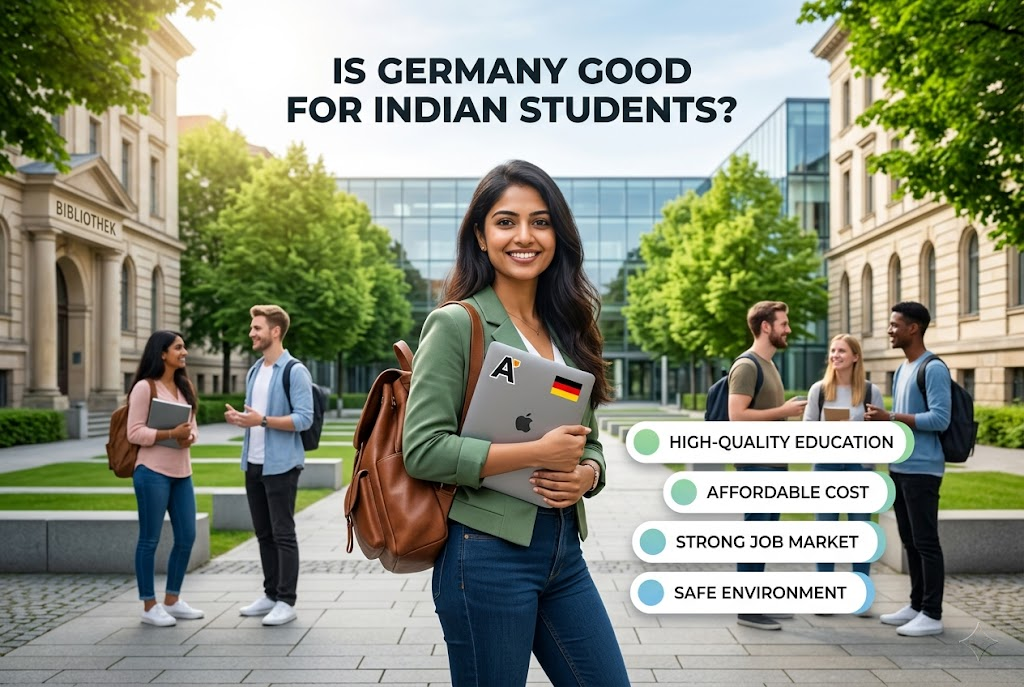
Germany has become one of the fastest-growing study abroad destinations for Indian students — and in 2026, that trend is expected to accelerate even further. Rising education costs in countries like the USA, UK, Canada, and Australia are pushing students toward more affordable destinations that still offer strong career opportunities and global-quality education.
That is exactly where Germany stands out.
The Germany Indian students 2026 discussion is no longer just about low tuition fees. Students today are also looking at:
Long-term career growth
Post-study work opportunities
Quality of life
Immigration pathways
Industry demand
Return on investment
Germany performs surprisingly well across all these areas.
According to the DAAD Germany Official Website, the number of Indian students in Germany has grown rapidly in recent years, especially in engineering, computer science, AI, and management programs. Meanwhile, Germany’s skilled worker shortage is creating strong demand for qualified international graduates across multiple industries.
However, Germany is not perfect for everyone.
The country offers incredible opportunities for students who prepare strategically — but it can also become challenging for those who underestimate language barriers, bureaucracy, and cultural differences.
So, is Germany truly worth it for Indian students in 2026? Let’s examine the reality carefully.
One of Germany’s biggest advantages is affordability.
Unlike countries where international students spend massive amounts on tuition fees, most German public universities charge either very low fees or none at all.
Students usually pay:
Semester contributions
Health insurance
Living expenses
instead of extremely high tuition fees.
Here’s a comparison:
Country
Average Tuition Cost
Germany
Very Low
USA
Very High
Canada
High
UK
High
Australia
High
This dramatically reduces financial pressure on Indian families.
Moreover, Germany’s strong economy creates long-term earning opportunities after graduation, making overall return on investment highly attractive.
Best Courses for Indian Students in Germany
Germany is especially strong in technical and analytical fields.
Popular programs include:
Mechanical engineering
Automotive engineering
Computer science
Artificial intelligence
Data science
Renewable energy
Robotics
Business analytics
The country’s industrial ecosystem provides direct exposure to world-leading companies such as:
BMW
Siemens
SAP
Bosch
Volkswagen
Students in engineering and technology programs often benefit from strong internship and employment opportunities.
Meanwhile, healthcare and healthcare management fields are also growing rapidly because Germany faces long-term workforce shortages in medical and elderly care sectors.
Germany Indian Students 2026: Job Opportunities Are Improving
Germany’s labor shortage is becoming one of Europe’s biggest economic challenges.
As a result, the government is actively encouraging skilled international graduates to remain in the country after studies.
For Indian students, this creates excellent long-term employment potential.
However, success depends heavily on:
Skills
Internship experience
Networking
German language proficiency
Students who prepare early usually secure much stronger outcomes.
Cost of Living in Germany for Students
Germany is affordable compared to several Western countries, but students still need proper financial planning.
Average monthly expenses:
Expense Category
Estimated Cost
Accommodation
€300–700
Food
€150–300
Health Insurance
€120–150
Transportation
€30–80
Miscellaneous
€100–250
Major cities like Munich and Frankfurt are expensive, while smaller cities offer significantly lower living costs.
Many students support themselves through part-time work during studies.
Is German Language Necessary?
This is one of the most important questions Indian students ask.
The answer depends on your goals.
For English-taught programs:
German may not be mandatory initially
For long-term career growth:
German becomes extremely valuable
German proficiency improves:
Internship opportunities
Job prospects
Networking
Social integration
PR pathways
Students targeting healthcare, consulting, manufacturing, or administration sectors usually require stronger German skills.
Meanwhile, many tech startups and multinational companies operate in English-speaking environments.
Still, students who learn German early enjoy major long-term advantages.
Student Life and Safety in Germany
Germany offers a safe and structured lifestyle for international students.
Benefits include:
Reliable public transportation
High-quality healthcare
Strong public infrastructure
Cultural diversity
Excellent work-life balance
Indian student communities are also growing rapidly across cities like:
Berlin
Munich
Aachen
Hamburg
Stuttgart
Frankfurt
However, cultural adjustment can initially feel difficult for students unfamiliar with:
German punctuality
Direct communication style
Administrative systems
The first few months often require patience and adaptability.
Expert Insight: Germany Rewards Prepared Students
Germany is not a destination where students can rely only on university degrees.
The students who succeed most usually:
Learn German gradually
Build technical skills
Gain internships early
Understand the local job market
Develop practical portfolios
Germany’s economy increasingly rewards problem-solving abilities rather than just academic qualifications.
For example:
AI specialists
Software developers
Data engineers
Renewable energy professionals
are currently experiencing exceptional demand.
Meanwhile, students who ignore networking, language learning, or internships often struggle after graduation despite earning good degrees.
Latest Trends and Updates
Germany is actively expanding skilled migration reforms to attract more international graduates into sectors facing labor shortages, especially engineering, AI, cybersecurity, and healthcare.

English-taught master’s programs are increasing rapidly across German universities to attract global talent from countries like India.

AI-driven hiring systems and ATS-based recruitment are becoming more common, making practical skills and optimized resumes increasingly important.

Germany is also simplifying certain EU Blue Card and skilled worker pathways to improve long-term retention of international professionals.

Meanwhile, companies are placing greater emphasis on internships, technical portfolios, and real-world problem-solving skills rather than academic grades alone.
Real-Life Example: How Strategic Preparation Made the Difference
Priya moved to Germany for a master’s degree in data analytics. Unlike many students who focused only on coursework, she started learning German immediately after arrival.
During her second semester, she secured a student internship with a logistics technology company in Hamburg.
By graduation, she had:
Internship experience
German communication skills
Industry contacts
Practical project work
As a result, she received a full-time job offer within weeks of completing her degree.
Meanwhile, several classmates who delayed networking and language preparation struggled much longer despite similar academic backgrounds.
Pros and Cons of Germany for Indian Students
Pros
Cons
Low tuition fees
German language barriers
Strong job market
Bureaucratic paperwork
Excellent engineering ecosystem
Cultural adjustment challenges
Good work-life balance
Competitive housing in major cities
Long-term career opportunities
Slower administrative systems
Beginner vs Expert Approach to Studying in Germany
Germany is absolutely one of the best destinations for Indian students in 2026 — but only for those willing to prepare strategically.
The country offers:
Affordable education
Strong career opportunities
Excellent infrastructure
Long-term growth potential
Access to Europe’s largest economy
However, Germany rewards students who actively build skills, learn the language, gain internships, and understand the local culture.
Students who treat Germany as only a “cheap study destination” often struggle. Meanwhile, those who approach it as a long-term career ecosystem frequently achieve outstanding results.
For Indian students focused on strong ROI, technical growth, and sustainable international careers, Germany remains one of the smartest global education choices available today.
FAQs
Yes. Germany is one of the most affordable high-quality education destinations globally because public universities charge very low tuition fees.
Yes, especially in high-demand sectors like IT, engineering, AI, and healthcare, though preparation and skills matter greatly.
Not always for studies, but German proficiency significantly improves job opportunities and long-term settlement prospects.
Germany is generally considered very safe with strong public infrastructure and student-friendly cities.
Yes. Skilled graduates working in Germany can eventually qualify for long-term residence and permanent settlement pathways.

 May 19, 2026
 7 Min
 No Comment