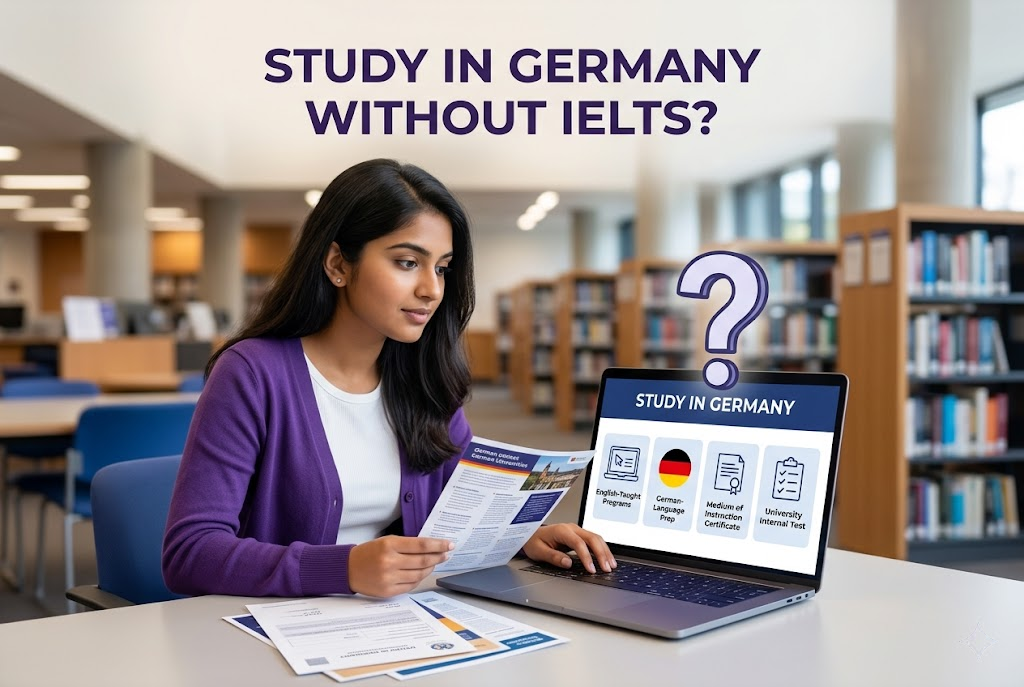
Yes, it is possible to study in Germany without IELTS in 2026 — but the answer depends on:
The university
The course
Your previous education language
Visa requirements
Many Indian students are surprised to learn that several German universities accept alternatives to IELTS, while some even waive English language tests completely under specific conditions.
The Germany without IELTS study pathway has become increasingly popular because:
More universities now offer English-taught programs
International student demand is growing
Flexible admission systems are expanding
However, students should understand one important reality:
“Without IELTS” does not always mean “without English proficiency proof.”
Universities still need evidence that students can study successfully in English.
According to the DAAD Official Study Portal, language requirements vary depending on the university and program type.
Germany Without IELTS Study: English-Taught Programs
Germany now offers thousands of English-taught programs, especially in:
Engineering
Computer Science
Data Science
Business
Artificial Intelligence
International Management
Many master’s programs are fully English-based.
This expansion has increased flexibility in language requirements for international applicants.
Is IELTS Required for Germany Student Visa?
This is where students get confused.
Even if a university waives IELTS:
Visa officers may still ask for English proficiency evidence
However, in many cases:
University admission letter itself becomes strong proof
Additional documents like MOI letters may strengthen the visa application.
Still, visa approval depends on:
Overall profile
Financial proof
Academic consistency
Genuine study intent
not IELTS alone.
Alternatives to IELTS for Germany
Many universities accept:
TOEFL
Duolingo English Test
Cambridge English exams
PTE Academic
Some institutions also conduct:
Online interviews
Internal language assessments
Students should compare:
Acceptance rates
Test costs
Processing time
before choosing alternatives.
Advantages of Applying Without IELTS
Students choose Germany without IELTS study pathways because:
IELTS preparation takes time
Test fees are expensive
Faster application process
MOI is simpler for some students
It can reduce stress during application preparation.
Risks and Limitations
However, applying without IELTS also has challenges.
Some limitations include:
Fewer university options
Visa uncertainty in rare cases
Competitive programs may still prefer IELTS
Scholarship applications may require formal scores
Students with strong IELTS or TOEFL scores often have:
Wider university access
Stronger scholarship chances
Better global application flexibility
Expert Insight: IELTS Waiver Is Helpful — But Skills Still Matter
One important reality students should understand:
German universities may waive IELTS paperwork, but they do not waive communication expectations.
Students still need:
Academic English skills
Presentation ability
Research communication
Classroom participation confidence
The students who struggle most in Germany are not always students without IELTS — but students with weak practical communication ability.
Language ability affects:
Internships
Networking
Group projects
Job opportunities
far beyond university admission.
Latest Trends and Updates
Germany is becoming increasingly flexible with English proficiency alternatives because international student demand continues rising.

Many universities are now accepting MOI certificates, Duolingo scores, and internal assessments for selected programs.

At the same time, highly competitive technical and research universities still prefer standardized tests like IELTS or TOEFL for stronger profile evaluation.

Visa officers are also focusing more on overall student credibility, financial preparedness, and academic consistency instead of only test scores.

English-taught programs in AI, business analytics, data science, and engineering are expanding rapidly across Germany.
Real-Life Example: Studying in Germany Without IELTS
Arjun completed his engineering degree from an English-medium college in India.
Instead of IELTS, he:
Obtained an MOI certificate
Applied to English-taught universities
Submitted strong SOP and academic documents
One university accepted his application without IELTS.
During visa processing, his:
Admission letter
MOI certificate
Strong academics
helped support his application successfully.
However, he still worked actively on improving spoken English before departure.
Pros and Cons of Studying in Germany Without IELTS
Pros
Cons
Saves IELTS preparation time
Limited university choices
Reduces application cost
Some visas may require extra proof
Faster application process
Scholarships may prefer IELTS
MOI accepted in some universities
Competitive programs may reject waivers
Useful for English-medium students
Communication skills still essential
Beginner vs Expert Application Strategy
Beginner Approach
Expert Approach
Applies randomly without IELTS
Researches waiver-friendly universities carefully
Assumes all universities waive IELTS
Verifies official requirements directly
Ignores communication improvement
Builds practical English fluency
Relies only on MOI
Maintains backup language test option
Focuses only on admission
Plans long-term employability
What to Do Next Before Applying
Before applying without IELTS:
Research official university requirements carefully
Studying in Germany without IELTS is absolutely possible for many Indian students in 2026, especially through:
MOI certificates
Alternative language tests
English-medium academic backgrounds
However, students should approach the process strategically instead of assuming all universities have identical policies.
Success depends on:
Careful university research
Strong documentation
Practical communication ability
Early preparation
Germany may waive IELTS requirements in some cases — but long-term academic and career success still depends heavily on your real-world English communication and professional skills.
FAQs
Yes, many universities accept MOI certificates or alternative English proofs.
Not always. University admission and alternative language proof may be accepted.
It is a document confirming your previous education was conducted in English.
TOEFL, Duolingo, PTE, and Cambridge English are accepted by many universities.
It depends on the university and visa situation. Strong communication skills are still important.

 May 19, 2026
 6 Min
 No Comment