November 13, 2026
 6 Min
 No Comment
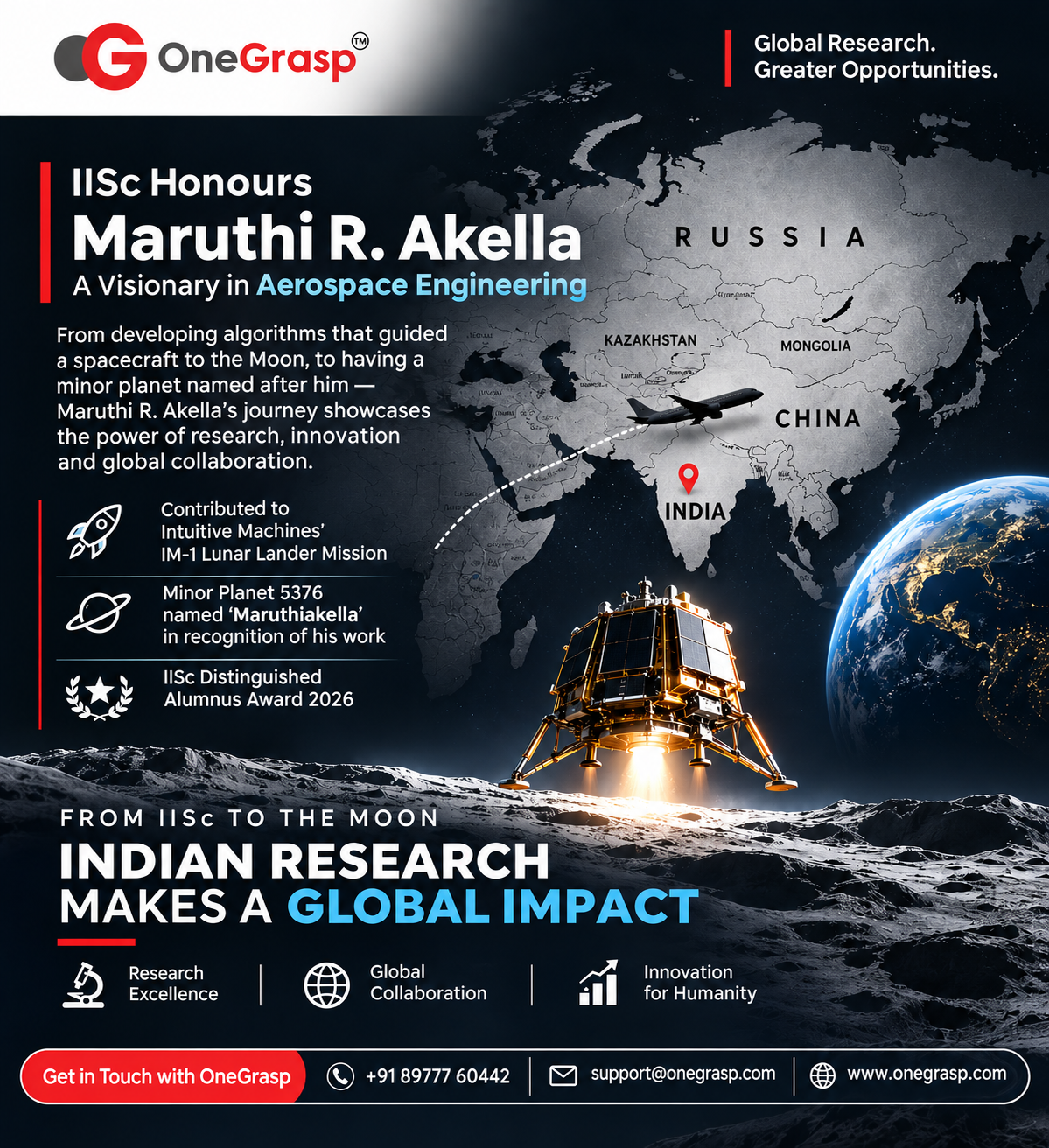
An Indian scientist whose research helped guide a spacecraft to the lunar surface has received an extraordinary international recognition, highlighting the growing global impact of Indian scientific talent.
India continues to make its mark on the global scientific stage. In a remarkable achievement, aerospace scientist and Indian Institute of Science (IISc) alumnus Maruthi R. Akella has been honoured for his contributions to spacecraft guidance and control systems, with minor planet 5376 officially bearing the name Maruthiakella.
The recognition celebrates his contributions to aerospace engineering and the development of advanced algorithms that supported the guidance of Intuitive Machines’ IM-1 lunar lander mission.
The achievement also places a spotlight on the importance of research, innovation, and the international contributions of Indian scientists.
Who Is Maruthi R. Akella?
Maruthi R. Akella is a distinguished aerospace engineering researcher and academic who holds the Cockrell Family Chair in Engineering at The University of Texas at Austin.
An alumnus of the Indian Institute of Science, Akella has built an internationally recognised career in aerospace engineering, with research contributions spanning spacecraft guidance, navigation, control systems, and autonomous flight technologies.
His work focuses on developing mathematical models, algorithms, and intelligent control mechanisms that help complex aerospace systems navigate challenging environments with precision and reliability.
His contributions demonstrate how fundamental scientific research can translate into technologies with real-world applications, including space exploration.
How His Research Contributed to a Moon Mission
One of the significant highlights of Akella’s scientific contributions is his involvement in the development of algorithms that provided onboard guidance for Intuitive Machines’ IM-1 lunar lander mission.
The IM-1 mission, also known as Odysseus, was launched in February 2024 and achieved a historic milestone by becoming the first commercial spacecraft to successfully land on the Moon, although the lander ultimately rested on its side.
The mission also marked the first US lunar landing since the Apollo 17 mission in 1972.
Spacecraft landing operations are among the most technically demanding stages of a space mission. A lander must continuously process information about its position, velocity, orientation, and surrounding environment while making rapid adjustments to achieve a controlled descent.
Guidance and control algorithms play a critical role in these operations. They help spacecraft determine their trajectory, respond to changing conditions, and execute precise manoeuvres.
Akella’s research contributions to onboard guidance technology illustrate the significance of advanced control engineering in enabling modern lunar exploration.
Minor Planet 5376 Named ‘Maruthiakella’
In recognition of his contributions to science and aerospace engineering, minor planet 5376 has been named Maruthiakella.
Having a celestial body named after a scientist is a distinctive form of recognition that connects an individual’s scientific legacy with the broader story of space exploration.
This honour represents more than an individual milestone. It reflects the impact that years of research, academic dedication, and technological innovation can have on humanity’s understanding and exploration of space.
It also serves as an inspiration for aspiring scientists, engineers, researchers, and students who dream of contributing to discoveries beyond Earth.
IISc Recognises Its Distinguished Alumni
The Indian Institute of Science (IISc), one of India’s leading institutions for advanced scientific research and higher education, has recognised Maruthi R. Akella among its five Distinguished Alumnus/Alumna Award recipients for 2026.
The Distinguished Alumnus/Alumna Awards celebrate former students whose professional achievements and contributions have created meaningful impact across science, technology, academia, industry, and society.
Akella’s recognition highlights the international influence of IISc alumni and reinforces the role of Indian research institutions in nurturing scientists who contribute to globally significant technological advancements.
What This Achievement Means for Young Researchers in India
Maruthi R. Akella’s journey offers several important lessons for the next generation of Indian researchers.
1. Research Can Create Global Impact
Scientific research conducted at universities and research institutions can contribute to some of the world’s most ambitious technological missions. Research is not limited to academic publications; it can influence real-world engineering and innovation.
2. Interdisciplinary Knowledge Creates Opportunities
Modern space exploration requires expertise in mathematics, computer science, electronics, aerospace engineering, artificial intelligence, and control systems. Researchers who develop interdisciplinary skills can contribute to emerging global technologies.
3. Academic Foundations Can Lead to International Recognition
Strong academic foundations, consistent research efforts, and collaboration with international scientific communities can open pathways to opportunities at globally recognised institutions and organisations.
4. Innovation Requires Long-Term Commitment
Major scientific achievements are often the result of years of research, experimentation, testing, and refinement. The journey from an academic concept to a technology used in a space mission requires persistence and dedication.
5. Indian Researchers Can Shape the Future of Global Science
The achievements of Indian scientists demonstrate that geographical boundaries do not limit scientific contributions. Indian researchers can participate in international projects, develop breakthrough technologies, and influence the future of humanity.
The Bigger Picture: India’s Growing Role in Global Research and Space Innovation
India’s scientific ecosystem is expanding across multiple areas, including space exploration, artificial intelligence, biotechnology, advanced manufacturing, quantum technologies, and sustainable energy.
Institutions such as IISc, IITs, national laboratories, universities, and emerging research centres are contributing to this transformation.
At the same time, international research collaborations are creating opportunities for Indian scholars and scientists to participate in projects that address complex global challenges.
The recognition of Maruthi R. Akella is another reminder that scientific excellence is built through curiosity, rigorous research, collaboration, and the determination to solve problems that once seemed impossible.
OneGrasp Perspective: Turning Research Potential into Global Opportunities
At OneGrasp, we believe that research should extend beyond academic boundaries and create opportunities for global recognition, collaboration, and career growth.
The journey of scientists like Maruthi R. Akella demonstrates what becomes possible when research, innovation, and international exposure come together.
For young researchers, postgraduate students, PhD scholars, faculty members, and aspiring innovators, the next step is to actively engage with the global research ecosystem through scientific conferences, research collaborations, academic publications, innovation platforms, and interdisciplinary learning.
The next breakthrough in science could come from a young researcher sitting in an Indian university today.
The opportunity is to discover that potential, develop it, and connect it with the world.
OneGrasp – Building Global Research Connections and Career Growth Opportunities.